Bambu Lab’s Global Assistive Device Challenge: 3D Printing Focuses on Real Needs
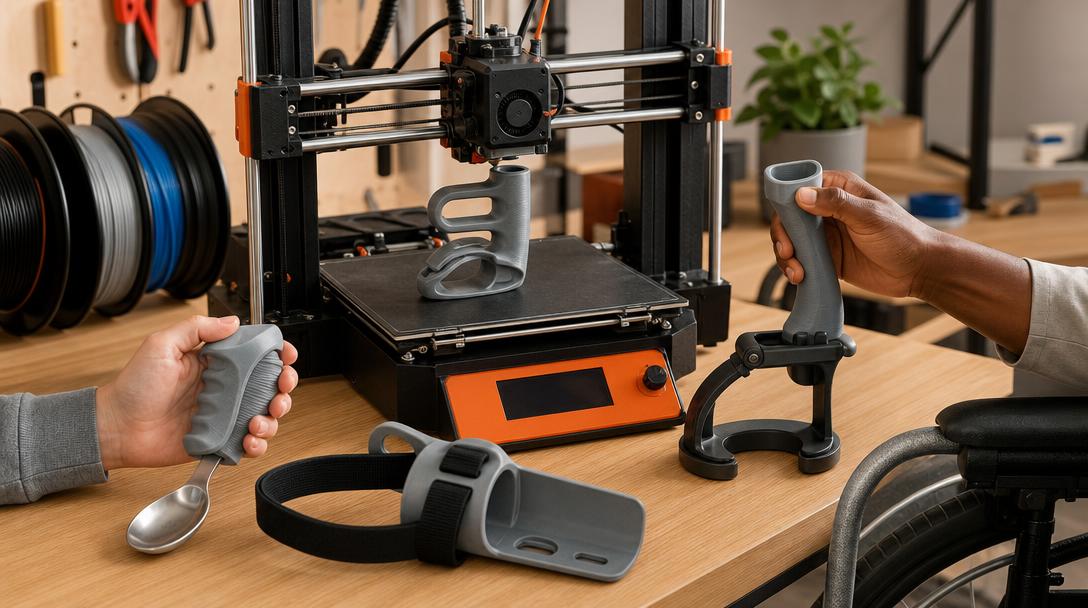
One of the greatest strengths of 3D printing is that it can produce a part tailored to a specific person’s everyday needs instead of offering a one-size-fits-all product. Bambu Lab has launched a global design challenge on MakerWorld to turn this potential into a more structured and measurable initiative. Running from September to December 2026, the program is seeking printable solutions to 24 real problems identified by people with disabilities and organizations working with them.
The news was published by 3D Printing Industry on September 18, 2026. According to Bambu Lab’s announcement, seven accessibility organizations are involved in the project. This detail matters because the challenge is not simply asking for a general “assistive product idea”; it starts directly from problems experienced by specific users.
Problems are defined with users, not at a desk
One example involves the challenges Jessica Cox, who was born without arms, faces in everyday life. While putting on one sock may be possible, losing the friction support from the first foot when putting on the second sock is a small-looking but genuine usability problem that can become a design brief. Similarly, carrying a waste bag while walking with a service dog or fastening a bicycle helmet buckle independently are also among the issues awaiting solutions.
The Emerging Tech Lab at Rancho Los Amigos National Rehabilitation Center is looking for reaching tools that do not require a squeezing motion, as well as storage solutions that make it easier for wheelchair users to access their phones, wallets, or keys. Ayúdame3D is requesting one-handed kitchen tools, a toothbrush aid, and a hair-tying aid; Makers Making Change is seeking ideas such as a knitting needle support, guitar pick, and pencil-cap aid for people with limited grip strength.
A testing process from file to real product
The challenge is about more than simply collecting model files. Applications will be accepted for two months, after which partner organizations will print the shortlisted designs on desktop filament printers and test them directly with users. Some solutions are planned to be delivered to users as finished parts after evaluation. This approach measures more than whether the first prototype looks successful: Can the part actually be gripped, operated with one hand, cleaned, and integrated into the user’s daily routine?
The winning designs are intended to be added to open-source libraries and distributed through volunteer printing networks operating in more than 70 countries. In this way, a solution developed for one person’s needs can become an FDM production file accessible to other users with similar requirements.
What Ucuz3D readers can take away
This development shows that the value of FDM printing lies not only in the complexity of the model. A simple handle, cap, tool, or carrier can provide meaningful independence when designed with the right dimensions, surface texture, and usage scenario in mind. PLA may be suitable for rapid prototyping in such parts; if impact resistance, flexibility, or outdoor use is required, PETG, TPU, or another filament should be considered. Material selection should be made together with the user’s strength, whether the part will be repeatedly bent, and the cleaning conditions.
If a file is ready for the part you need, you can review production options through the 3D printing service. When deciding on the material and weight of the part, examining the price per gram approach can help you understand the cost difference between a prototype and a final-use part. If you would like to upload your file and get an instant price, you can use the online calculator. The printing materials page is also a useful starting point for comparing the general properties of filaments.
Bambu Lab’s challenge is moving 3D printing beyond an abstract technology showcase and into a design cycle driven by real user feedback. The best result may come not from the most spectacular model, but from the part that enables a specific person to perform a specific task more safely, easily, and independently.



 Türkçe
 العربية
 Русский
 فارسی
فارسی Deutsch