TPC or ASA? A Flexible Wear Part or a UV-Resistant Rigid Fixture?
TPC and ASA are not two materials that meet the same need in FDM printing. TPC is suited to parts requiring controlled flexibility and wear resistance, while ASA is a more meaningful choice for rigid fixtures that will be used outdoors and exposed to sunlight. If you clarify from the outset whether your part needs to deform under load or retain its shape, the choice becomes easier.
What is TPC used for, and what is ASA used for?
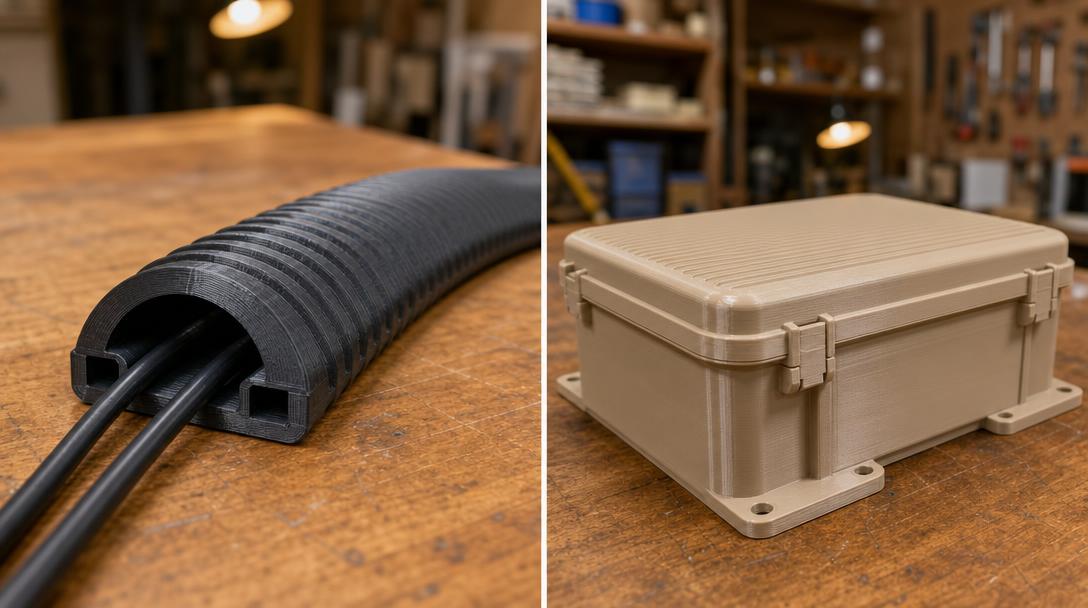
TPC is a flexible FDM material in the thermoplastic copolyester family. It should not be thought of as a completely soft rubber; flexibility, recovery and surface durability can vary depending on the product’s hardness rating. It can be considered for gasket-like components, vibration dampers, cable protectors, gripping surfaces and parts exposed to repeated bending.
ASA is used as a rigid engineering plastic, similarly to ABS. It is particularly suitable for outdoor enclosures, mounting fixtures, sensor housings, parts around vehicles and technical components exposed to sunlight. ASA’s advantage in outdoor environments does not, by itself, guarantee every geometry or every printing setting; part design and print orientation still matter.
Flexibility, rigidity and impact
The main difference with TPC is its flexibility. During impact or compression, it can absorb part of the energy through deformation. This can make it advantageous for parts that isolate small vibrations or need to conform to a surface. However, TPC may be too flexible for a rigid arm, a dimension-critical socket or a connector that must not move under load.
ASA produces a rigid part that retains its dimensions and shape better than TPC. Its impact resistance can be satisfactory with a good design and suitable printing settings; however, layer orientation, wall count and printing temperature have a significant effect on the result. For a part exposed to impact, consider not only the filament name but also how the part will be loaded.
Outdoor use and heat behavior
For a rigid fixture that will be exposed to sunlight, UV and changing weather conditions for long periods, ASA is generally the more logical starting point. TPC’s outdoor performance can vary according to the product formulation; being flexible does not automatically make it UV-resistant. The manufacturer’s data should be checked for TPC parts intended for outdoor use.
In terms of heat, ASA is a more suitable candidate for rigid parts used in typical outdoor conditions. With TPC, the risk of softening and deforming under load may increase as the temperature rises. Do not make a decision for parts near engines, inside enclosed vehicles or close to hot machinery without taking the actual operating temperature into account.
Printing ease and design notes
Because of shrinkage and warping, ASA may require more environmental control than TPC on most desktop printers. An enclosed cabinet, good bed preparation and reduced airflow can help. With large, angular parts, splitting the design into sections or rounding the corners can also reduce the risk.
With TPC, printing speed, the extruder path and the filament’s moisture level are important. If there is too much space in the flexible material’s feed path, the filament may buckle or the flow may become unstable. Direct drive setups can provide a more controlled starting point for most flexible filaments; however, the result varies depending on the printer and the TPC product.
Which material for which part?
- TPC: flexible cover, vibration foot, cable protector, gasket-like component or flexible contact part subject to wear.
- ASA: outdoor enclosure, sun-exposed fixture, rigid mounting foot, sensor housing or technical part that must retain its shape.
When evaluating costs, do not look only at the price per kilogram. With TPC, the correct feeding and settings process that reduces failed prints, and with ASA, the enclosure and surface preparation, affect the overall production economics. If you are not printing the part yourself, you can share the geometry and usage conditions through the 3d printing service and ask which approach is suitable.
Before placing an order, reviewing the price per gram approach makes it easier to evaluate material selection together with part weight. To explore the alternatives, you can try your model in the online 3d printing tool. You can also visit the engineering materials page to compare material properties in one place.
In summary, if the part needs to flex and withstand repeated movement, TPC is the better starting point; if it needs to remain rigid, work outdoors and be better prepared for UV exposure, ASA is the more appropriate choice. When you are unsure, a small sample or a test print containing critical dimensions provides the safest decision before final production.


 Türkçe
 العربية
 Русский
 فارسی
فارسی Deutsch