Onsite 3D Printing at Georgia-Pacific Facilities Reduces Downtime and Part-Waiting Costs
Ordering small parts needed inside a factory from external suppliers can unnecessarily slow production, especially when a single plastic part causes an entire piece of equipment to remain out of operation. Georgia-Pacific’s 17 September 2026 post shows how 3D printing is being used as a practical complementary solution to this problem at its Muskogee and Brewton facilities. The source is the company’s 17 September 2026 statement; the examples below are based on the company’s own account of its field experience.
Producing the need, not the entire part assembly
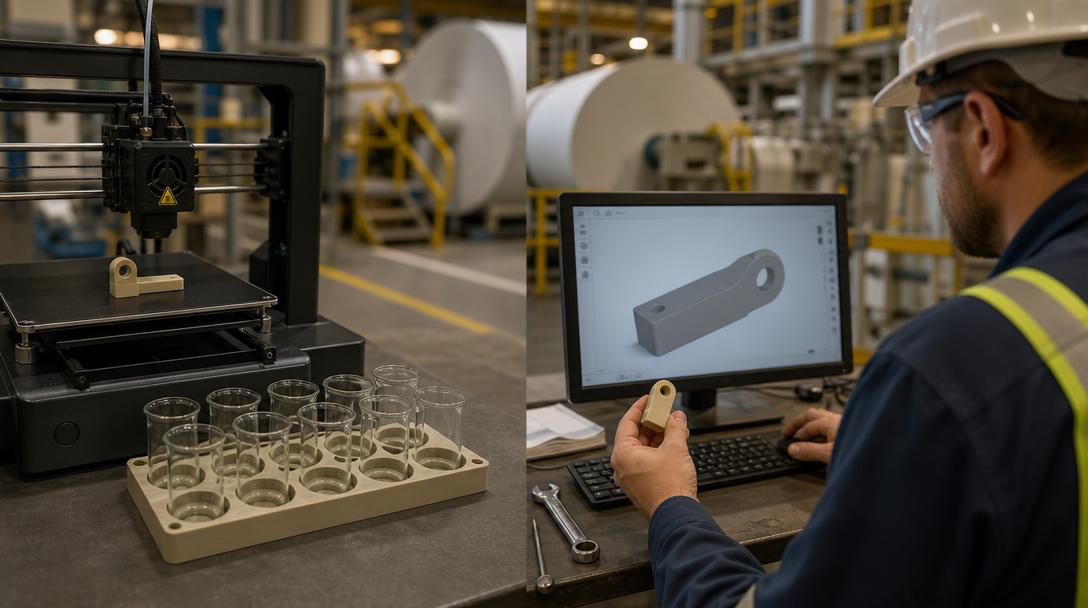
At the Muskogee facility, teams turn issues reported by operators and maintenance staff into small parts modelled in CAD. One notable example is the small clips in the junction boxes used by laser-guided vehicles. When a single clip breaks, printing only the required part instead of replacing the entire box can reduce waiting time and unnecessary part consumption.
Within the same workflow, custom mounts for turnstile cameras and protective cages designed to help safeguard drones flying in confined spaces have also been developed. These examples show that FDM can create value not only for prototype models, but also for low-volume auxiliary parts with defined dimensions, functions, and operating conditions. Of course, it is not suitable for every part: material and design validation are essential for safety-critical components, parts operating at high temperatures, or components requiring certification.
Small but effective design for workplace safety
The example from the Brewton facility shows that 3D printing is not limited to spare-part production. Operators collecting water samples previously had to carry several glass beakers separately. The team designed a custom sample organiser that allows the containers to be carried neatly and safely in a single trip. According to the company’s account, the solution reduces the risk of breakage, the possibility of mixing up samples, and the mental burden on operators of remembering where they left off if their work is interrupted.
Choosing the right material is important for this type of part. Rigidity, the possibility of impact, chemical exposure, the cleaning method, and ambient temperature should all be assessed together. If the part is used only for positioning and carrying, an easy-to-print FDM material may be sufficient; for designs operating in hotter, more impact-prone, or outdoor conditions, it may be more appropriate to review engineering-material 3D printing options.
Key takeaways for Ucuz3D readers
- Define the impact of the failure before focusing on the part: Is one small part causing the downtime, or does the entire assembly need to be replaced?
- Record the dimensions and operating conditions: Temperature, impact, flexing, UV exposure, chemical contact, and the cleaning method directly affect the material decision.
- Do not skip the approval process: Georgia-Pacific states that printed parts are inspected and approved before use; parts related to safety can also be produced in distinctive colours for easier identification.
- Check intellectual property: When designing a repair fixture for your own equipment, develop a safe and authorised solution instead of copying patented components.
If the model and operating conditions of the part you need are clear, you can consider low-volume production through the 3D printing service. When making your decision, consider the price per gram together with the part’s printing time, support requirements, and post-processing needs. You can also use the instant pricing tool to upload the file and view production options.
The main message of the Georgia-Pacific example is not that every part must be 3D printed. Value emerges when long lead times, low quantities, special geometries, and a genuine need on the shop floor come together. When used within the right limits, FDM can give maintenance teams faster opportunities to test solutions, shorter waiting times, and practical answers shaped around the equipment’s needs.
Scaling this approach also requires a design library and a simple approval workflow. When the dimensions, material notes, and revisions of frequently used fixtures are documented, the same solution can be reproduced across different shifts. In this way, 3D printing becomes more than a one-off display of expertise and turns into a repeatable digital inventory for the maintenance team.


 Türkçe
 العربية
 Русский
 فارسی
فارسی Deutsch