3D Printing Market Reached $4.48 Billion in Q2 2026: What Does It Mean for FDM?
The additive manufacturing market continued to grow in the second quarter of 2026. According to an 18 September 2026 report by 3Druck.com, Additive Manufacturing Research (AM Research) data shows that the total market, including metal, polymer and ceramic printers, materials and services, grew by 12% year on year. In the second quarter, the total market volume reached approximately $4.48 billion.
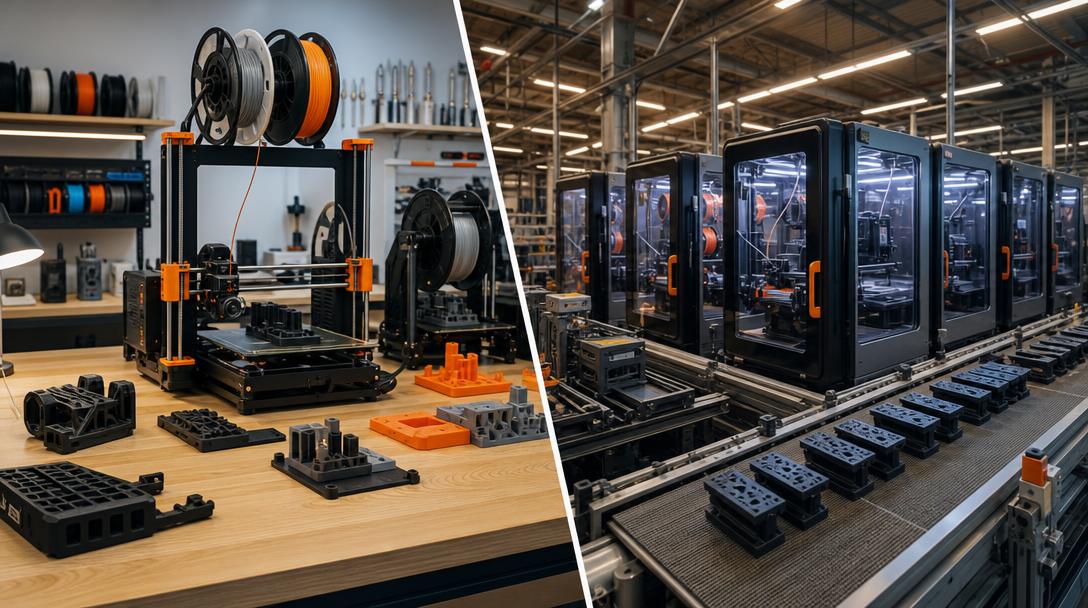
This figure does not directly represent desktop FDM filament sales; professional systems, manufacturing services and various additive manufacturing technologies are also included in the total. Nevertheless, there is an important signal for Ucuz3D readers: 3D printing is evolving from merely a workshop tool for producing prototypes into a broader manufacturing ecosystem that provides parts, fixtures and production support.
Why is the polymer segment attracting attention?
The AM Research summary reports that the polymer additive manufacturing market reached $2.68 billion in the second quarter of 2026, compared with $2.42 billion in the same period a year earlier. Although the polymer category includes different manufacturing methods, the practical implication for FDM users is clear: plastic-based printing remains one of the industry’s main areas of activity, both in materials and services.
During the same period, the additive manufacturing services market also reached $2.50 billion. This suggests that companies are increasingly choosing to outsource manufacturing, prototyping or low-volume part production when needed instead of buying their own printer for every part. Particularly for products such as jigs, enclosures, assembly fixtures, spare parts and functional prototypes, the decision is no longer limited to investing in a printer; modelling, material selection, print settings and quality control are also part of the process.
Three practical implications for FDM users
1. Material selection is becoming more important
As the market grows, the idea of a single “best filament” becomes even less adequate. PLA or PLA+ may be sufficient for a visual prototype, while PETG or ASA may be more suitable for an outdoor fixture; TPU or TPC may make more sense for parts that need flexibility and impact absorption. Defining heat, load, UV and wear conditions from the outset helps prevent unnecessarily expensive material choices. You can review the available options on our printing materials page.
2. When using a service, you should not look only at the gram-based calculation
The actual cost of a part depends not only on the amount of filament but also on print time, support requirements, expected tolerances and post-processing needs. Therefore, when reviewing the per-gram pricing model on the cheap 3D printing prices page, you should also specify the part’s intended use and technical requirements. A more accurate assessment helps you find not the cheapest option, but the option that works on the first print.
3. Moving from prototypes to small-batch production is becoming easier
Growth in the services market can provide flexibility for businesses that want to move from a few prototypes to low-volume production. Once the design has been validated, the same file can be reassessed with different infill, wall-count or material settings. If your file is ready, you can speed up the production decision by getting an instant quote through the online 3D printing tool. When necessary, it is also possible to clarify your dimensional, material and surface requirements together through a professional 3D printing service.
How should we interpret the growth data?
AM Research also emphasises that the impact of interest rates and capital expenditure on the sector should be monitored. For this reason, it would not be accurate to interpret growth in a single quarter as a definite and permanent result for all sub-markets. However, the 12% annual increase and the rise in the polymer segment show that FDM continues to maintain visibility in manufacturing decisions. For Ucuz3D readers, the most meaningful conclusion is this: a part that is correctly designed, printed with the right material and validated for a real-world use case can be more than just a sample in this growing ecosystem; it can become a functional part of the manufacturing process.


 Türkçe
 العربية
 Русский
 فارسی
فارسی Deutsch