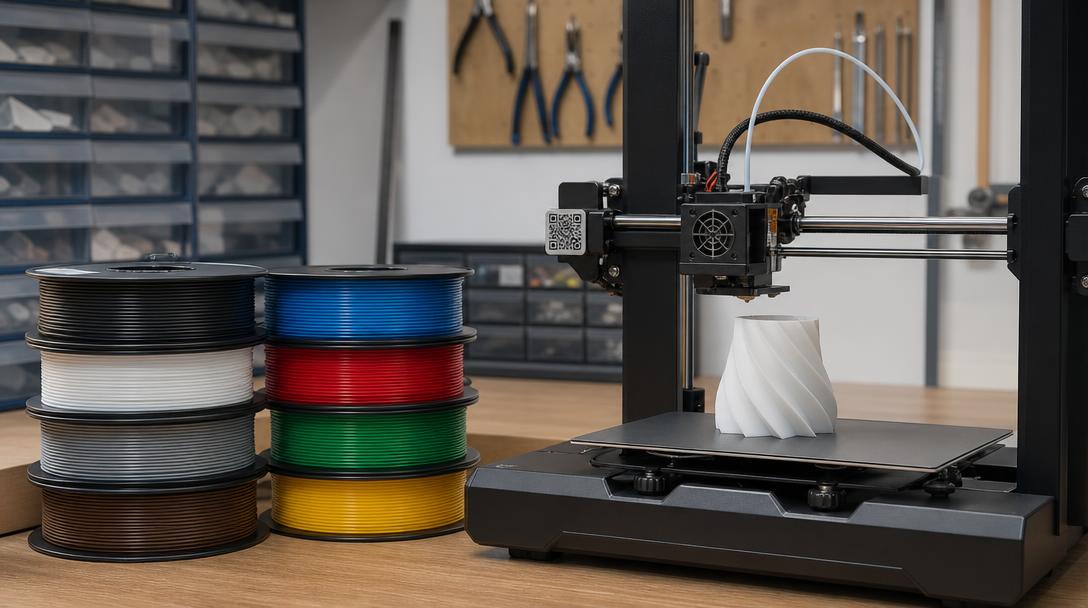
Bambu Lab Cuts Filament Prices: What Does It Mean for FDM Users?
Bambu Lab has announced that it has reduced the regular selling prices of some of its filaments. The development was reported in a 3Druck.com news article dated 17 September 2026. According to the report, the manufacturer says the change was driven by feedback from customers and that it offers a quantity-based advantage for users who purchase more than one spool. Actual sales conditions, stock availability and delivery options in Turkey should be checked separately; nevertheless, the decision has a noteworthy aspect in terms of competition in the FDM filament market.
Why is the price change important?
Filament is a consumable used not for a single print, but for an ongoing production workflow. For a workshop developing prototypes, a designer testing different settings for the same part or a business carrying out small-batch production, material costs make up a significant part of the overall calculation. For this reason, a recognised brand changing its pricing policy for basic PLA products is not merely a figure on a product page. It can affect users’ decisions about stocking up, trying different colours and managing the cost per print.
On the other hand, a lower price does not automatically mean a better choice for every project. Whether the filament is properly dried and wound, its diameter consistency, differences between colour batches and the correct configuration of the printer profile all directly affect the print result. Especially in batch printing, the expected advantage of a spool with a lower cost may be reduced if the rate of failed prints and remakes increases.
For which projects does PLA Basic make sense?
PLA is frequently preferred for projects such as prototypes, visual models, desktop accessories, enclosures and presentation pieces because it is easy to process in FDM printing and has a wide range of uses. Its low tendency to shrink and generally easy bed adhesion also make it a practical starting point for beginners. However, standard PLA should not be treated as the default material for hot areas inside cars, outdoor environments exposed to continuous sunlight or parts carrying high mechanical loads.
If the part will be used outdoors, UV exposure and weather conditions should be considered; if it will be exposed to heat, its operating temperature; and if it will be subjected to impact, its geometry, layer orientation and material structure should all be assessed together. At this point, you can review the options on our printing materials page and compare whether PETG, ASA or another FDM material suitable for the project would be a better choice than PLA.
What should you consider when buying in bulk?
- Actual usage volume: Stocking filament that you will not use in the near future can increase the risk of moisture absorption.
- Storage: Materials that are particularly sensitive to moisture should be kept in dry and enclosed conditions.
- Colour and surface finish: Even within the same product family, batch and colour variations can affect the appearance; a small test print is useful for visible parts.
- Printer compatibility: The spool’s physical dimensions, feeding system and profile settings should be checked.
- The part’s function: Consider not only cost, but also requirements related to heat, impact, rigidity and outdoor use.
How should you assess costs with Ucuz3D?
If you are not producing on your own printer or want repeatable results, do not limit your material decision to the spool price alone. When ordering a 3D printing service, the part geometry, print orientation and surface expectations also determine the overall result. Reviewing the price per gram model and production options before placing an order will help you compare different scenarios more accurately. If your file is ready, you can get an instant quote using the online 3D printing tool and see the FDM production cost directly.
How does the discount decision affect your printing plan?
For workshop use, the most reliable approach is to base purchasing decisions not on a single campaign headline, but on a repeatable production plan. If you are going to print several test versions of the same part, first verify the surface quality, bed adhesion and dimensional stability with a small amount of material. Then determine the colours and quantities you need. This reduces the number of spools left unused and lowers the risk of making a large purchase before validating your print profile. In FDM production, reliable results depend as much on proper storage and correct settings as on the material price.
In conclusion, Bambu Lab’s pricing move is a signal that could increase competition and accessibility in basic PLA use. However, the right decision emerges only when you assess current sales conditions, your storage capabilities and the actual operating conditions of the part you intend to print together.



 Türkçe
 العربية
 Русский
 فارسی
فارسی Deutsch