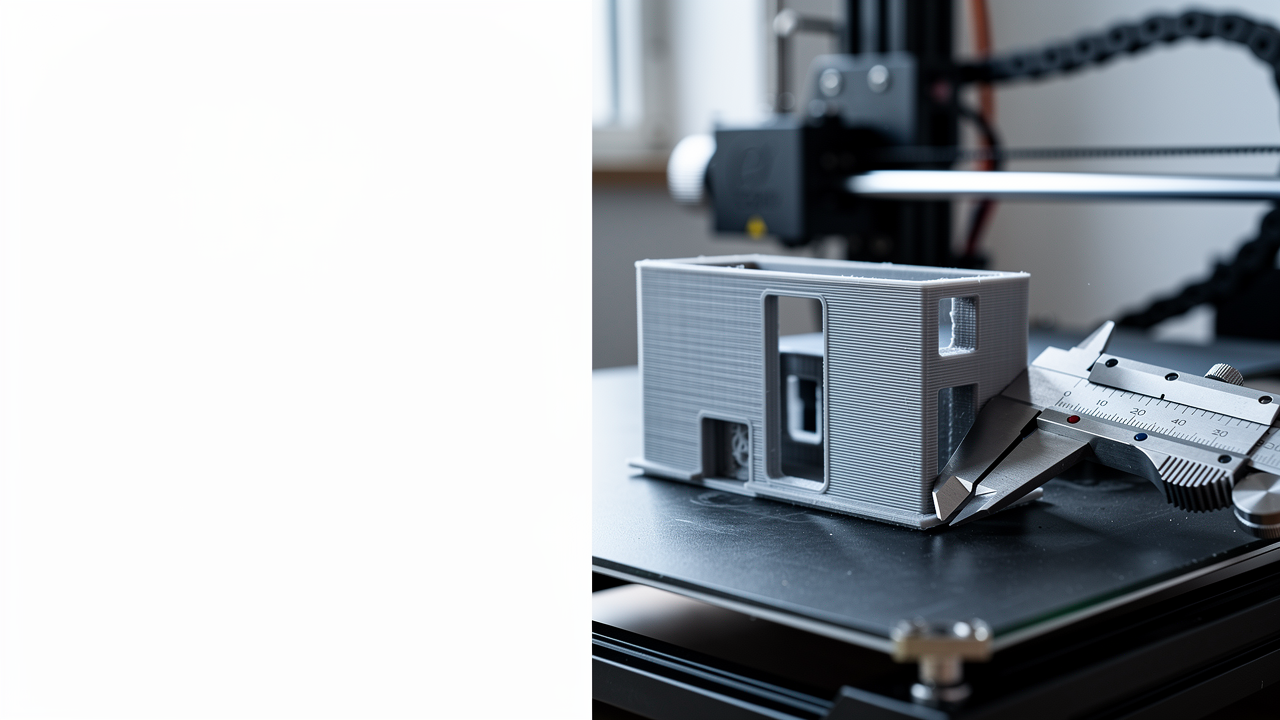

How to Design a Zero-Support Conical Hole? A Clean Internal Void Guide for FDM Printing
Conical hole design makes it possible to produce most internal voids without supports in FDM printing when done correctly. The basic idea is to avoid creating a flat horizontal ceiling and to raise the inner surface at an angle where the layers can support themselves.
Especially for funnel transitions, cable entry points, liquid-guiding parts, and the start of internal channels, using a conical geometry or a form closer to a teardrop instead of a classic cylindrical hole significantly improves print quality. This reduces the hassle of removing supports, results in a cleaner inner surface, and makes part production more predictable. If your design is going into production, you can first get an instant quote to quickly see how dimensions and geometry affect the result.
Why does a conical form work better than a straight hole?
An FDM printer does not handle wide horizontal surfaces suspended in mid-air very well. When a flat internal ceiling forms, the layers sag, the surface comes out rough, and sometimes the print fails without support. In a conical form, however, each new layer gets some support from the layer below it. This gives cleaner results, especially on surfaces progressing at around 45 degrees.
That is why, in areas such as funnels, flow channels, cable guides, or screw entry openings, a gradually narrowing or widening geometry is often more logical than a fully cylindrical start. In functional parts, this approach makes it easier to achieve a good 3d printing service result with less post-processing.
Which angles are considered safe?
There is no single magic number; the material, cooling, layer height, and nozzle diameter all change the outcome. Still, in practice, this approach works well:
- Slopes of 45 degrees and below are generally a safe starting point.
- 50-55 degrees may still be acceptable on some printers, but surface quality can decrease.
- On steeper internal surfaces, the risk of sagging rises quickly.
If the inner surface of the part matters more for function than appearance, a slightly more aggressive angle can be tested. However, for an assembly part that requires a precise fit, it is better to choose a safer angle. It is especially important to think about print allowance in advance in areas involving press-fit assembly, flow, or gasket contact.
4 points to consider during design
1) Make the transition controlled, not abrupt
Use a smooth conical transition instead of geometry that suddenly widens from a cylindrical void. Sudden protrusions increase the need for support.
2) Consider print orientation together with the design
The support requirement for the same part can change completely when it is printed in a different orientation. For this reason, the axis of the internal void should be evaluated together with how the part will sit on the print bed.
3) Do not forget inner diameter tolerance
In FDM printing, holes often come out slightly narrower than the theoretical dimension. Conical entries make assembly easier, but you still need to account for the actual tolerance at the narrow end.
4) If necessary, use a teardrop approach instead of a fully conical one
Especially for horizontal holes, a teardrop form with a pointed upper section is a more support-free solution than a classic circle. This logic is compatible with design principles that reduce support requirements; you can also see similar examples in the guide Design for Printability: Overhang Angles and the 45 Degree Rule.
Which parts is it especially useful for?
- Small funnels that guide dust, granules, or liquids
- Cable pass-through openings and enclosure entry points
- Screw or pin guidance starts
- Cleaning tools, flow adapters, and technical prototypes
In these types of parts, producing without supports can reduce both production time and post-processing needs. As the number of parts increases, this difference also affects cost; on a project basis, it becomes easier to plan more clearly using affordable 3d printing prices and a per-gram approach.
When is support still necessary?
A conical form does not solve every problem. If there is a very large diameter change over a very short distance, if the internal surface is expected to be visually flawless, or if the material has weak bridging performance, support may still be necessary. In materials prone to stringing, such as PETG, small sags may still appear on the inner surface even if the geometry is correct. In such cases, splitting the part, reducing the angle, or redesigning the internal form may be a better solution.
In short, conical hole design is a small design decision in FDM, but one with a big impact. If you want your part to be produced more cleanly, more quickly, and with less risk, replacing flat internal ceilings with self-supporting geometry is often the smartest approach.


 Türkçe
 العربية
 Русский
 فارسی
فارسی Deutsch