How Cordiant Uses 3D Printing for Full-Scale Tire Prototypes
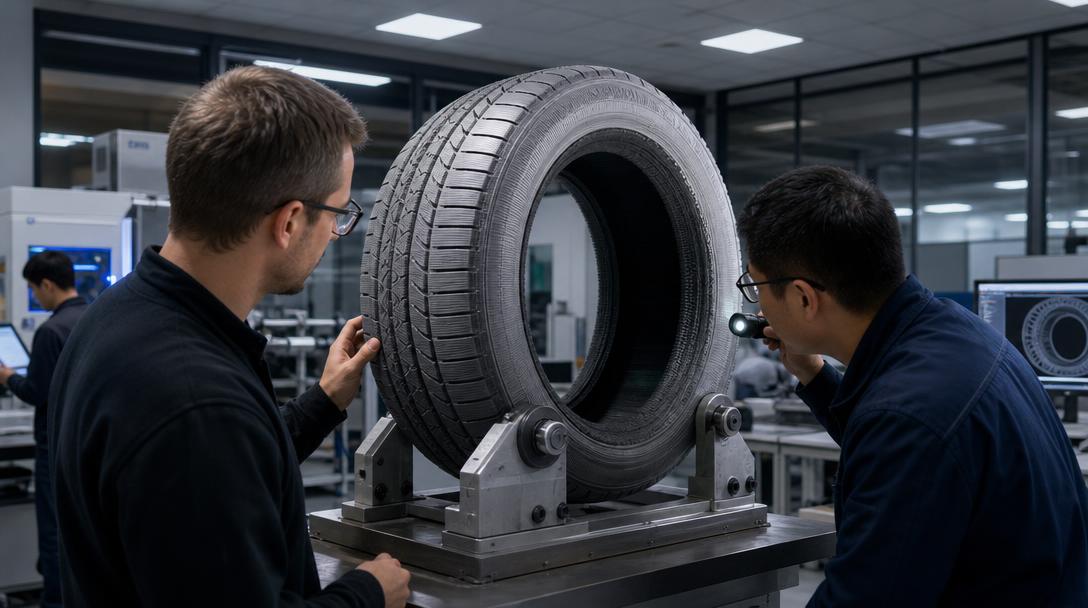
In tire development, prototype production is not limited to checking how the tread looks. A full-scale prototype makes it possible to assess the relationship between the mold, material, production time, and testing plan as a whole. The news that Cordiant is developing 3D printing technology for full-scale tire prototypes shows that additive manufacturing is being considered in the automotive industry not only for small plastic fixtures, but also for larger parts of the product development cycle.
European Rubber Journal published the news on September 7, 2026. The headline reports that Cordiant has developed 3D printing technology for producing full-scale tire prototypes. At this stage, the article does not say that production tires are being manufactured directly with 3D printing; the more cautious and accurate interpretation is that the technology is being used in the prototyping and development process.
Why is a full-scale prototype important?
A prototype of a tire at its actual diameter provides much more information than a desktop-scale model. The design team can examine the shoulder area, sidewall geometry, tread pattern proportions, and its physical relationship with the vehicle body at full size. This can save time, particularly when evaluating new tread patterns and concepts before they are transferred to a mold.
In a traditional prototyping workflow, special preparation may be required for the model, mold, or auxiliary production steps. 3D printing does not always replace the final product here; however, it can create a faster intermediate step between initial geometric validation, a presentation model, assembly checks, and design revisions. When the design changes, being able to prepare a new prototype in less time can help development teams test more variants.
What this news means in practice for Ucuz3D readers
This development does not mean that every part printed with FDM can be used directly in the automotive industry. A tire is a highly specialized product in terms of elasticity, fatigue, heat, friction, and safety. Therefore, producing a prototype for visual or geometric validation is not the same as functionally producing a tire that will be used on the road. The intended use, material, and level of validation must be clearly distinguished.
Nevertheless, the same decision-making logic also applies to smaller parts. If you are developing a vehicle interior fixture, cable guide, sensor mount, or assembly jig, you can first print a low-risk prototype to identify issues with dimensions, access, and assembly. If the part is expected to be exposed to real loads, temperatures, or outdoor conditions, the prototype material should not be confused with the material intended for final use. At this point, reviewing our printing materials according to the operating conditions provides a good starting point.
What should be considered when producing prototypes with FDM?
- Geometry: If a large or complex model does not fit within the build volume, it should be divided into sections; connection points should be considered during the design stage.
- Orientation: Layer orientation is important, especially for connections that carry loads during assembly. Strength should not be determined by looking only at the external appearance.
- Material: PLA can be practical for visual and dimensional prototypes; however, when heat, impact, or outdoor exposure is involved, PETG, ASA, or an engineering-grade material may be more suitable. The final choice depends on the part and printer conditions.
- Validation: The fact that a part prints successfully does not mean it has been approved for real-world use. Load, temperature, vibration, and chemical exposure should be evaluated separately.
If you need not just a single test piece but a dimensionally accurate and repeatable part, you can plan the production process with a professional 3D printing service. Once the part weight and printing conditions are clear, the price per gram approach can help you understand the cost. If your file is ready, you can also get an initial quote from the instant pricing page. For projects where heat, load, or wear resistance is a priority, engineering materials should also be considered.
Conclusion
The Cordiant news reminds us that the value of 3D printing in the automotive industry should be considered more broadly than the idea of “always producing the final product directly from a printer.” In a large and specialized application such as a full-scale tire prototype, the main benefits may be seeing the design earlier, accelerating revisions, and clarifying decisions before moving to the mold stage. The same approach applies at Ucuz3D: first determine what the part needs to prove, then choose the FDM material and production method accordingly.



 Türkçe
 العربية
 Русский
 فارسی
فارسی Deutsch