Hike Medical Expands Personalized 3D Printing with a 600-Printer Orthotics Farm
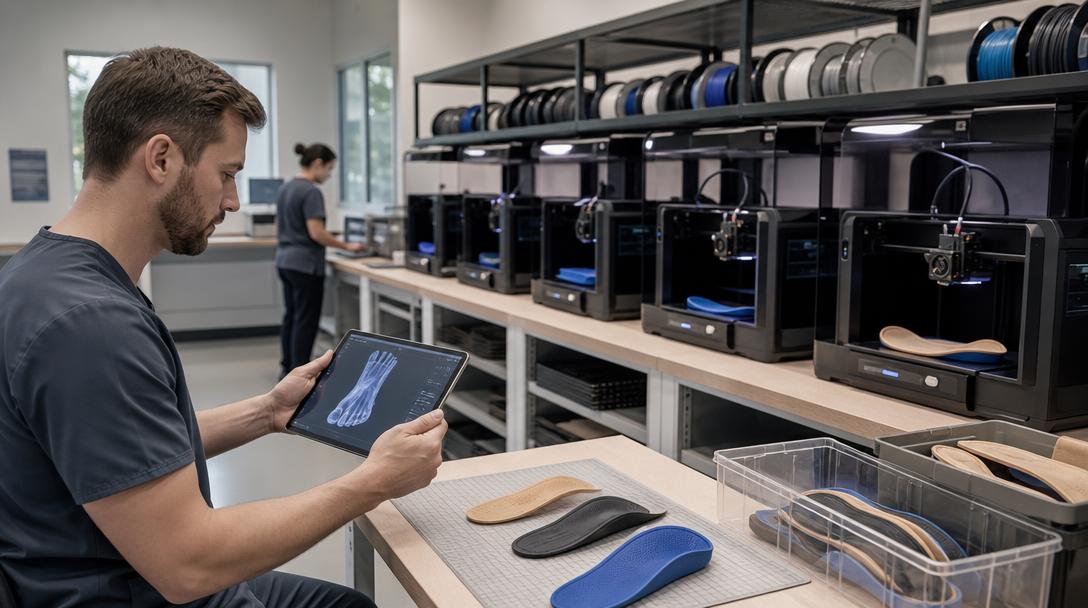
3D printing for personalized orthopedic products is evolving beyond prototyping into a manufacturing infrastructure that extends from measurement to delivery. US-based Hike Medical has announced that it raised $22.5 million to expand this transformation. The company’s facility in Peoria, Illinois, reportedly operates more than 600 3D printers throughout the day and is positioned as one of the largest orthopedic 3D printing farms in the United States.
The development was reported in a 3D Printing Industry news article dated September 7, 2026. Hike’s goal is not simply to print more parts; it aims to combine patient referrals, insurance approval, clinical evaluation and manufacturing in a single digital workflow. This is intended to transfer measurement data more directly into production for products such as personalized insoles.
What problem does 3D printing solve here?
In traditional orthotics manufacturing, taking measurements, preparing molds, obtaining clinical approval and manufacturing can be divided into separate steps. This can stretch the time before a patient receives the product over several weeks. Hike says it has reduced the delivery time for custom insoles from weeks to days by connecting scans captured with a mobile device to the manufacturing process. According to information shared by the company, the current production workflow has a turnaround time of approximately five business days.
In this type of model, having a 3D printer that is fast on its own is not enough. The real gain comes from allowing the process to continue without remeasuring the scan data, losing the clinical decision or repeatedly preparing the production file by hand. A large printer farm can only become meaningful capacity when it is supported by this kind of digital workflow.
What stands out about the Hike model
Hike describes its platform in three sections: Hike Intelligence, which handles referral and insurance processes; Hike Clinical, where clinicians manage scanning and ordering steps; and Hike Lab, the company’s in-house manufacturing unit. This structure aims to turn 3D printing from a manufacturing step outsourced to an external provider into an integrated part of healthcare delivery.
The company also claims to have reduced the remake rate for custom insoles from approximately 1 in 15 products to 1 in 400. This claim should be understood as a company statement; the report does not provide detailed technical verification regarding the printer model, printing method or material family used. Therefore, this example should not be taken to mean that every FDM printer will produce the same clinical outcome.
A practical lesson for Ucuz3D readers
The most important message in this news for desktop FDM users and small manufacturers is that personalization does not begin with investment in a printer alone. Accurate scanning, cleaning measurement data, repeatable slicing, material tracking and quality control must be designed together. For products that come into contact with the human body in particular, material suitability, surface cleanliness, mechanical behavior and clinical approval processes must be evaluated separately.
If you are developing a similar product or device, first define the part’s function and conditions of use. You can review general filament options on our printing materials page, and look at engineering materials for projects that require resistance to loads and heat. When you want to outsource production, sharing the part’s intended use through our 3D printing service makes it easier to determine the right material and manufacturing approach.
When moving from the first prototype to small-batch production, assess the price per gram model not on its own, but together with support requirements, post-processing, tolerance control and the risk of reprints. Once your file is ready, you can also make a quick preliminary assessment through the online 3D printing process.
The Hike Medical example shows that the future of 3D printing in healthcare lies not only in larger printers, but also in reliable and traceable processes extending from measurement to manufacturing. However, in clinical applications, company statements should not be accepted as direct production standards until they have been independently verified and the relevant regulatory and expert assessments have been completed.


 Türkçe
 العربية
 Русский
 فارسی
فارسی Deutsch