PLA+ or Copper PLA? Everyday Functional Part or Metallic Decorative Model?
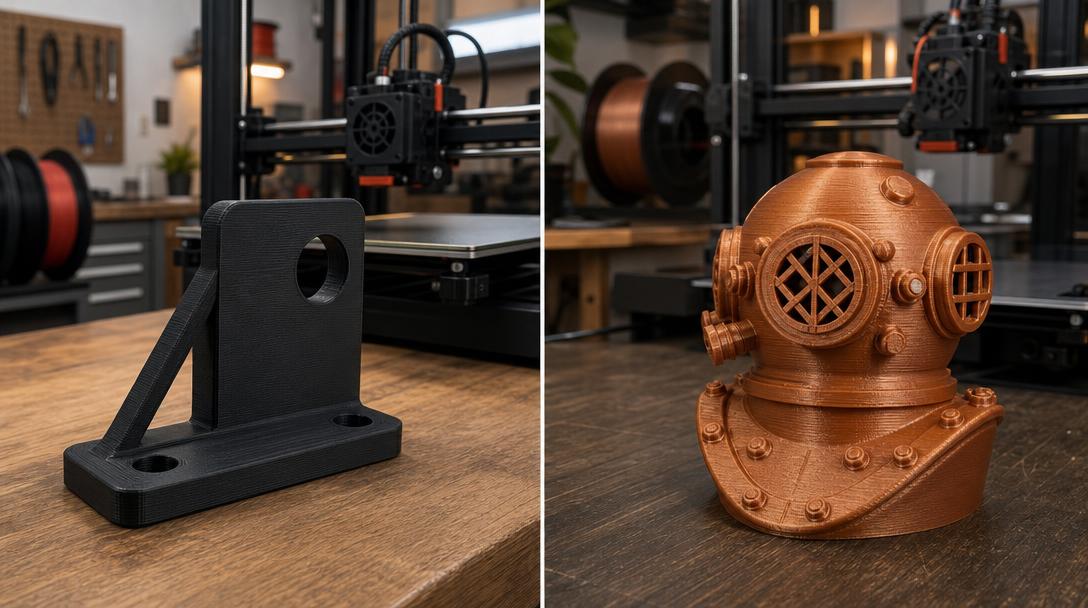
Is your priority in an FDM part everyday-use durability, or a metallic appearance and a weighty feel in the hand? Although PLA+ and Copper PLA belong to the same printing family, their intended purposes differ. PLA+ is generally designed to offer a tougher balance in use than standard PLA while remaining a relatively easy-to-print option. Copper PLA, on the other hand, stands out for decorative projects seeking a copper-like appearance and texture through metal filler within a plastic binder. The decision should be based less on how the part will look and more on how it will function.
What is PLA+ used for, and what is Copper PLA used for?
PLA+ is a practical starting material for parts such as boxes, fixtures, prototypes, assembly aids, and desktop accessories. Its rigid structure, ease of achieving accurate dimensions, and broad FDM printer compatibility make it useful for everyday production. When choosing PLA+, remember that formulations and manufacturer settings can vary between products, so a single technical value should not be generalized to all spools.
The purpose of Copper PLA is not to produce a solid copper part. The metallic filler in the plastic-based filament can give the print a copper-like color, surface, and a more substantial sense of weight. For this reason, it is suitable for figurines, decorative models, sign letters, display objects, and visual prototypes. Metal-filled filaments do not automatically provide the function or conductivity of real metal; the part should not be selected with that expectation.
Differences in outdoor use, heat, and impact resistance
Neither material is automatically guaranteed to withstand continuous sunlight, high temperatures, or harsh outdoor conditions. PLA+ and Copper PLA may deform when used in a vehicle interior exposed to heat or in a thin fixture left in the summer heat. For a part intended for outdoor use, UV exposure, moisture, wall thickness, print orientation, and connection design should be evaluated together; the “plus” in the filament name or its metallic appearance alone is not a sufficient criterion.
In terms of impact, PLA+ may be a more balanced choice for everyday fixtures; however, the part geometry, layer orientation, and number of walls can significantly change the result. In Copper PLA, filler particles may affect the surface and machining behavior. For a part that receives impacts, has thin clips, or flexes frequently, neither option replaces a flexible material.
Rigidity, appearance, and printability
PLA+ is a more straightforward choice for users who want a rigid structure and an even surface. Copper PLA prioritizes visual impact; its metallic character can produce a different appearance through sanding, brushing, or post-processing. However, manufacturer recommendations should be followed regarding nozzle wear and flow behavior when using metal-filled filament. Check the filament’s technical information to determine whether a hardened nozzle is required.
PLA+ generally has the advantage in printability. With Copper PLA, the particle filler may require more careful testing of first-layer, flow, and surface settings. Nozzle diameter, layer height, and print speed should be tested together, especially for small details. Printing a large and highly visible model without first producing a test piece can put your expectations for its appearance at risk.
Cost considerations and which material suits which part
For PLA+, the cost logic is to produce a functional part with less risk of adjustment and to iterate quickly when necessary. With Copper PLA, you should consider not only the weight-based calculation but also the value provided by the decorative surface and the time required for post-processing. Review the current price per gram approach and evaluate material consumption, support requirements, and processing time together.
- Everyday fixture, box, or dimensional-check prototype: PLA+ is the more sensible starting point.
- Metallic-looking figurine, display model, or decorative part: Copper PLA stands out.
- High heat, continuous outdoor exposure, or real mechanical operation: Do not automatically choose between these two; also evaluate engineering materials.
- Part that must flex, act like a gasket, or absorb impacts: Look for a suitable flexible FDM material instead of PLA+ and Copper PLA.
If your part geometry is ready, you can evaluate production options through the 3d printing service and get an instant quote before ordering. See the printing materials page to review the general material options. In short, PLA+ is more meaningful for function and printing practicality, while Copper PLA is more suitable for appearance and decorative character.



 Türkçe
 العربية
 Русский
 فارسی
فارسی Deutsch