
Fillet or Chamfer? Which Is Right for Strength and Printability
Fillet or chamfer? In FDM parts, the short answer is this: at corners that carry load and are at risk of crack initiation, a fillet is often the safer choice; when you want to reduce supports, make printing easier, and create a controlled edge break, a chamfer is more practical. The right choice depends on the direction of the load on the part, the print orientation, and what that corner actually does in production.
In 3D printing, edge geometry affects more than just appearance; it also determines stress distribution, how the layers behave, and how clean the print will come out. That is why the difference between rounding a corner and beveling an edge is more critical than expected, especially in functional fixtures, enclosures, and assembly parts.
When is a fillet the better choice?
A fillet, meaning a rounded transition, helps distribute the stress that builds up at a sharp corner. This provides a major advantage especially in a loaded arm, around a screw, or in areas with sudden section changes. Since interlayer strength is already limited in FDM printing, softening the corner can make it harder for a crack to start from a single point.
- In strength-focused parts: it is preferred in parts such as load-bearing brackets, holder arms, and clip bases.
- For aesthetic surface transitions: it provides a smoother and more professional appearance.
- In products touched by hand: it reduces the feel of a sharp edge.
However, a fillet is not always automatically better. Very large radii can increase print time in some orientations or create a need for support on the underside. For that reason, it should be used not just because “it looks nice,” but specifically at points where stress concentration is a real issue.
When does a chamfer offer an advantage?
A chamfer, meaning a beveled edge, is often a more manufacturing-friendly solution for FDM. That is because a chamfer designed at around 45 degrees can usually be printed without support and gives cleaner results on bottom edges. Especially on sharp outer corners rising from the build plate or at hole entries, a chamfer is very useful both for printability and assembly comfort.
A chamfer stands out in these situations:
- When you want to reduce supports: it softens downward-facing sharp edges.
- When easier assembly is needed: it makes alignment easier in snap-fit parts, covers, or guide entries.
- When you want to tolerate the elephant foot effect: it can make first-layer bulging less visible.
Especially in prototype parts, if fast revision is important, a chamfer often gives a more predictable print result. If you want to see the cost impact of your design, you can easily compare different versions by getting an instant quote for online 3d printing.
Ask 3 practical questions before deciding
If you are undecided between fillet and chamfer, asking these three questions is usually enough:
- Does this corner carry load? If yes, consider a fillet first.
- Does this surface need to be printed without support? If yes, a chamfer may make more sense.
- Does this edge serve an assembly or guiding function? At part entry points, a chamfer is often more functional.
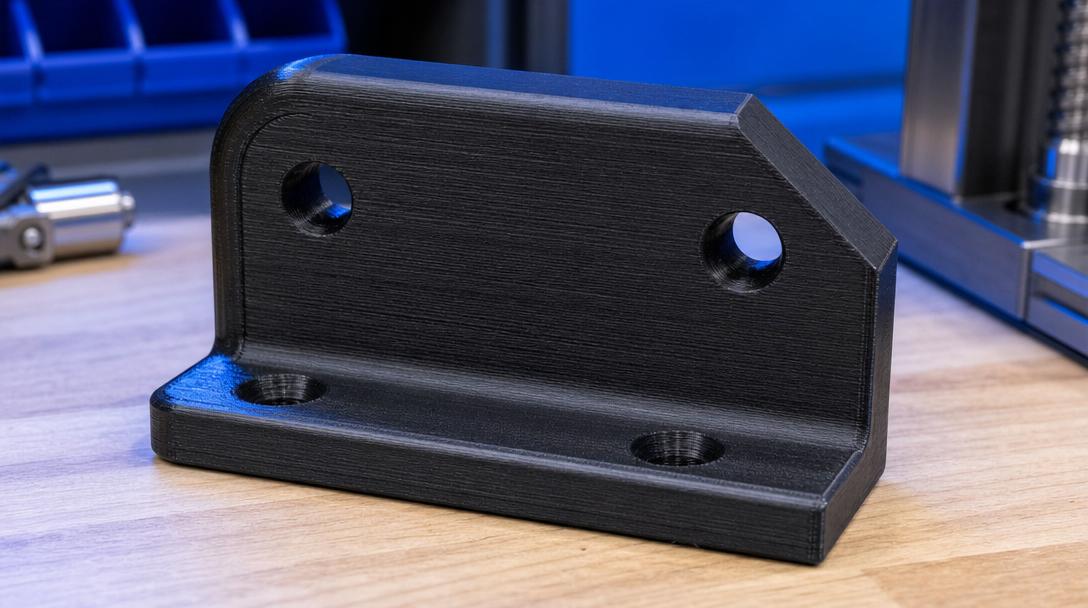
For example, a fillet on the inner corner of an L bracket can reduce the risk of cracking. But on the lower outer edge of the same part that touches the build plate, a small chamfer can hide first-layer defects and make the print look cleaner. In other words, most good designs do not rely on a single answer; fillet and chamfer are often used together on the same part.
The most common mistake in FDM printing
The most common mistake is trying to solve every sharp corner with a large fillet. In some areas, however, this decision can create unnecessary supports, longer print times, and dimensional issues. Likewise, adding chamfers everywhere may fail to provide the required strength at critical loaded corners. At this point, part orientation must also be taken into account, because the relationship between the layers and the load is just as important as the edge form. If you want to explore this in more depth, you can also take a look at the guide How Does Print Orientation Affect Part Strength?.
In conclusion, a fillet is more of a tool for stress management and smooth transitions, while a chamfer is more of a tool for manufacturability and ease of assembly. Establishing this distinction correctly before turning a functional design into a print gives you a result that is both stronger and cleaner. If you want to make your part suitable for production or have it printed directly, you can evaluate your model through Ucuz3D’s 3d printing service.


 Türkçe
 العربية
 Русский
 فارسی
فارسی Deutsch