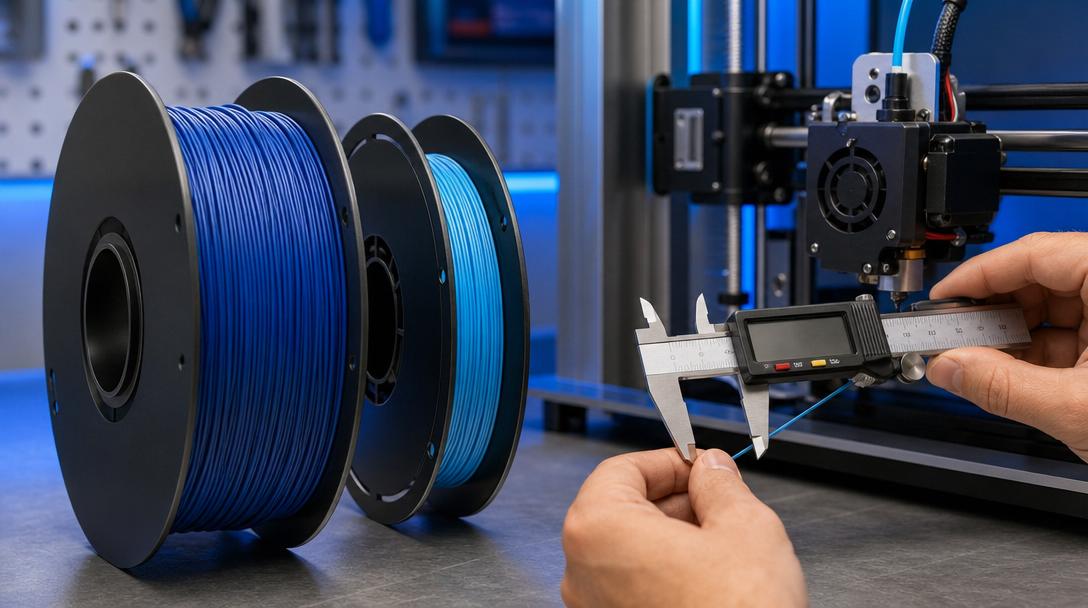

Filament Diameter: 1.75mm or 2.85mm? Why Tolerance Matters
Filament diameter is one of the fundamental variables in FDM printing that is often overlooked, yet it directly affects the quality of the final result. Between the 1.75mm and 2.85mm options, not only your printer’s mechanical compatibility matters, but also the manufacturing tolerance that can vary from spool to spool. If the amount of material calculated by the slicer does not exactly match the plastic that actually flows through the nozzle, problems such as under-extrusion, surface waviness, or dimensional inaccuracy can appear. If you are looking for consistency in your prints, the approach in the guide on what tolerance is and how interlocking parts should be designed also applies here: small differences can lead to big results.
What is the real difference between 1.75mm and 2.85mm?
The main difference is the filament’s nominal thickness. Today, most desktop FDM printers use 1.75mm, while some systems and certain extruder designs work with 2.85mm filament. Because 1.75mm filament is more common, it is generally more practical for most users in terms of material options, brand variety, and profile support. In some applications, 2.85mm may offer a stiffer feeding character; however, it would not be correct to say that this automatically means better print quality.
The critical point here is this: whichever diameter the printer was designed for, that diameter should be used. Using 2.85mm in a 1.75mm system, or 1.75mm in a 2.85mm system, simply will not work properly physically. The real performance difference is related less to the nominal diameter itself and more to how stable that value remains throughout the entire print.
Why does tolerance affect print quality so much?
Just because a filament spool says 1.75mm on the label does not mean it is exactly 1.75mm at every point. Quality manufacturers usually offer tight tolerances such as ±0.02mm or ±0.03mm. This difference may look small on paper, but it can grow in extrusion volume and affect the balance of the layers. If the filament is thicker in some sections, more material than expected comes out of the nozzle; if it is thinner in others, underfilling occurs.
- Surface quality may deteriorate: Waviness on walls, glossy-to-matte transitions, or inconsistent lines may appear.
- Dimensional accuracy may decrease: The intended tolerance may be lost in press-fit parts, covers, screw seats, or mechanical components.
- Flow settings may become unreliable: Even if flow calibration is correct at one point, it may not deliver the same result throughout the entire print.
- Risk increases in long prints: In jobs that take hours, diameter fluctuation can turn into cumulative error.
Especially if you produce technical parts, you need to look not only at the printer settings but also at the consistency of the material. That is why, when choosing a professional 3d printing service, material quality is at least as important as the printer model itself.
When should you consider 1.75mm, and when 2.85mm?
For a new user or someone who wants broad filament availability, 1.75mm is usually the more sensible choice. It is easy to find profiles, there are many extruder and hotend options, and it is flexible enough for everyday prototyping work. 2.85mm is still a strong option in certain machine ecosystems; however, the market standard has now clearly shifted toward 1.75mm.
When making this choice, these questions are more valuable: Which diameter does your printer support? Is the material you want to use easy to find in that diameter? How tight is the spool-to-spool tolerance specified by the manufacturer? Because a low-quality filament with the correct nominal diameter can cause far more problems than a high-quality spool with tight tolerances.
What should you check when buying filament and preparing for printing?
When choosing filament, do not focus only on color or price; also read the technical label. The tolerance value specified by the manufacturer, the winding quality, and the material consistency can make a serious difference. In addition, for critical projects, it is a good habit to measure the filament at several points with calipers, keep the spool dry, and verify the extrusion multiplier setting with a test part.
When planning costs, you should consider not only the spool price but also the risk of waste. To move forward with suitable material and the right settings, it becomes easier to make a decision by looking at the price per gram approach and getting an instant quote based on your needs.
In short, there is no single magical answer to the question of 1.75mm or 2.85mm; the right answer depends on your printer’s system and your project requirements. However, whichever diameter you use, choosing filament with tight tolerance and consistent quality means cleaner surfaces, more accurate dimensions, and more predictable results in FDM printing. If you want a technical part to be produced reliably, the healthiest approach is to move forward with material and setting choices that match your project requirements.




 Türkçe
 العربية
 Русский
 فارسی
فارسی Deutsch