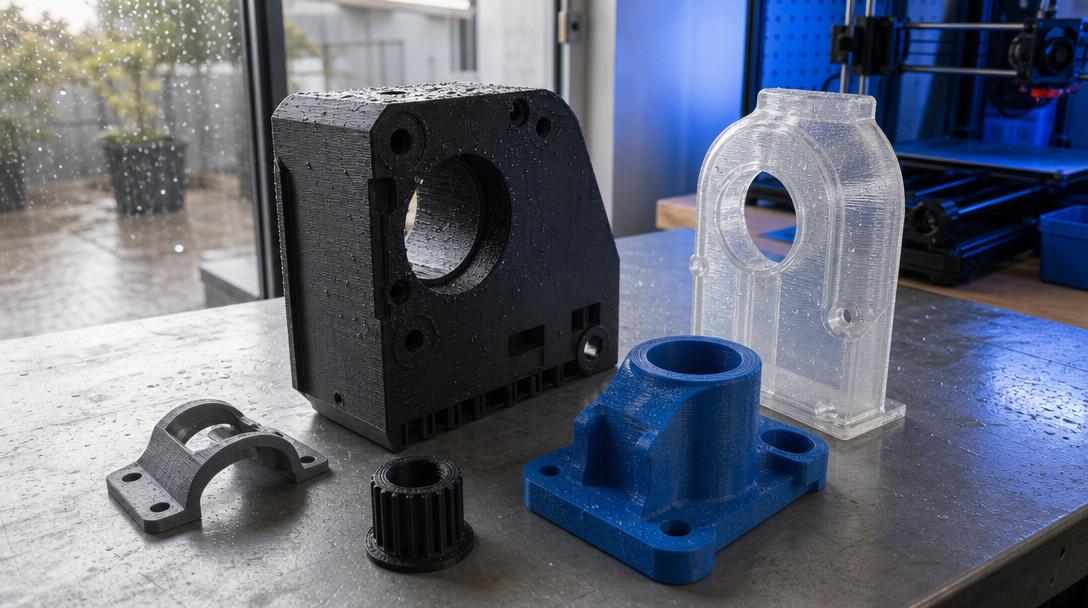

Choosing UV- and Weather-Resistant Filament for Parts Used Outdoors
When producing a part that will be used outdoors, the most critical decision is choosing a UV- and weather-resistant filament. A part that fades under the sun, becomes brittle after rain, or cracks during hot-cold cycles can quickly lose its function even if it is well designed. That is why, for parts such as pot accessories, sensor enclosures, cable clamps, protective covers, or mounting brackets, you need to consider not only print quality but also how the material behaves outdoors.
Why is PLA often not the first choice for outdoor use?
PLA is an easy material to print; however, it may struggle to maintain its shape in areas exposed to prolonged sunlight and heat. The risk of softening increases especially inside vehicles, near balcony railings, or on surfaces exposed to the summer sun. For this reason, if you are considering outdoor use, instead of choosing PLA just because it prints easily, it is better to first evaluate the expected temperature, impact, and UV exposure the part will face. When planning the right 3d baskı hizmeti for your project, material selection is just as decisive as the design.
The most sensible filament candidates for outdoor conditions
There is no single “best” filament for outdoor parts; the right option depends on the part’s function. Still, in FDM production, the most commonly considered materials are:
- ASA: Because of its UV resistance and balanced performance against weather conditions, it is one of the strongest candidates for outdoor use. It is often preferred for sun-exposed enclosures, sign fixings, and protective covers.
- PETG: It offers good moisture resistance and overall durability. It may not be as strong as ASA under intense UV exposure; however, it provides a sufficient balance for most projects involving moderate outdoor use, garden accessories, and functional enclosures.
- Polikarbonat (PC): It stands out in parts that require high heat resistance and impact strength. However, its printing conditions are more demanding, and it may not be the first option for every geometry.
- TPU: It is a meaningful option for seals, flexible feet, vibration dampers, or impact-absorbing outdoor parts. It should be considered when flexibility is needed rather than a rigid structural part.
If you would like to compare options such as ASA, PC, nylon, and similar materials in particular, the printing with engineering materials approach helps you make a more accurate decision based on the part’s use scenario.
When choosing filament, think not only about UV but also about the design
Outdoor performance is not determined only by the filament name. A part with thin walls, water-trapping areas, or the wrong print orientation may still fail early even if a good material is selected. For that reason, it is useful to ask these questions when making your choice:
- Will the part receive direct sunlight all day, or will it stay in the shade?
- Will it only be exposed to rain and moisture, or will there also be impact and vibration?
- Is the part decorative, or is it a functional load-bearing component?
- Are there sensitive details such as screw holes, clips, or press-fit tolerances?
Since print orientation affects strength as much as the material does, especially when designing load-bearing parts, the principles in the guide How Does Print Orientation Affect Part Strength? can significantly improve the outcome.
Which material is more suitable for which scenario?
To give a practical summary: ASA is generally a safe starting point for rigid outdoor enclosures that will remain in the sun for long periods. For general-purpose parts exposed to moisture but not very high heat loads, PETG is sufficient for most users. If there is high temperature, impact, or a more technical use case, it makes sense to look at PC. If flexibility is required, TPU should be evaluated separately. The goal here is not to force one material to fit every job, but to make a balanced choice based on the part’s function.
If you are not sure which material will give your part the longest service life, you can upload your model and get an anında fiyat, then add a material note based on your use scenario. You can also visit the ucuz 3d baskı fiyatları page to see the per-gram pricing approach and make a healthier decision between budget and durability.
In short, the right result for parts placed outdoors does not come only from a filament described as “durable”; it comes from a choice that evaluates UV, moisture, temperature, impact, and design conditions together. If you would like to clarify the most suitable material for your project, share your model; based on the part type and area of use, we can determine the most sensible FDM option together.


 Türkçe
 العربية
 Русский
 فارسی
فارسی Deutsch