
Drilling Jig Design: Speed and Consistency in Repetitive Work with 3D Printing
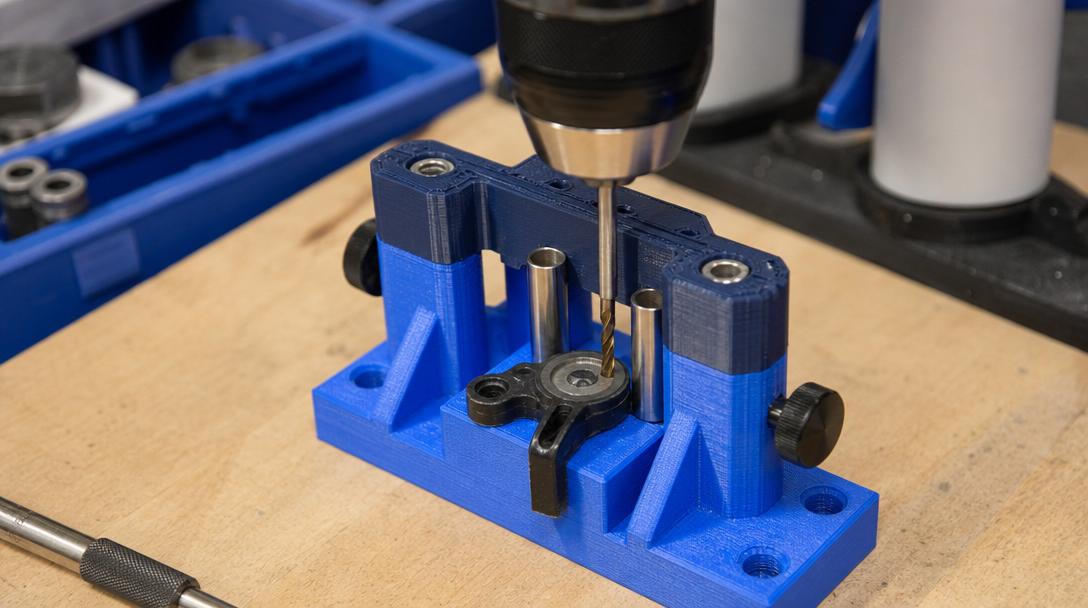
Drilling jig design is one of the most practical solutions when you want to make the same hole in the correct position again and again. A simple jig produced with 3D printing reduces dimensional deviation, increases work speed, and significantly lowers the need for expensive fixtures, especially in small workshops.
What exactly does a drilling jig do?
A drilling jig is an auxiliary tool that guides the drill bit to the correct point and positions the part with the same reference every time. It is used for wood, plastic, thin sheet metal, or jobs that require marking before assembly. It saves a great deal of time, especially in low-volume production, prototyping, and custom assembly parts. For teams that need dimension-specific tools, automation and robotics-focused 3D printing solutions make it easier to bring this type of fixture to life quickly.
The critical point here is this: a jig printed with FDM should not be considered the same as a heavy-industry gauge. However, if it is designed with the right material, the right wall thickness, and the right reference surfaces, it can work extremely efficiently in assembly, guiding, hole marking, and light drilling operations.
Determine the reference surfaces first in the design
The success of a good jig starts with reference logic before hole diameter. The jig should be built according to whichever edge, corner, or surface of the part will sit the same way every time. If the part can move freely inside the jig, even the most accurate hole center will not be useful in the field.
- Define at least two fixed reference surfaces: one for lateral position and one for longitudinal position.
- Seat the part in only one direction: use an asymmetrical guide geometry to reduce the possibility of incorrect insertion.
- Consider drill allowance: evaluate the hole axis not only according to the nominal dimension, but also according to the drill bit’s tendency to wander.
- Thicken the points that will wear: the drill entry zone and thin walls perpendicular to the print direction should not remain weak.
At this stage, fit and clearance values become important. The part that will sit inside the jig should be neither too tight nor too loose. For this reason, reviewing the guide What Is Tolerance? How Should Interlocking Parts Be Designed? before the design stage increases the chance of getting the right result, especially on the first attempt.
How should suitable geometry for FDM be selected?
When designing a 3D printed jig, the goal is not only to make the model printable, but also to limit deformation during use. For this reason, instead of thin and long single-piece walls, a ribbed form with a wide base that can distribute the load should be preferred. PLA may be sufficient for a fast prototype; however, if the workshop temperature is high or a tougher structure is desired, PETG or suitable engineering materials are a more sensible choice.
There are two approaches in applications that require a hole guide. The first is to create the hole center with the printed body itself; this method is suitable for light-duty work. The second is to add a metal bushing or ready-made guide to the printed body; if the number of repetitions is high, this provides a much longer service life. If you plan to use the jig not only as an assembly aid but as an actual production tool, it is also important to choose the print direction according to the load line of the layers.
When does it make sense to have a jig made with 3D printing?
If the tool you need is not a standard catalog product, if it needs to be put into use within a few days, or if you want to test it first and then revise it, 3D printing is a very powerful method. Before moving on to a hard fixture that will be machined with CNC, it is possible to quickly evaluate dimensions, access, and ergonomics. This provides a major advantage, especially in maintenance teams, assembly lines, and product development processes.
If you have designed a jig according to your own dimensions, or if you only have a rough idea, uploading your file and seeing an instant quote is enough for the first decision. A well-designed drilling jig may look like a small 3D printed part, but it can be one of the most useful auxiliary tools in the workshop for reducing error rates and standardizing the job.


 Türkçe
 العربية
 Русский
 فارسی
فارسی Deutsch