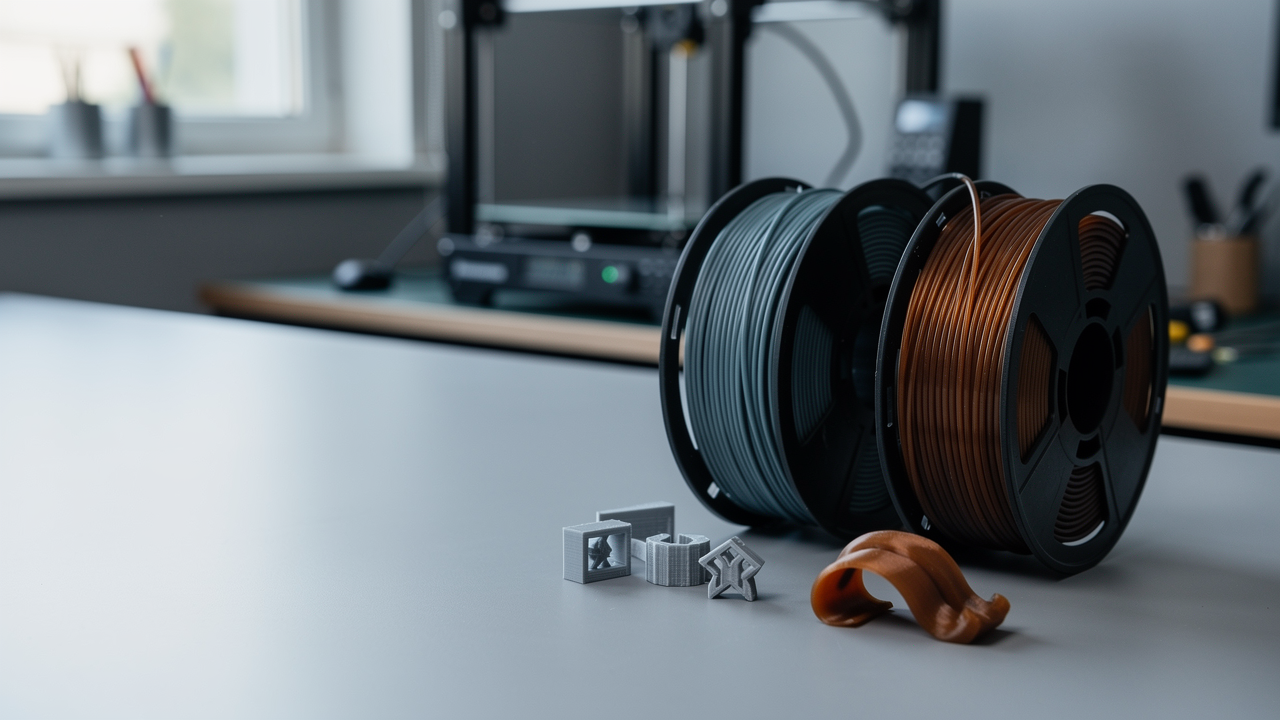

ABS or TPU? Are You Printing a Rigid Fixture or a Flexible Protector?
Why are these two often confused?
ABS and TPU are often mentioned in the same sentence when functional parts are discussed; but in reality, they answer completely different needs. ABS can be thought of as a more rigid, more stiff, and more heat-resistant entry-level engineering material than the PLA class. TPU, on the other hand, stands out for parts that need flexibility, impact absorption, and a grippy feel on the surface. In other words, the question is usually not “which one is better?” but “what will the part do while in use?”
It is important to clarify this difference before turning your part into a print. Especially on the production side, when getting a 3d baskı hizmeti, choosing the material based on the use case rather than appearance usually means fewer revisions.
What is each good for, and what is it not?
ABS makes sense for enclosures, mounting brackets, covers, fixed fixtures, lightly loaded technical bodies, and parts that are partially exposed to warm environments. With careful design, it can perform well in details such as hole areas, clip slots, and screw connections. However, it may not be the right choice for parts that need to flex continuously, grip the ground, or dampen energy during impact.
TPU is strong for bumpers, feet, cases, gasket-like geometries, cable protectors, vibration-reducing spacers, and flexible parts that work through surface friction. In contrast, for parts expected to deliver high rigidity, sharp dimensional stability, and “load-bearing frame” behavior, TPU is often simply too soft. That is why carrying a load and absorbing impact are not the same thing; TPU is stronger at the second job.
Which one is ahead in heat and outdoor use?
On the heat side, ABS is generally a safer first stop than TPU. For moderate temperature scenarios such as covers that may face summer heat without getting as hot as around a motor, some interior vehicle helper parts, or workshop fixtures, ABS may be the more sensible option. Although some TPU types are durable, shape stability becomes more critical in flexible materials as temperature rises.
Outdoors, the decision should be based not only on sunlight but also on the part’s function. If you are printing a rigid outdoor fixture, ABS can be used; however, for parts that will see long-term UV exposure, different materials are often considered as well. TPU can work outdoors for roles such as a protective case, bumper, or contact surface; but it should not be considered for the role of a rigid load-bearing part.
Where does the difference become clear in impact, rigidity, and flexibility?
If you want rigidity, ABS is by far the more appropriate side. Printing a bracket, body, or a fixture that must function without losing its shape in TPU is generally not a sensible choice. That is because TPU flexes in a controlled way under load; sometimes this is an advantage, and sometimes it is a direct problem.
When it comes to impact management, the picture reverses. If the part will face drops, collisions, compression, or vibration, TPU offers a serious advantage. Typical examples include the inner surface of a phone holder, foot pads for table legs, device corner protectors, or cable pass-through guards. ABS is not completely weak against impact; however, “impact-absorbing behavior” and “hard but durable behavior” are not the same.
How do printability and cost logic change?
In printability, the challenges of these two materials are different. On the ABS side, warping, corner lift, and the need for an enclosed volume are discussed more often. On the TPU side, because of the filament’s flexibility, feed, speed, and retraction settings become more sensitive. So what is “easy” depends on your printer and the geometry of the part. TPU may be comfortable for a simple protective sleeve; but for a large box-style body, enclosure management becomes critical on the ABS side.
In cost logic, looking only at spool price is not enough. Failed print rate, support requirements, print time, and the number of revisions to the part all change the total cost. When placing an order, you need to look not only at the material but at the whole job; for that, the per-gram approach on the ucuz 3d baskı fiyatları side is a useful reference. If you want to prepare the file and make a quick comparison, the anında fiyat flow can also shorten the decision process.
Which one makes more sense for which part?
- ABS: box, bracket, fixed fixture, body, indoor technical cover, rigid part exposed to moderate heat
- TPU: bumper, case, foot, vibration-reducing spacer, grip surface, flexible protector, cable protection part
In short, if the part needs to keep its shape, lean toward ABS; if the part needs to flex and manage impact, lean toward TPU. If your scenario is more complex and you are still undecided, the framework on the mühendislik malzemeleri 3d baskı page can be a good second step for seeing different engineering options as well.


 Türkçe
 العربية
 Русский
 فارسی
فارسی Deutsch