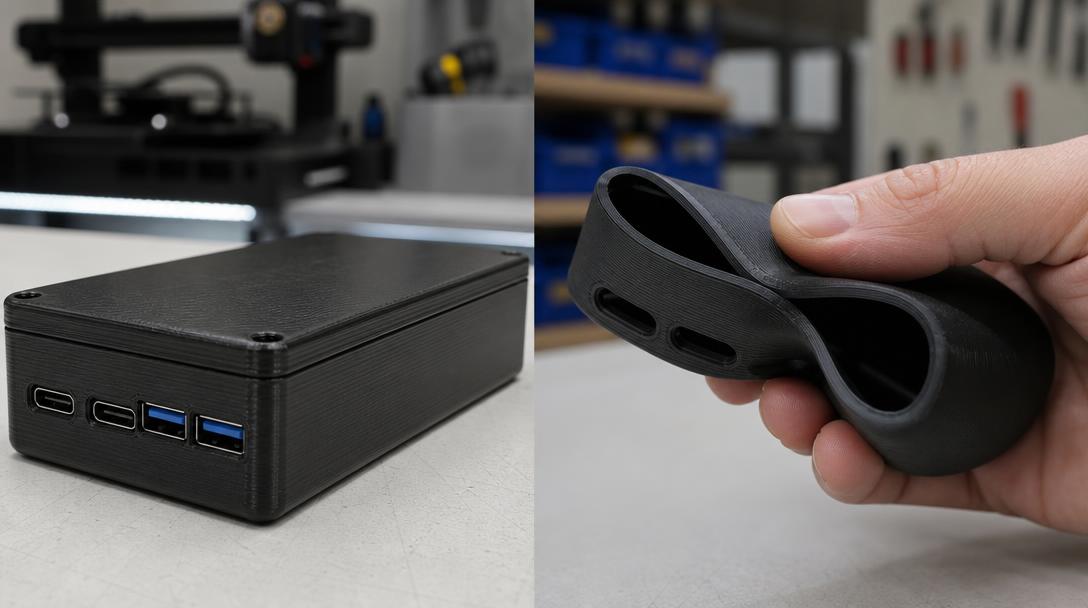
ABS or TPE? Rigid Outer Housing or Flexible Protection?
In an FDM part, the first decision is often the material rather than the shape. Does the part need to remain rigid, or does it need to absorb impacts? ABS and TPE provide two different answers to this question. ABS is a rigid engineering plastic with relatively good heat resistance, while TPE stands out in protective and contact parts thanks to its rubber-like flexibility. Therefore, the choice should be based not only on the material names but also on the part’s operating conditions.
What are ABS and TPE used for?
ABS can be preferred for boxes, housings, mounting hardware, brackets, prototypes, and rigid parts exposed to mechanical loads. Its rigid structure provides an advantage in housings and screw connections that need to maintain their dimensions. Compared with PLA, it may also be a more suitable option for some applications exposed to heat. However, the printer environment and settings are important because of the risk of shrinkage and interlayer cracking during printing.
TPE is suitable for flexible gasket-like parts, bumpers, vibration-damping feet, cable protectors, and gripping surfaces. If the part needs to compress, bend, or conform to a surface, TPE’s elastic behavior can be useful. Since hardness and printing behavior can vary across the TPE family depending on the product formulation, the manufacturer’s technical datasheet and sample testing should be taken into account.
Outdoor use, heat, and impact
ABS offers more consistent rigidity than TPE outdoors; however, not every ABS product can be expected to perform equally under prolonged exposure to sunlight and UV. Parts that will remain outdoors require a material with specified UV resistance and an appropriate design. TPE can absorb impacts and vibrations, but its soft structure may be affected over time by friction, compression, and environmental conditions. In other words, instead of relying only on a decision based on flexibility or rigidity for outdoor use, the actual exposure should be evaluated.
When heat is involved, ABS is generally the safer starting point; nevertheless, the print’s continuous operating temperature and the risk of deformation under load should be checked separately. TPE can soften as the temperature rises and change shape more easily. On the other hand, controlled flexibility on an impact-prone surface may be more functional than a rigid part that could break.
Rigidity, flexibility, and ease of printing
- Rigidity: ABS is the better choice for rigid housings, covers, and fixtures; because TPE needs to flex, it may struggle to maintain dimensions in these applications.
- Flexibility and impact: TPE has an advantage in absorbing impacts and conforming to surfaces. ABS, with an adequate design and print orientation, can produce durable rigid parts.
- Ease of printing: ABS may require an enclosed chamber, good bed adhesion, and controlled airflow. With TPE, a low print speed, controlled retraction, and as little empty space as possible in the filament path are generally safer starting points.
- Surface and post-processing: ABS may be suitable for certain post-processing methods; with TPE, processes such as sanding and gluing may be more limited or dependent on the product type.
Which material for which part?
If you are printing an electronics box, a rigid protective housing, a mounting fixture, or a rigid bracket exposed to heat, ABS is the more logical starting point. For a vibration foot, flexible cover, impact bumper, cable pass-through protector, or a part that operates by compression, consider TPE. If the two materials need to be combined in the same part, the printing system, layer compatibility, and assembly method should also be tested; a simpler geometry that can be printed with a single material is often more predictable.
When making your decision, part thickness, wall count, print orientation, and connection method are just as important as the material’s behavior. A thin ABS wall may turn out differently than expected due to heat and shrinkage; with TPE, excessively thin areas may stretch more than intended during use. For this reason, a small test print for a critical part reduces risk before final production.
To clarify your material choice together with the print quantity, part size, and usage conditions, you can visit our printing materials page. If you would like to move the part you need into production, review the 3d printing service options; understanding the price per gram model and getting an instant price can make your decision easier.




 Türkçe
 العربية
 Русский
 فارسی
فارسی Deutsch