Glass Fiber Reinforced or Copper PLA? Technical Rigidity or Metallic Appearance?
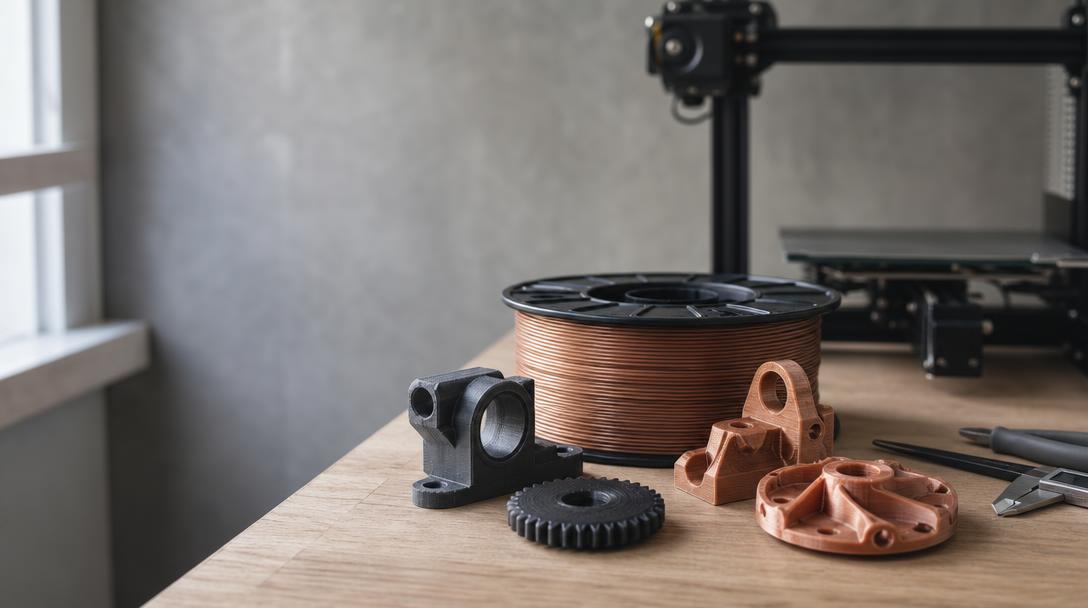
Is dimensional stability and technical rigidity your priority in an FDM part, or are you looking for a metallic appearance and a decorative sense of weight? Glass fiber reinforced filament and Copper PLA represent these two different expectations. They are not materials that can be placed in the same printing basket; the right choice should be based on the part’s function.
When does glass fiber reinforced filament stand out?
Glass fiber reinforcement is an engineering-focused option intended to increase the rigidity and dimensional stability of the base polymer. It can be suitable for mounting hardware, load-bearing brackets, assembly fixtures, and functional parts that need to retain their shape. It can provide an advantage in designs that should not flex excessively under load; however, final strength does not come from the filament alone. Layer orientation, wall count, infill pattern, printing temperature, and design geometry all affect the result.
Glass fiber reinforced filament also comes with requirements regarding printing equipment and surface expectations. Fiber-filled materials can wear a standard brass nozzle more quickly; a wear-resistant nozzle recommended by the manufacturer may be necessary. Layer lines generally look more technical than those on decorative Copper PLA prints. Fiber reinforcement does not automatically make a part unbreakable; while rigidity increases, some designs subject to impact or requiring flexibility may behave less forgivingly.
For which applications does Copper PLA make more sense?
Copper PLA is not a part made from real copper. It is a decorative FDM material with metallic filler added to a PLA matrix, standing out through its appearance and sense of weight. It can be preferred for busts, sign lettering, decorative covers, scale-model details, and presentation prototypes. With surface finishing and suitable settings, the metallic effect can be enhanced; however, it would be incorrect to expect electrical conductivity, corrosion behavior, or the strength of real metal.
Copper PLA generally benefits from the ease of printing associated with the PLA family. Producing prototypes and visual models on open printers can be more accessible than working with glass fiber reinforced materials. However, the density and nozzle-wear characteristics of metal-filled filament can vary depending on the product formulation. Choosing Copper PLA solely for its metallic appearance may be risky for a part that will remain outdoors for a long time, be exposed to high temperatures, or carry impact loads.
Differences in outdoor use, heat, and impact
- Outdoor use: The outdoor performance of glass fiber reinforced material depends on the base polymer it contains; fiber alone does not mean UV resistance. Copper PLA is not automatically an outdoor solution for sun, moisture, and heat.
- Heat: Engineering filaments reinforced with glass fiber can target more stable parts under heat when combined with a suitable polymer. For Copper PLA, the temperature limits of the PLA base must be taken into account.
- Impact: Rigidity is not the same as impact resistance. A glass fiber reinforced part may flex less; Copper PLA may also not be the first choice for impact-related mechanical applications because of its decorative filler.
- Flexibility: Neither material is designed for producing flexible parts. For seals, bumpers, or bending clips, consider a suitable material such as TPU, TPE, or TPC.
Printing ease and cost considerations
If easy prototyping, low equipment risk, and visual results are important, Copper PLA may be the more sensible starting point. If rigidity, repeatable dimensions, and function are the priorities, glass fiber reinforced filament stands out; however, a wear-resistant nozzle and more careful profile tuning can affect the total cost. Look beyond the price per kilogram and consider the required wall count, the risk of failed prints, and any post-processing. Reviewing the general price per gram model can help you evaluate both options in the same part scenario.
Which one should you choose for your part?
If you are producing an assembly fixture, a component that must retain its dimensions, or a rigid technical connection part, glass fiber reinforced filament is the more suitable candidate. Copper PLA is more appropriate for a decorative model, exhibition prototype, or presentation part where a metallic appearance is desired. If the part’s purpose is unclear, first review our printing materials; for high-performance options, visit the engineering materials page. You can then share your part and its usage conditions for a 3D printing service and evaluate the production scenario with the online 3D printing tool.


 Türkçe
 العربية
 Русский
 فارسی
فارسی Deutsch