
3D Printing in Medical Education: Students Make Lab Tools from Recycled Plastic
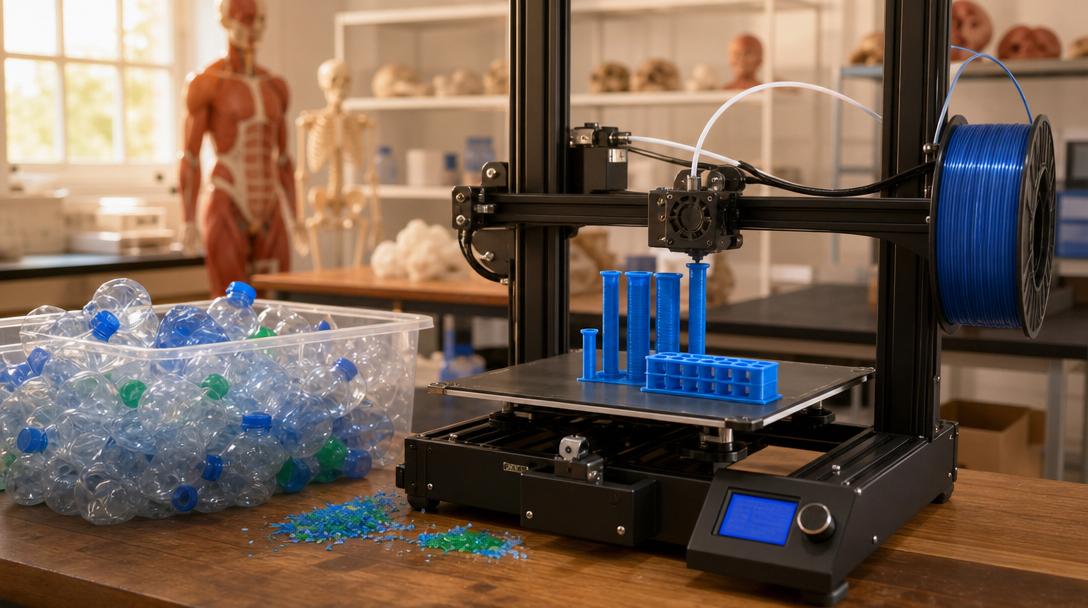
Access to laboratory tools at medical schools is not always easy—especially for small-budget educational institutions in developing countries, which can struggle to source basic experimental equipment. In this project, a fine example of using 3D printing in medical education, a group of medical students brought an unusual and sustainable solution to the problem: collecting plastic waste and turning it into lab tools on FDM 3D printers.
As part of the project, students process PET bottles and plastic packaging collected from recycling points on and around campus, turn them into filament, and then use that filament to produce petri dish holders, test tube racks, microscope slide carriers and various dissection tools. Compared to the traditional supply chain, costs are reported to drop by as much as 70%, and the entire production process can be carried out within the school.
Why Does FDM 3D Printing Stand Out in This Project?
The core technology behind the project is 3D printing with FDM (filament extrusion). There are a few reasons for this: FDM printers are more accessible than other technologies; they can work with materials such as recycled PET and PLA; and the per-part cost is extremely low. The students also share their lab tool designs as open source, so other schools can produce the same models on their own printers.
Which Materials Are Used?
- Recycled PET (rPET): Obtained from bottle plastic, this material is an ideal choice for producing reusable lab tools thanks to its chemical resistance and durability.
- PLA and PLA+: Biodegradable and easy to print; preferred especially for single-use molds and carriers.
- PETG: Used when more durable parts are needed; although not autoclavable, it is suitable for alcohol-based disinfection.
The project does more than just produce equipment—it also draws attention to the plastic waste problem. A significant portion of a medical school’s annual plastic waste can be reprocessed and turned into lab tools, thereby reducing the amount of waste as well.
3D Printing in Education: Not Just Lab Tools
For medical students, 3D-printed models have many uses, from anatomy to surgical planning. What makes this project different, however, is that students act as both producer and consumer: they design and produce their own tools, learning the 3D printing process along the way. Educational institutions are increasingly becoming aware of the use of 3D printing in STEM projects in education.
The small 3D printing labs set up at medical schools follow a workflow similar to that of workshops offering 3D printing solutions in the medical field: first identify the need, design or download the model, then produce it on an FDM printer. The difference here is that the raw material used is plastic waste and that students play an active role at every stage of the process.
The scalability of the project is also quite striking. Students report that a single desktop FDM printer can produce roughly 50 to 100 lab tools per month. This kind of production capacity is more than enough to meet the basic needs of a small laboratory. If you too need a 3D printing service for a similar project, you can use the instant price calculator to evaluate prototype or series production options.
Combining sustainable material use with low-cost production, this approach once again reveals the potential of 3D printing in medical education. The project also contributes to plastic waste management while helping students develop their engineering and design skills. In the coming period, similar projects are expected to spread to other universities as well.


 Türkçe
 العربية
 Русский
 فارسی
فارسی Deutsch