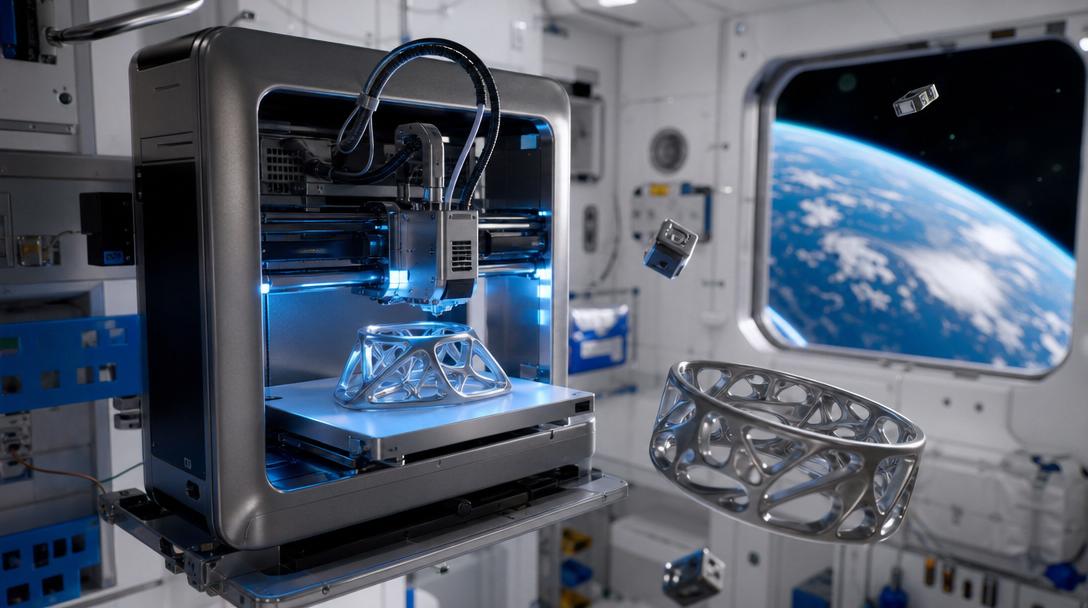

Is 3D Printing in Space Possible? Auburn and NASA Validate Conductive Structures in Microgravity
3D printing in space is no longer science fiction. Researchers at Auburn University and NASA’s Marshall Space Flight Center have developed a dry 3D printing platform capable of producing conductive silver and copper structures in a microgravity environment. Published in the journal npj Advanced Manufacturing, the study shows that this ink- and liquid-free method could pave the way for on-demand electronics manufacturing on future Moon and Mars missions.
How Does Dry Nanoparticle Technology Work?
The Dry-ANM (Dry Additive Nanomanufacturing) platform developed by the research team works on a different principle than conventional 3D printing methods. The system generates metal nanoparticles during printing, deposits them onto a surface, and turns them into conductive structures through a sintering process. Because it uses no liquid-based materials, it eliminates the droplet-control and surface-tension problems encountered in microgravity. Each side of the device measures roughly 60 cm, combining particle generation, printing, and sintering in a single system — a major advantage given the limited space aboard spacecraft.
Parabolic Flight Tests Completed Successfully
The technology was tested during two days of parabolic flights as part of a NASA-supported campaign. Across 50 separate microgravity sessions, each lasting about 25 seconds, the researchers successfully produced conductive silver and copper structures. In tests involving antennas and other conductive patterns, the metal particles were observed to behave differently in microgravity than on Earth, yet the team adapted the process and continued to produce functional structures. This provides the first detailed evidence of conductive structure production in microgravity using a dry printing platform.
What Does It Mean for Space Missions?
The most striking aspect of the research is the possibility of astronauts manufacturing their own electronic components in space. Here is what that means:
- On-demand spare parts: Instead of waiting for a new component from Earth to fix a failed sensor or communications hardware, parts can be made on the spot.
- Customized equipment: Sensors and circuits designed instantly to match the mission’s needs.
- Less reliance on stockpiles: A compact manufacturing system instead of carrying tons of spare parts on long-duration missions.
This technology becomes especially critical on missions that require months of travel, such as those to Mars, where resupply from Earth would be impossible in the event of a failure. The team notes that it has previously worked with zinc oxide, indium tin oxide, and dielectric materials as well — indicating that the platform could be expanded in the future to produce more complex electronic systems.
Parallels with NASA’s Artemis Program
The timing of this research is noteworthy: NASA’s Artemis II mission was successfully completed around the Moon this year, and Artemis III is planned for 2027. As humanity ventures farther from Earth, replacing faulty equipment becomes harder. Being able to manufacture electronics on the spot in space is becoming not just a convenience but a necessity for the sustainability of deep-space missions. While additive manufacturing technologies are already used at many stages — from prototyping to production — in the aerospace field, innovations like this continue to push the boundaries of the technology.
Research like this shows that 3D printing will play a critical role not only in terrestrial manufacturing but also in making humanity’s presence in space sustainable. If your project needs a similarly innovative approach, you can reach us through our fast quote page to get a price for prototypes or functional parts that can be produced with FDM technology. To better understand how far 3D printing technologies have come, you can also take a look at our history of 3D printing guide.



 Türkçe
 العربية
 Русский
 فارسی
فارسی Deutsch