
FDM Nozzle Selection and Maintenance: Which Tip for Which Job?
In FDM 3D printing, the nozzle (extruder tip) is the most critical component, depositing the heated filament layer by layer. Choosing the right nozzle and performing regular maintenance directly determines print quality. In this article we compare nozzle materials and diameters, and explain which tip to choose for each situation, along with the latest developments in the industry.
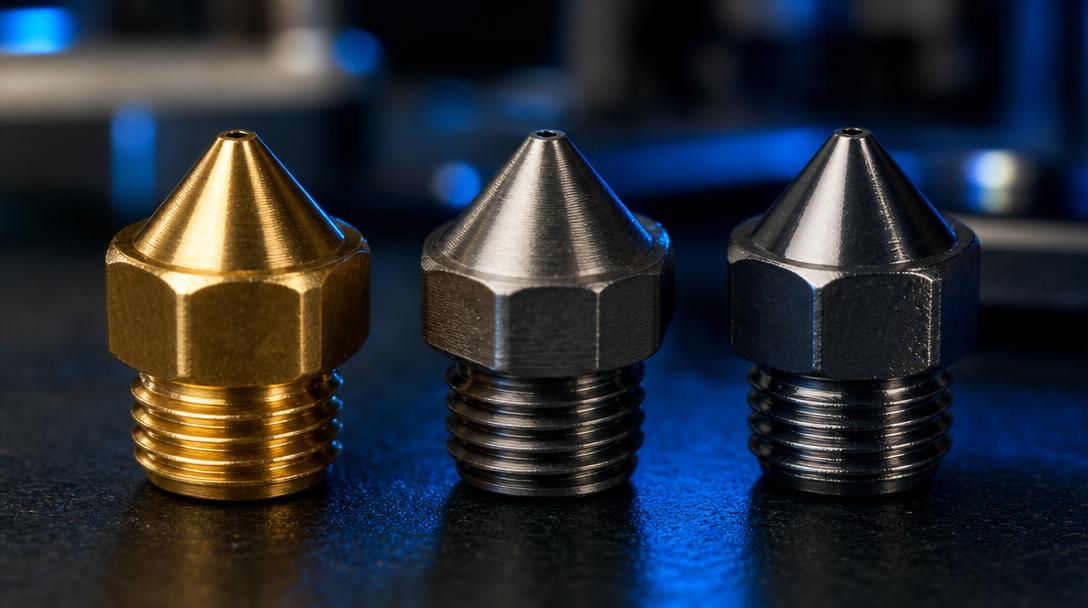
Nozzle Materials: Brass, Hardened Steel and Tungsten
Nozzle material is the most important factor affecting print quality and nozzle life, especially when abrasive filaments are used. There are three main options:
- Brass nozzle: The most common and economical choice. It has high thermal conductivity and is ideal for standard filaments such as PLA, PETG and ABS. However, it wears out quickly when used with carbon fiber, glow-in-the-dark or metal-filled filaments.
- Hardened steel nozzle: The most balanced option for abrasive filaments. With carbon fiber reinforced, wood-filled and glittery filaments, it lasts 5-10 times longer than a brass nozzle. Since its thermal conductivity is lower than brass, you may need to raise the printing temperature by 5-10 °C.
- Tungsten carbide nozzle: The hardest type of nozzle. It barely wears at all and has better thermal conductivity than hardened steel. It is especially economical in the long run for workshops that continuously print abrasive filaments.
Nozzle Diameter Selection: Is 0.4 mm the Standard, or 0.6 or 0.8 mm?
Most FDM printers come with a 0.4 mm nozzle, and this diameter is ideal for the detail-speed balance. However, different diameters can offer advantages depending on your job:
- 0.4 mm: General-purpose use. Suitable for fine detail, precision parts and prototypes. A layer height in the 0.12-0.28 mm range is ideal.
- 0.6 mm: Preferred for faster printing and stronger parts. Even if the wall count stays the same, the perimeters become wider. It is a good choice for functional parts, jigs and fixtures.
- 0.8 mm: Ideal for the fast printing of large, durable parts. The layer height can go up to 0.32-0.48 mm, halving the print time. It stands out for industrial parts, boxes and enclosures where some loss of detail is acceptable.
Industry Developments: Hardened Components and Industrial Nozzle Technology
The recent spread of abrasive filaments has brought innovations in nozzle technology along with it. Manufacturers such as E3D are developing DLC (diamond-like carbon) coated extruder gears and hardened nozzle sets for Bambu Lab printers. Upgrades like these make it possible to use carbon fiber reinforced filaments safely on continuous production lines.
Meanwhile, tungsten carbide nozzles, which used to be found only in industrial printers, are now becoming common for desktop FDM printers as well. Thanks to their long life, they greatly reduce the frequency of nozzle changes, especially for prototype workshops and companies doing small-scale production. If you regularly print with materials such as carbon fiber reinforced filament, thinking of your nozzle investment over the long term will protect your budget.
When Should a Nozzle Be Replaced?
Spotting a worn nozzle is not always easy. The following signs indicate that it is time for a nozzle change:
- Continuously repeating lines or grooves on the printed surface
- Inconsistency in the amount of extrusion (too little flow then too much)
- Deterioration of first-layer spreading
- Visible widening of the nozzle hole (measurable with calipers)
- During filament diameter checks, the filament coming out of the nozzle being crooked rather than evenly cylindrical
Brass nozzles last 300-500 hours with standard filaments and 50-100 hours with abrasive filaments. Hardened steel nozzles, on the other hand, can be used for 500+ hours with abrasive filaments. Tungsten carbide nozzles push this figure beyond 2000 hours.
Nozzle selection and maintenance is one of the cornerstones of quality in FDM printing. By choosing the right material and diameter for your job, you can both improve your print quality and reduce the frequency of nozzle changes. If you would like to determine the most suitable material and nozzle combination for your own project, we at Ucuz3D can help you with our printing with engineering materials options. You can also use our instant price calculation tool to see the per-gram cost of your design in seconds.
For more information about nozzle wear and proper maintenance methods, take a look at our guide on nozzle sizes and their effect on printing.



 Türkçe
 العربية
 Русский
 فارسی
فارسی Deutsch