3D-Printed Floating Harness for Georgia Sea Turtle: The Power of Custom Design
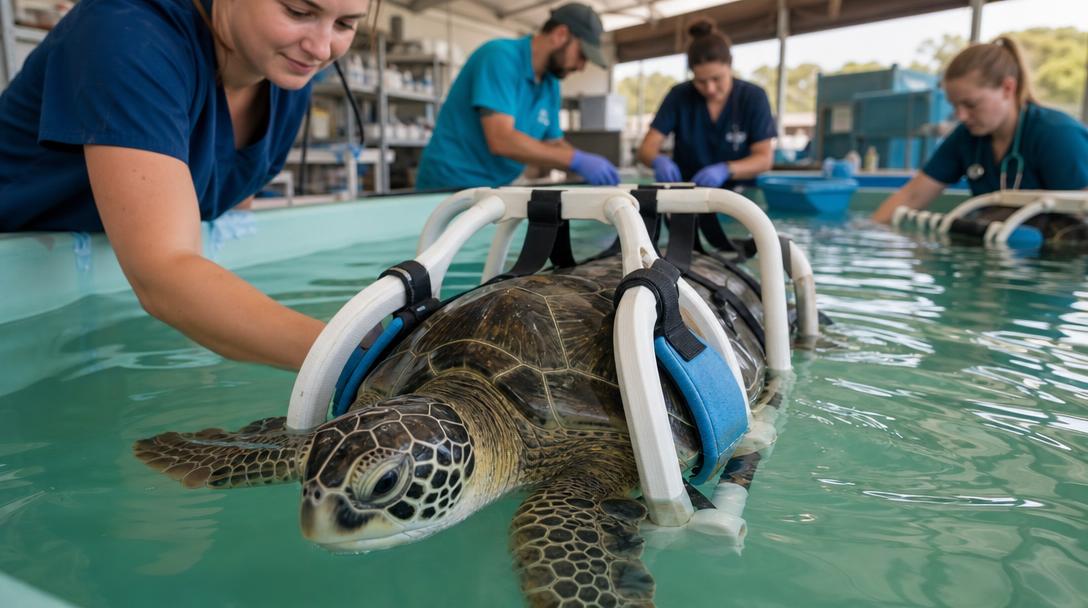
The Georgia Sea Turtle Center developed a custom floating harness for a young green sea turtle that lost the ability to swim after being struck by a boat. Spinal trauma made it difficult for the turtle, named Cebu, to swim safely at normal water depths. The center’s veterinary and conservation teams used 3D-printing capabilities to create a solution suited to the animal’s shell and rehabilitation needs.
The news was published by VoxelMatters on September 19, 2026. According to Georgia Sea Turtle Center director Jaynie L. Gaskin, Cebu was initially kept in very shallow water and, during some periods, could not be placed in water at all. As recovery progressed, the team wanted the turtle to be able to undergo physical therapy in deeper water using natural flipper movements.
Why wasn’t a ready-made device enough?
During the early stages of rehabilitation, flotation equipment or continuous human support could be used. However, these options were not ideal for long-term use. Providing constant manual support could tire the animal, while standard flotation devices could create unwanted pressure or friction on the delicate shell. Cebu’s body structure and limited mobility required a device designed to specific measurements rather than a general-purpose product.
Here, the value of 3D printing lies not only in producing the part quickly, but also in being able to modify the design for the specific case. The harness’s flotation points, connection areas, and contact surfaces can be remodelled whenever necessary. Because the veterinary team’s observations after the first trial could be incorporated into the design, production could proceed without depending on a one-time mould investment. This approach shows why desktop FDM printing is attracting attention for assistive devices that require low-volume production and extensive customization.
What does this example tell 3D-printing users?
- The use case comes first: The choice of material or printer should be made only after determining whether the part will operate in water, under impact, in sunlight, or under continuous contact.
- Contact surfaces can be critical: For parts that come into contact with a living being, skin, or a sensitive surface, sharp edges, layer orientation, surface roughness, and connection security should be evaluated separately.
- A prototype and an end-use product are not the same thing: The fact that a 3D-printed device works physically does not mean it is safe or clinically suitable under all conditions. The design should be validated by a veterinary or relevant specialist team.
- Iterative production provides an advantage: Being able to obtain a new version when dimensions change or the balance point needs to be readjusted can save significant time in custom solutions.
A project like this also reminds us that 3D printing is not limited to producing decorative models or prototypes. Sometimes, the value of a part is determined not by the amount of filament used, but by its ability to enable rehabilitation by fitting the right person or the right animal. The same idea can also apply to orthopaedic aids, accessibility devices, custom-sized holders, and educational models.
Decision sequence when producing a similar part
- Determine the dimensions and contact points safely.
- Define in writing the load the part will carry, how long it will be exposed to water or moisture, and the possible impacts it may experience.
- Design a geometry that reduces sharp edges and has connections that can be inspected and cleaned.
- Choose the material not only for ease of printing, but also according to the actual conditions of use.
- Do not test the part on a living being without expert supervision.
If you would like to have a device, enclosure, or prototype with finalized dimensions produced externally, you can explore the 3d printing service option. Reviewing the part’s estimated material consumption and the price per gram model can make budget decisions easier for low-volume production. Once your file is ready, you can start the pre-production quotation process through the online 3d printing tool. You can also review the our printing materials page for general material options.


 Türkçe
 العربية
 Русский
 فارسی
فارسی Deutsch