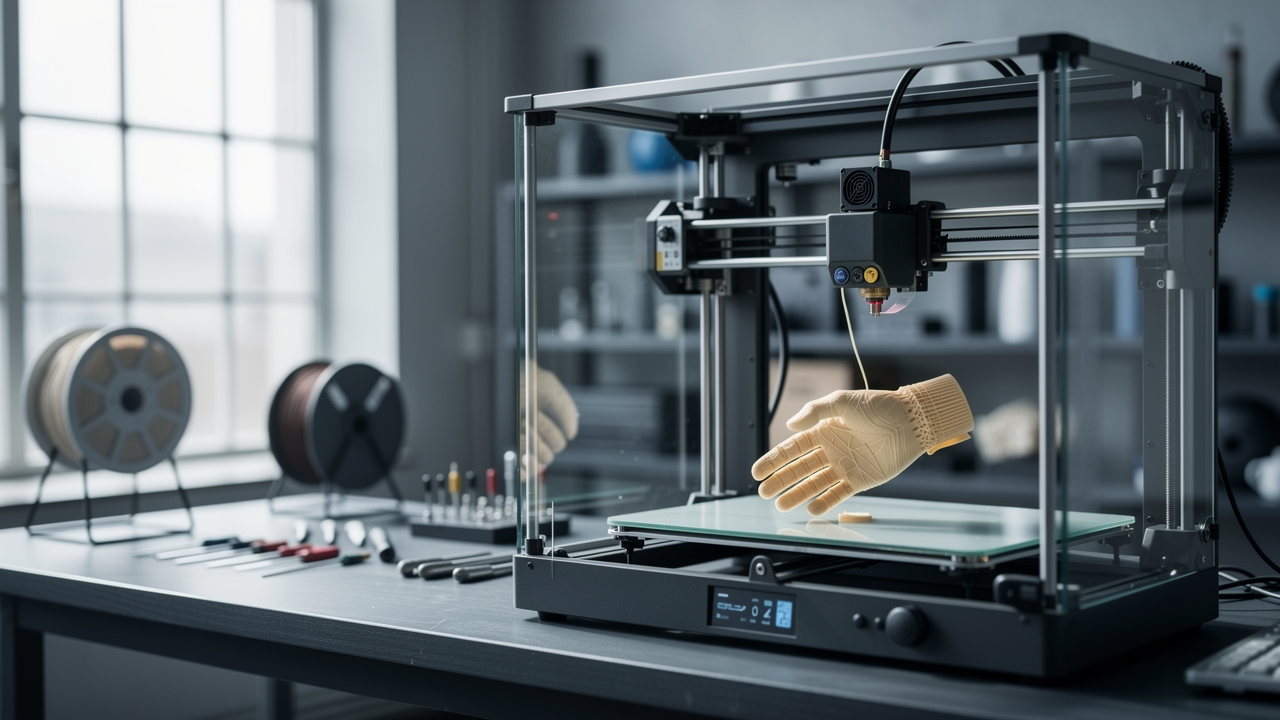

Why the Stratasys and Limbitless Partnership Matters: 3D Printing Is Becoming More Accessible in Pediatric Prosthetics
According to 3D Printing Industry’s August 20, 2026 report, Stratasys and Limbitless Solutions at the University of Central Florida have expanded their 12-year collaboration focused on producing 3D printed prosthetics for children. From Ucuz3D’s perspective, the value of this news is not just that it is a “well-intentioned partnership”; it also shows how 3D printing is used in a medical product workflow that is genuinely functional, scalable, and repeatable.
This matters for the desktop and industrial FDM ecosystem because pediatric prosthetics are a difficult area in traditional manufacturing due to cost, lead times, and the need for frequent replacement as children grow. 3D printing, by contrast, turns the advantages of customization, rapid iteration, and low-volume production into a clear social benefit. If you are also looking for a 3d printing service for a custom-sized part, a product that requires personal fit, or a low-volume functional solution, this news explains very well why 3D printing should be approached differently from standard mold-based production.
What is the main point that stands out in the news?
At the center of the story is Stratasys donating an F370 printer from its Certified Pre-Owned program to support Limbitless operations. But this is not simply about adding a new machine. The more important aspect is that materials, engineering support, training, and production infrastructure have all grown together within the same workflow over many years. In other words, this is not a one-time demonstration; it is a mature production model.
According to 3D Printing Industry, Limbitless has evolved over the years from a small university lab into a production and training structure operating with multiple printers. This transformation shows that 3D printing can create value not only in prototyping but also in end-use parts delivered to real users.
Why does 3D printing stand out in pediatric prosthetics?
Because as children grow, their prosthetic needs do not remain fixed. In the traditional approach, every new size change can create serious pressure in terms of time and cost. With 3D printing, revisions on the digital model, remanufacturing, and personal customization can move much faster. This is exactly where additive manufacturing is strongest: products that are non-standard, personalized, and need to be updated again and again.
The report also notes that Limbitless uses ABS-based parts, allowing it to produce prosthetic components that are safe, durable, lightweight, and paintable. This is important because material selection here affects not only mechanical performance, but also how well the child accepts the product. A customizable appearance helps make the prosthetic not only functional, but also more psychologically acceptable.
What does this news say from a commercial and technical perspective?
First, 3D printing continues to offer a serious advantage in products that require low volumes but high adaptation. Second, the real value is not only in the printer itself; it is created across the chain of file preparation, measurement, material selection, post-processing, and delivering the right final product to the user. On the Ucuz3D side, this is also the point customers confuse most often: production cost is not only the raw filament weight.
That is why, in similar projects, when looking at affordable 3d printing prices or a per-gram pricing logic, the part’s level of customization and the repeat-production scenario should also be taken into account. Especially for parts that come into contact with people, depend on measurements, or fall outside standard series production, workflow quality can often be more decisive than the material price itself.
What should Ucuz3D readers take away from this?
This news is another reminder that 3D printing is not only a rapid prototyping tool. When the right process is established, it can become a much more agile production method for personalized medical support products, educational models, and low-volume functional solutions. In the same way, for engineering and functional part needs, the engineering materials 3d printing approach should be considered differently from standard decorative prints.
If you are also evaluating whether your part requires an investment in a desktop printer or outsourced production, the healthiest path is often to test the scenario directly in the online 3d printing workflow. The Stratasys-Limbitless news tells us this: the real strength of 3D printing lies in its ability to turn a personalized need into a fast and sustainable production model.


 Türkçe
 العربية
 Русский
 فارسی
فارسی Deutsch