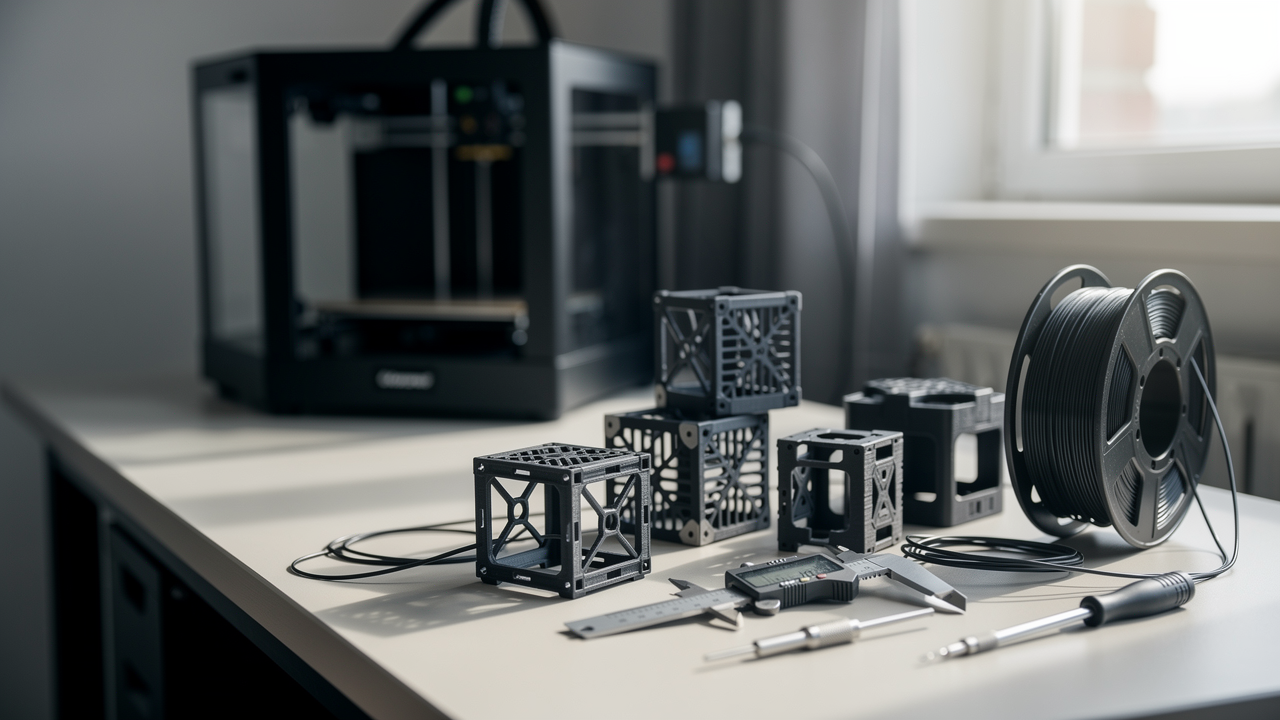

A New Threshold for FFF in CubeSat Structures: How ROBOZE and NESST Validated a Space-Grade Structure with Carbon PEEK
It has long been debated how far high-performance polymers can go on the FDM/FFF side. According to the TCT Magazine report dated 5 August 2026, the Italian space startup NESST Srl designed, manufactured, and validated a CubeSat 3U structure in a project supported by the Italian Space Agency and the European Space Agency. The critical point here is that the structural parts were produced on the ROBOZE ARGO 500 platform using the FFF process with Carbon PEEK.
What makes this news important is not just the phrase “3D printing for space.” The truly striking part is the claim that high-performance polymer parts printed with FFF delivered mechanical performance comparable to traditional aluminum alloys. In addition, the material is reported to meet outgassing requirements considered critical for space applications. In other words, this is not about desktop hobby printing; it is a serious engineering workflow built on process control, material characterization, and validation steps.
Why does this matter for Ucuz3D readers?
This development shows that FDM/FFF is not limited to prototyping and, with the right material and the right process, can also move toward more demanding functional parts. Of course, Carbon PEEK and similar materials are not part of every workshop’s daily routine. But the takeaway is very clear: when material selection, print parameters, and application requirements are considered together, the role of additive manufacturing grows significantly. The same logic also applies to more accessible engineering plastics. If your part will face load, heat, or chemical exposure, you should first look at suitable engineering materials.
This news sends a strong signal especially for jobs that require low-volume production, fast iteration, and geometric freedom. Internal channels, lightweight structures, or consolidated geometries that simplify assembly and become more difficult in traditional machining can become more accessible with FDM-based production. Even though the application is in the space sector, the same way of thinking can also be adapted to industrial parts such as fixtures, enclosures, test apparatus, and custom carriers.
Why do Carbon PEEK and process discipline stand out?
Carbon-reinforced PEEK-based filaments stand out for reasons such as high temperature resistance, rigidity, and dimensional stability, but they are also difficult to print. They require high nozzle and chamber temperatures, a controlled environment, and repeatable parameters. That is why the news is important not only for the material name itself, but also for the “validation” part. Because buying a high-performance filament and producing reliable parts from it are not the same thing.
On the Ucuz3D side, when choosing the right method for a part, it is generally best to first look at the use scenario. Will the part actually carry a load, be exposed to heat, work outdoors, and how many units will be needed? The answers to these questions directly affect both the scope of the 3d printing service and the material choices. On the cost side, it is not only the raw filament that matters; the number of trials, print time, and the risk of failed prints are also decisive. That is why, instead of memorizing fixed figures, it is healthier to think in terms of the per-gram pricing logic on the affordable 3d printing prices page.
3 practical lessons to take from this news
- Material is not everything: The same filament will not meet expectations with a weak process.
- Validation is a critical step: Especially for technical parts, testing, measurement, and application conditions must be evaluated together.
- Geometric freedom is the real advantage: FDM often offers not just low-cost production, but a different design approach.
In conclusion, the ROBOZE and NESST example is a strong field report showing that FFF can move into more critical areas with high-performance polymers. Not every business will start producing CubeSat structures tomorrow; however, validated applications like this clearly show that the limits of FDM are expanding from prototyping toward functional engineering parts. If you would like to see which material and process combination makes sense for your own part, you can quickly make an initial feasibility assessment by getting an instant quote through the online 3d printing flow.


 Türkçe
 العربية
 Русский
 فارسی
فارسی Deutsch