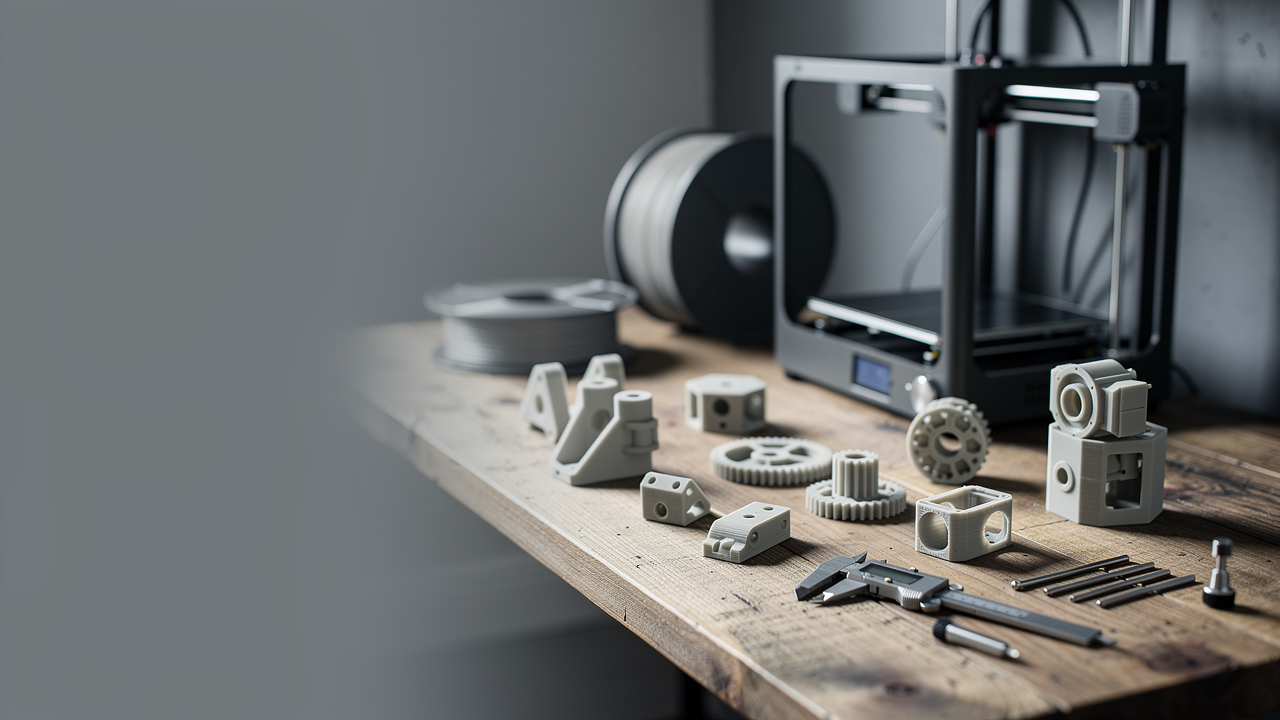

Why Is Solidon3D Getting Attention? How Adapting a Downloaded STL Without Opening CAD Could Affect the 3D Printing Workflow
An STL file downloaded from the internet often does not work exactly the way you want. A hole may be slightly too narrow, a lid may not fit properly, wall thickness may be too weak, or a small dimensional difference may make the part unusable. According to VoxelMatters’ report dated August 22, 2026, Solidon3D is targeting exactly this gap: it aims to turn a downloaded model into a workflow where it can be adjusted, dimensioned, and made more suitable for printing without entering the traditional CAD process.
For Ucuz3D readers, the important part of this news is not simply that a new piece of software has appeared, but that it directly targets the STL workflow bottleneck. In practice, many parts are not designed from scratch; instead, a ready-made model is found and then adapted to real dimensions, a real hole, or a real mounting point. Especially in hobby fixtures, boxes, lids, hangers, connectors, and small 3d printing service requests, the problem often comes not from the print itself, but from the STL not fully matching the real-world need.
What is the core of the news?
Based on what is reported in the article, Solidon3D offers clickable features and a parametric editing logic on the STL itself instead of pushing the user directly into a complex CAD modeling screen. Issues such as holes, pockets, wall thickness, or lid fit can be changed without turning into a geometry battle. The software also stands out with an approach that takes the downloaded file directly from sources such as MakerWorld, Printables, or Thingiverse and brings it into the working scene.
This could speed up everyday decisions, especially without going all the way to reverse engineering, such as “let’s make this model a bit larger,” “let’s change this hole from M4 to M5,” or “let the lid fit tighter.” It may not be a complete solution for everyone; complex mechanical parts or high-precision assemblies may still require professional CAD and dimensioning. Still, its potential to reduce the in-between tasks that waste time in FDM part preparation is noteworthy.
Why does it matter for the 3D print ordering workflow?
In Turkey, many users get stuck at the same point before printing: the model exists, but it is not ready for printing. This is exactly where file quality, part orientation, and dimensional accuracy become critical in the online 3d printing workflow. If the file is prepared in a more print-ready way, both the need for trial prints may decrease and the decision-making process may speed up.
The same situation also affects the cost side. When part print time, support requirements, failed print risk, and the number of repeat attempts go down, the overall production logic improves. That is why users should look not only at affordable 3d printing prices, but also at how ready the file is for production. A well-prepared STL often creates a greater cost advantage than it first appears.
What should Ucuz3D readers take away from this development?
- A ready STL is not always a production-ready file. A model that looks correct visually may cause problems in a real assembly.
- Small dimensional changes are highly critical. Hole diameter, clearance for fit, wall thickness, and lid tolerance determine the outcome in an FDM part.
- Parametric correction tools are becoming more valuable. For users who do not know how to model from scratch, this type of software may give the file a second chance without throwing it away.
- Material selection is still a separate issue. Even if the STL is fixed, questions remain: will the part be used outdoors, will it take impact, or will it be exposed to heat? At that point, the choice should be made according to the options on the our printing materials page.
What is the real signal?
In my view, the real value of this news is that it makes it visible once again that the new bottleneck in 3D printing is not so much the printer as file preparation. Desktop FDM printers have become faster, multi-color systems have increased, and material options have expanded. In contrast, a significant number of users still get stuck at the stage of “turning a good-looking STL into a working part.” Solidon3D is newsworthy because it targets this pain point.
In short, this development is worth watching, especially for those who want to produce functional prototypes or spare parts from ready-made models. It would not be right to assume that it will solve every file magically; however, its claim to shorten the distance between a user with limited CAD knowledge and a production-ready result is a genuinely meaningful topic in today’s FDM workflow.


 Türkçe
 العربية
 Русский
 فارسی
فارسی Deutsch