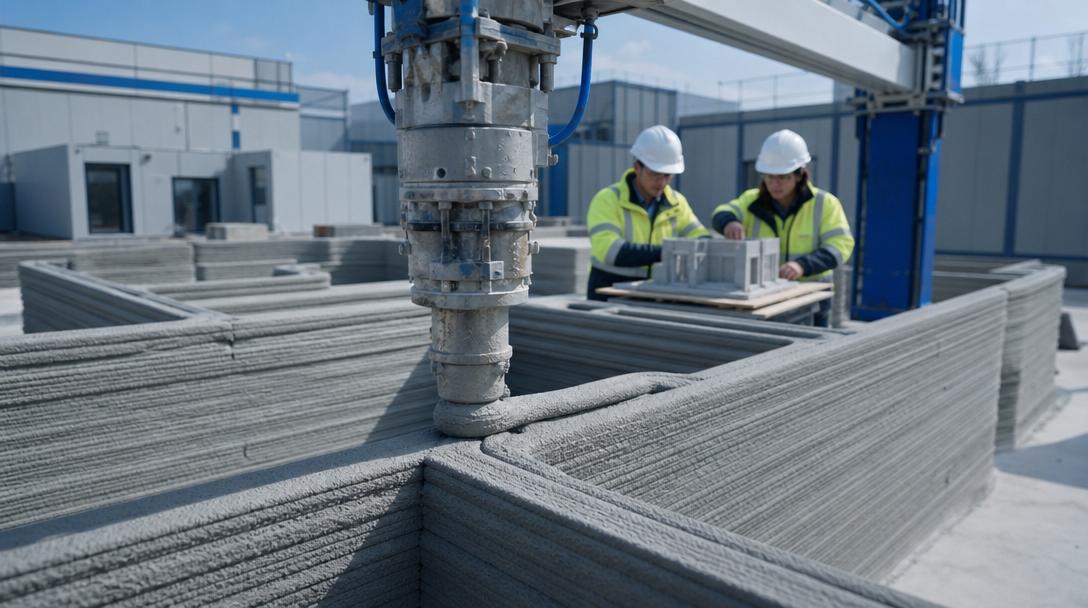

Why Is Prototype 3D Printing Rising Again in Construction? Titan America’s xForm3D Move
Prototype 3D printing remains one of the first steps that speeds up decision-making, even in heavy-scale fields like construction. The xForm3D product family that Titan America announced on June 24 shows that concrete 3D printing is no longer only for demonstration purposes; it is now positioned as a more systematic production tool for housing, infrastructure and coastal applications.
Why does Titan America’s xForm3D announcement matter?
According to the announcement shared in TCT Magazine, Titan America introduced a family of 3D-printable concrete products under the name xForm3D. The family includes Standard for general automated construction applications, Marine for sea and underwater conditions, and the RMX variant with coarser aggregate that can be delivered to site by ready-mix concrete truck. The company’s core message is clear: less need for traditional formwork, higher speed, more consistent production and greater flexibility on the design side.
This development shows that 3D printing is being taken more seriously, especially in modular construction, infrastructure elements and repetitive on-site components. Final production in construction may be shifting toward concrete; however, the role of fast FDM prototypes — where you can request a quote right away for design validation, connection trials, small assembly aids and pre-site mock-up parts — is still very strong.
What does this news mean for an Ucuz3D customer?
At first glance, concrete 3D printing news may seem far removed from desktop or service-type filament printing. In practice, though, large-scale production projects progress through small-scale learning loops first. A wall joint, a cable pass-through detail, a mold edge, a sensor housing or an assembly fixture is first tested with a plastic prototype; once the solution that works in the field is validated, larger production methods take over. That is why, among our 3D printing applications across different sectors, construction, architectural models, on-site fixtures and custom connection parts hold an increasingly meaningful place.
- Speed: Design changes can be seen before making a large mold investment.
- Cost control: Risky geometries can be tested with low-cost prototypes before moving to final production.
- Easier communication: Teams decide based on a model they can hold in their hands instead of a 2D drawing.
- Field compatibility: Assembly aids, covers, temporary fixtures and dimensional check parts can be prepared quickly.
Where does real value form with FDM?
Since Ucuz3D’s focus is FDM, this news should not be read as “we are printing concrete”; the right reading is that a serious ecosystem of auxiliary parts and prototypes is forming around large-scale additive manufacturing projects. Especially for architectural models, prototypes of connection details, sensor boxes, cable-routing parts, dimensional check fixtures and low-volume field equipment, filament-based production offers a much more accessible starting point.
From this perspective, the Advantages of 3D Printing in Prototyping guide in our Knowledge Center provides a good framework: the earlier the uncertainty that delays decisions turns into a physical part, the more smoothly the subsequent production steps proceed. Titan America’s xForm3D launch shows exactly that the large-scale side of this chain is accelerating.
Conclusion
In short, the xForm3D announcement shows that 3D printing is moving to a more operational point on the construction and infrastructure side. If you, too, want to quickly see a building detail, an assembly fixture, a model or a custom connection part before production, starting with a small-scale FDM prototype can be one of the most practical steps.


 Türkçe
 العربية
 Русский
 فارسی
فارسی Deutsch