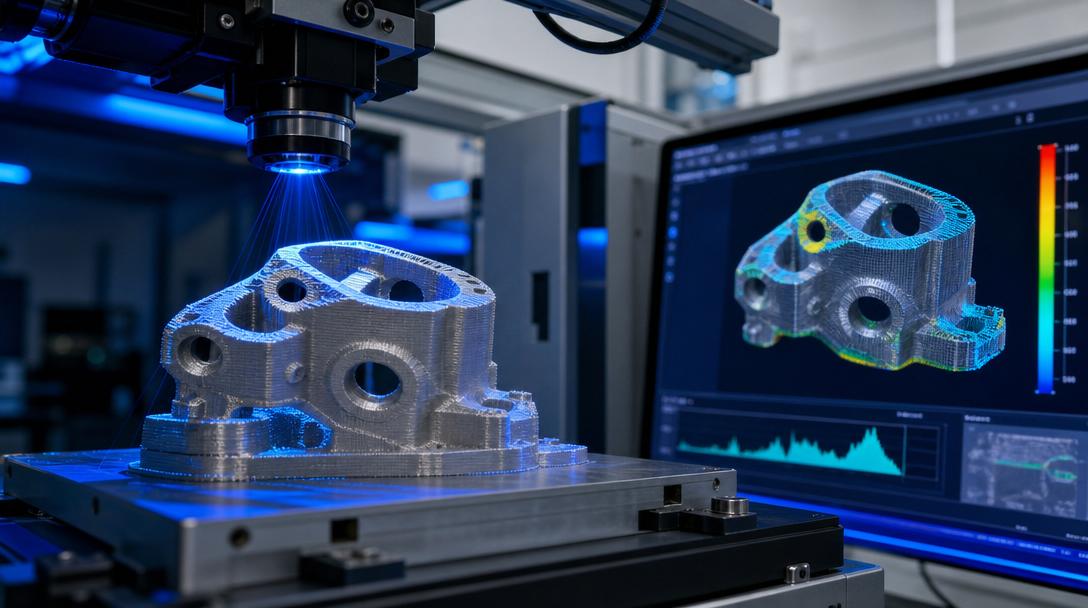

Why is in-process quality control gaining ground in 3D printing? What does Phase3D’s new funding tell us?
In-process quality control in 3D printing aims to catch defects during production rather than spotting them after the part is finished. The $2.9 million funding round Phase3D announced on June 22, 2026 shows exactly how this need is growing: as you move from prototype to small-batch production, measurement and monitoring are no longer just a concern for large factories.
Why does Phase3D’s announcement matter?
According to the news in TCT Magazine, Phase3D raised $2.9 million in an oversubscribed funding round and will use the capital to grow its software, data science and production capacity. The company aims in particular to scale its system that collects quality data during production in metal additive manufacturing. The news is not directly tied to the technology used by Ucuz3D, which provides FDM service; however, the message is very clear: customers no longer care only about “was the part printed?” but also about “how consistent is the part, how repeatable is it, and were any error signals detected during production?”
This approach is highly familiar on the FDM side too. A prototype may look good visually on the first try; but if assembly clearances, layer orientation, shrinkage allowance or surface accuracy are not checked, getting the same result on the second and third iteration becomes harder. Process discipline is just as decisive as print quality, especially for functional fixtures, enclosures, test jigs and low-volume spare parts.
How should “in-process quality control” be approached in FDM projects?
What makes Phase3D’s scaling move important is that it does not leave quality control until after printing. The direct equivalent in FDM projects is to check the file correctly before printing starts, monitor critical parameters during printing, and not skip dimensional verification after the part comes out. Especially if your prototype parts will later turn into series-like, low-volume production, this discipline significantly reduces wasted time and cost.
- Design accuracy: Wall thickness, tolerances and fit clearances should be checked before printing even begins.
- Material suitability: While PLA is enough for a visual mock-up, applications exposed to heat and impact may require PETG, ASA, nylon or carbon-fiber reinforced options.
- Process repeatability: Getting a similar result on the second print of the same part is the foundation of real production confidence.
- End-use focus: Whether the part is purely for testing, or it will be a fixture or enclosure that does real work in the field, must be clarified from the outset.
What is the practical takeaway of this news for Ucuz3D?
At Ucuz3D, it matters not just that a part is printed, but that it is handled with the right material and the right printing approach according to its use case. For example, clarifying tolerances early for a prototype that will go into assembly or a low-volume functional part reduces the need to reprint later. That is why, before turning the project into an order, you can request a quote right away and, by sharing your part’s intended use, work out the most suitable production approach together.
Similarly, in automotive, test rigs and operational equipment, the expectation of repeatability rises even further. In such applications, it is easy to see why 3D printing solutions in automotive often go beyond rapid prototyping. If your part’s dimensional fit is critical, on the design side the What Is Tolerance? How to Design Interlocking Parts? guide also makes decision-making easier.
Conclusion: even though the news comes from metal AM, the lesson applies to the entire 3D printing world
Phase3D’s funding news shows that quality assurance tools in additive manufacturing are no longer a side note. In FDM projects too, a good result comes from combining the right model, the right material and a controlled production process. If you also want to set up the right production approach from the start for your prototype or functional part needs, you can share your project details with Ucuz3D and move the process forward with less trial and more clarity.



 Türkçe
 العربية
 Русский
 فارسی
فارسی Deutsch