
A New Step for Spare Part 3D Printing: What Does Austal’s Maritime and Defense Supply Chain Project Tell Us?
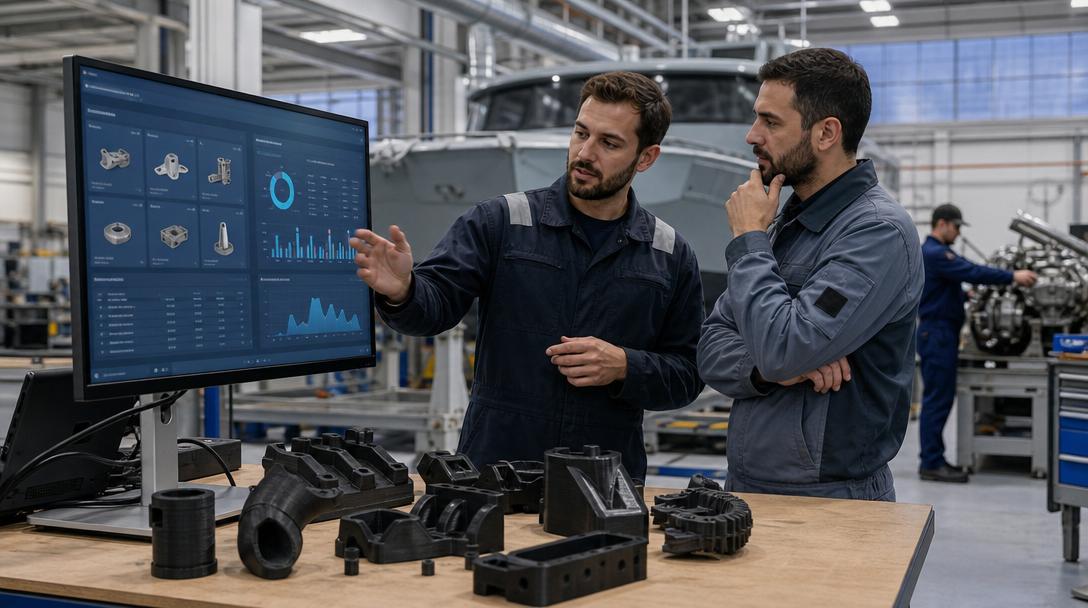
Spare part 3D printing is back on the agenda, especially when it comes to low-volume, critical parts with slow procurement times. The new research project launched by Austal, Curtin University and AMCRC targets exactly this: systematically determining which parts in maritime and defense supply chains are genuinely suitable for additive manufacturing.
According to the report published in TCT Magazine on June 25, 2026, the project will spend 18 months developing a practical decision framework capable of evaluating thousands of parts against operational, commercial and engineering criteria. The critical point here is that the question has shifted from “does 3D printing work?” to “on which part, under which conditions, does it produce which business impact?” This approach matters not only for large defense programs, but also for many manufacturers with needs in maintenance and repair, spare parts, enclosures, fixtures and prototypes.
Why does it matter?
In additive manufacturing, the biggest gain often lies not in printing every part, but in producing the right part at the right moment. Parts with long lead times, parts that are expensive to keep in stock, or parts that are hard to produce with traditional methods due to their geometry come to the fore. That is why Austal’s approach shows that 3D printing has moved beyond a technology showcase and become part of concrete purchasing and production decisions.
- It can reduce the need for tooling on low-volume parts
- It can shorten waiting times in maintenance processes
- It can ease physical stock pressure through a digital inventory mindset
- It can speed up prototype and functional validation cycles
From the perspective of Ucuz3D, the closest equivalent of this is functional enclosures, assembly fixtures, protective parts and rapid validation prototypes that can be produced with FDM. Especially when you need an urgent sample or short-deadline production, the request a quote now flow can offer a far more agile starting point than the classic supply chain.
How should it translate to the FDM side?
The framework mentioned in the report does not point directly to a single technology; in practice, however, many organizations start with polymer-based, fast and more accessible production scenarios first. Here, FDM remains a strong option especially for fixtures, auxiliary parts such as air ducts, on-site protectors, covers, boxes and low-volume spare part validations. On the sector application side, it is possible to consider more concrete examples of this together with the use cases on the 3D printing solutions for the defense industry page.
Of course, not every part is suitable for FDM. Requirements such as heat, chemical resistance, tolerance and mechanical load determine the right material choice. That is why the real value of such news is not saying “let’s print everything”; it is proposing a more disciplined approach to deciding which part will be added to the digital inventory, which will be tested as a prototype, and which will be considered as an out-of-series spare part.
What is the takeaway for manufacturers in Turkey?
This development also sends a clear message to local manufacturers: the value of 3D printing lies not just in owning a printer, but in the quality of decisions. If a part needs to be redesigned, a rapid sample taken, or a functional alternative tested for quick replacement, significant time savings can emerge when the process is managed correctly. To better understand the reverse engineering, part fit and geometry validation side in particular, the 3D Printing in Spare Part Production guide also offers a good framework.
In short, this project in partnership with Austal reminds us that the future of 3D printing lies not only in faster machines, but in smarter part selection. If you too want to see whether a specific part, enclosure or prototype idea is suitable for FDM, clarifying the right production path with a short technical assessment is a good first step.


 Türkçe
 العربية
 Русский
 فارسی
فارسی Deutsch