
Why Is FDM Fixture Production Taking Off? At DLA Columbus, Test Apparatus Is Ready in Hours
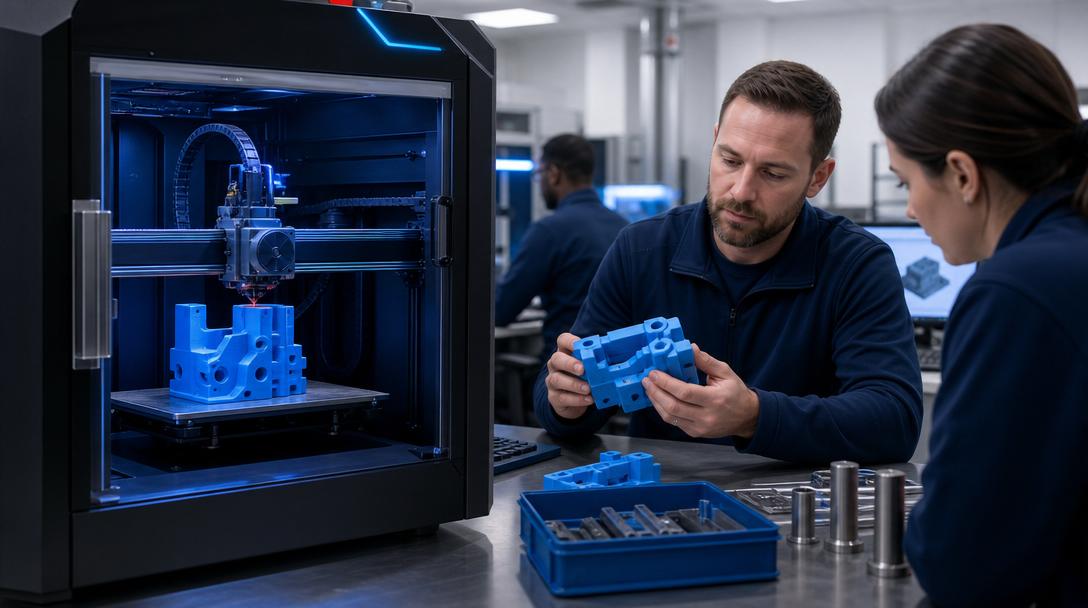
FDM fixture production can cut delivery times for custom test apparatus from weeks down to hours. A news item dated 25 June 2026 reports that the DLA Columbus test center in the USA can produce some fixtures in as little as six hours, offering concrete proof of why 3D printing is taking off for low-volume, speed-driven jobs.
What’s the key development in the news?
According to VoxelMatters, the Product Test Center at DLA’s Columbus facility used to prepare the custom fixtures it relies on for quality assurance via CNC in a matter of weeks or months, but with FDM-based production it has slashed that timeline dramatically. The critical point here isn’t just speed; because a different test requirement can arise every day, flexible production capability for one-off or low-volume apparatus also carries enormous value. This approach shows why 3D printing is increasingly the preferred choice in areas such as pre-production trial rigs, assembly aids and measurement apparatus.
Why does this news matter for Ucuz3D?
This development touches directly on Ucuz3D’s field of service, because parts produced with FDM can be used not only for visual prototypes but also for functional support equipment. Rapid iteration delivers a major advantage especially for jigs, fixtures, enclosures, holders and temporary production aids. If you too need a custom apparatus during product development or testing, you can request a quote right away and draw up a production plan in a short time, subject to technical feasibility. Likewise, for applications such as sensor housings, test-bench parts or custom enclosures, 3D printing solutions tailored to electronics and IoT projects bring the speed advantage described in this news story straight to the field.
FDM is especially meaningful here because it requires no tooling investment for low-volume parts; design revisions are also far easier to manage. When a dimension changes or a new cable outlet is needed, instead of commissioning a brand-new tool you can simply update the digital model and move on to a new print. That saves time for teams running tests, validation and field trials.
What lessons can be drawn from FDM fixture production?
The example described in the news shows that desktop or industrial FDM infrastructure is extremely powerful in the right use case. For a good result, however, part geometry, tolerance and material selection must be planned carefully. The following points are especially important for apparatus that bears loads or will see repeated use:
- Material selection: PLA may be enough for quick trials; for more durable use, PETG, ASA, nylon or carbon-fiber-reinforced options should be considered.
- Orientation: Layer direction directly affects which axis the part will be stressed along.
- Tolerance: If no print allowance is left in press-fit or screwed connections, the fixture can cause problems in the field.
- Revision speed: The fact that the first print doesn’t have to be the final product is one of the biggest advantages of 3D printing.
That’s why, when designing a fixture, you shouldn’t only ask “can it be printed?” but also “how many revisions will it take to reach the right result?” If you’d like to firm up your design decisions at this stage, the What Is Tolerance? How to Design Interlocking Parts guide is a good starting point.
Conclusion
The DLA example shows that FDM fixture production is a method that works not only for prototypes but at the pace of real operations. For custom test apparatus, electronic enclosures and low-volume support parts in particular, 3D printing can offer a serious time advantage. If you want to quickly validate a similar part or get it ready for production, just share your project’s suitable model and you can pin down the best production route in a short time.


 Türkçe
 العربية
 Русский
 فارسی
فارسی Deutsch