
Custom Running Insoles with Flexible 3D Printing: What Does Kila 2.0 Tell Us?
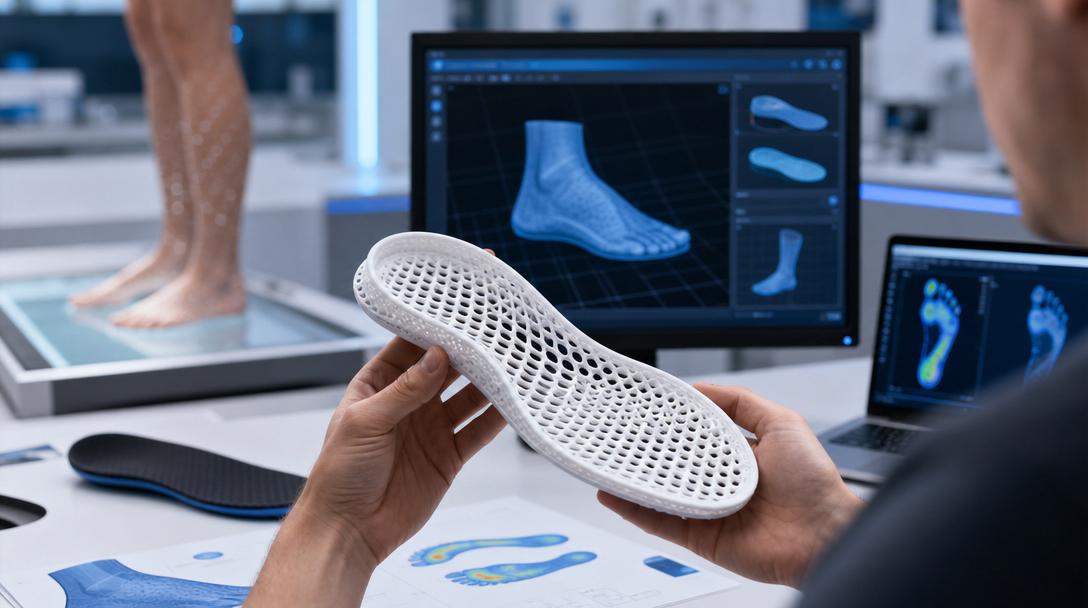
Kila’s Version 2.0 running insole, announced on June 4, 2026, clearly illustrates why flexible 3D printing and digital foot scanning are gaining momentum in custom product development. The news describes a performance product sold to the end user; but the real takeaway is that 3D scan data captured at home is connected directly to production, making it faster to prepare parts tailored to each individual.
What stands out in the Kila 2.0 news?
According to 3D Printing Industry, Kila builds its new running insole on a foam-based material called NanoPEBA. Users scan their feet at home with iPhone FaceID, the data is converted into a digital model, and production is completed at the San Diego facility. The company also highlights updated arch-support mapping in the new version, a reinforced structure suited to high-mileage use, and a faster delivery time.
The second notable point in the news is that the product positions itself as performance-focused, stepping outside the classic orthopedic approach. In other words, the issue here is not just “fitting” the foot; parameters such as energy return during running, weight, and form retention over long use are also built into the design. This shows that 3D printing can merge personalization and an engineering approach within the same workflow.
This approach demonstrates that 3D printing adds value not only for “complex part production” but also for products that require a personalized fit. Shortening the chain from digital measurement to physical product is especially important in areas like running, orthopedic support, wearable equipment, and ergonomic accessories. Similarly, for brands that need flexible or semi-flexible prototypes, TPU flexible printing service can save significant time in early sampling and form-validation processes.
Why is this development important for Ucuz3D?
Because Ucuz3D works with an FDM focus, this news should be read not as a claim that “we produce the same thing,” but in terms of design validation and use-case scenarios. For custom insoles, internal supports, wearable attachments, or auxiliary parts developed around the shape of the foot, the first step is often a rapid prototype. Especially when flexible geometry, base patterns, thickness variations, and iterative revisions based on user feedback are required, FDM-based trial parts speed up the decision process.
The critical lesson here is the shrinking distance between scan data and production. If you have an STL file, a model derived from a scan, or a product idea, it is more efficient to first produce a quick sample based on measurement, geometry, and intended use, then see the test. If you want to gauge the cost side early, you can decide by uploading your model and using the instant price calculator approach. The guide to TPU and flexible filaments is also a good starting point for choosing flexible materials and understanding which option offers an advantage in which use.
There is also an important boundary here: the final product, material formula, and performance promises mentioned in the news are not exactly identical to FDM. Even so, what is valuable from Ucuz3D’s perspective is quickly testing geometry that fits the shape of the foot, testing flexible zones, and gathering user feedback before mass production. In other words, the news highlights the logic of product development more than the technology of the final product.
Practical takeaways from this news
- For custom products, the chain of 3D scan + digital model + rapid printing is becoming more accessible.
- For flexible parts, usage data such as energy return, comfort, and durability—not just appearance—are becoming decisive.
- Instead of a flawless product in one go, reaching the right form through a few rapid iterations often offers a more realistic approach.
Kila’s new version is a current example showing that 3D printing is strengthening the personalization side of sports equipment. If you too are working on a flexible prototype, a wearable part, or a product idea adapted to the user, starting with a small trial run reduces both technical risk and wasted time.


 Türkçe
 العربية
 Русский
 فارسی
فارسی Deutsch