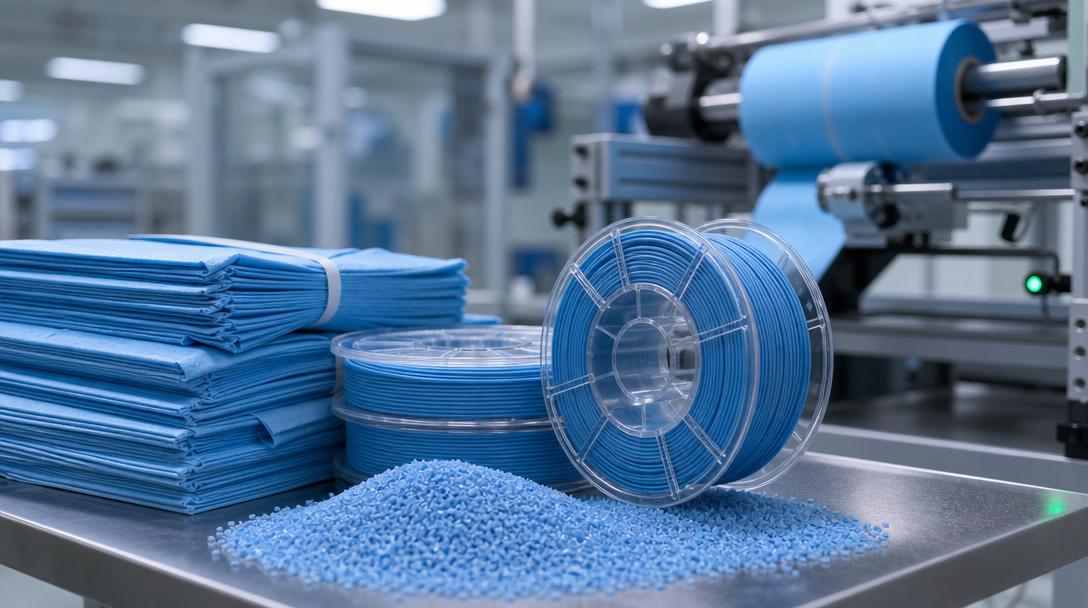

A New Step for Recycled 3D Printing Filament: Hospital Waste Becomes FDM Material
Recycled 3D printing filament is no longer just sustainability talk; a new partnership in the Netherlands is putting forward a concrete model for turning hospital waste into material usable in professional FDM production. For Ucuz3D, the significance is clear: filament quality, the supply chain, and the environmental footprint of low-volume production are all being rethought at once.
The news in brief: why is hospital waste becoming 3D printing filament?
According to IO+’s report dated June 25, 2026, Renewi, Van Straten Medical, O&M Halyard Europe and GreenCycl are working together to collect and reprocess the single-use polypropylene drapes used in operating rooms and sterilization processes, turning them into 3D printing filament. Known as “BlueWrap,” this blue sterilization wrap is normally incinerated after a single use. The new model instead converts this stream from waste into material, aiming for a more circular approach especially in filament-based production.
The striking figure shared in the report is this: a single 600-bed hospital can generate roughly 42 tons of sterilization-wrap waste per year. The partnership’s goal is to cut hospital waste by 15 percent. This is not only an environmental message; it is also a practical industrial scenario showing that plastic streams meeting a defined quality standard can be separated out and brought back into production.
Why is this notable on the FDM side?
For filament-based production services like Ucuz3D, the truly critical point is making the recycled raw material “print-ready.” GreenCycl turns the collected polypropylene drapes into clean, consistent granules; Van Straten Medical then extrudes these granules into GO 3D filament at its facility in De Meern, the Netherlands. In other words, the value of the news goes beyond the sentence “the plastic was recycled”; it lies in positioning the material as a processed product ready for professional 3D printing.
This development is especially important under the following headings:
- Material supply: Single-type polymer streams can deliver more predictable recycling quality.
- Low-volume production: FDM parts such as fixtures, enclosures, prototypes and auxiliary equipment can be produced with more sustainable materials.
- Industry application: A new material line can emerge for organizational equipment, carrier parts and training-oriented support products used around the hospital.
Of course, an important limit applies here: this news does not mean that “every medical part will be printed from recycled filament.” But when the process, material traceability and use case are set up correctly in medical and dental 3D printing applications, it is a strong reminder of just how flexible a production model FDM can offer.
What do the carbon and waste figures tell us?
According to the source, every 1 kilogram of this recycled filament can save roughly 3 kilograms of carbon dioxide compared with production from virgin plastic. What’s more, hospitals are framed not just as institutions that produce waste, but also as stakeholders that reuse the product within this loop. This approach could push local and application-specific filament lines further onto the agenda in the future.
Because material stability directly affects print quality in FDM production, discipline in storage and preparation remains important too. That is why, alongside filament selection, the question of how filament should be stored and how moisture and drying should be managed continues to be critical. As the recycled-material ecosystem grows, not only sustainability but also process discipline will become a competitive advantage.
What’s the takeaway for Ucuz3D?
This news says it directly: in 3D printing, the difference is no longer made only at the printer, but in the origin and traceability of the material. Especially on the prototype, enclosure, auxiliary-part and low-volume production side, FDM can offer a far stronger value proposition when combined with lower-impact, more controlled material streams. If you want to clarify the right filament and production approach for your project, you can share your file via our urgent order page and we can evaluate the most suitable production path together.



 Türkçe
 العربية
 Русский
 فارسی
فارسی Deutsch