
Why does medical 3D printing stand out for surgical planning, as shown by the Bambino Gesù case?
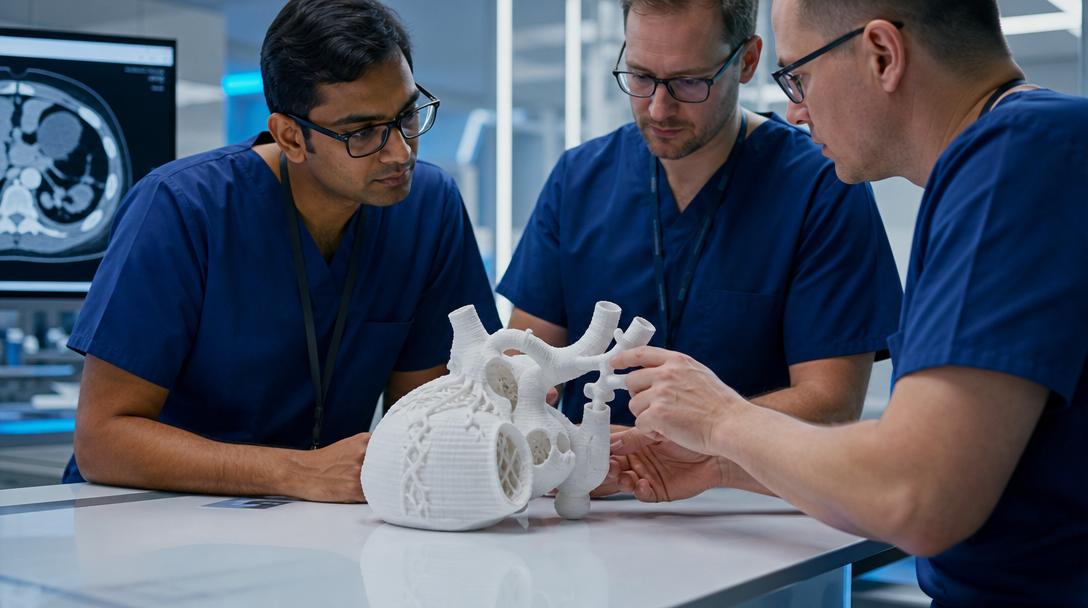
Medical 3D printing is back in the spotlight because it makes it easier for a team to view the same anatomical model and rehearse together before complex operations. A Bambino Gesù-focused review published on 24 June 2026 by 3D ADEPT clearly shows why patient-specific 3D models are so valuable, especially in high-risk surgical preparation.
The article describes how the 3D Laboratory at the Bambino Gesù Children’s Hospital in Rome uses digital modelling and physical prints in extremely complex cases, such as the separation of conjoined twins. The key point is this: when a surgical team works not only with images on a screen but with a model they can hold in their hands, shared decision-making, understanding cross-sections and planning the sequence of the operation all become far more tangible. This approach is a reminder not just for medicine but for fields like prototyping, training models and custom-use fixtures of the “see first, test, then apply” power of 3D printing.
Why does this story matter?
In the example reported by 3D ADEPT, the hospital’s 3D laboratory brings doctors, engineers and biotechnology specialists together in the same workflow. But the broader message is bigger: beyond standard parts, 3D printing makes a difference whenever each case or project needs its own physical validation. Especially when the geometry is complex, internal volumes are critical, or teams have to make decisions together on the same object, a physical model can save serious time.
- Provides visual clarity: it carries volume and relationships that 2D images struggle to convey into a physical model.
- Speeds up the decision process: it makes it easier for different teams to talk about the same part or anatomy.
- Allows rehearsal and validation: it lets you see critical steps before the final application.
- Suits low-volume custom production: it delivers a solution for one-off needs without waiting for a mould.
What is the lesson for Ucuz3D?
Because Ucuz3D focuses on FDM, this story should not be read as “producing the exact same medical solution one-to-one.” The right reading is this: as the need for person- or project-specific physical models grows, rapid prototyping and low-volume custom production become even more valuable. This approach is very powerful for teams who want to see form and function first, in fields such as medical, education, device housings, assembly fixtures or promotional models.
For example, in a medical or technical project, if you need to check dimensions, access, grip or placement before moving to the final part, our medical and dental focused 3D printing application page offers a good starting point. Similarly, for teams who want to quickly validate how a part works, our guide on the advantages of 3D printing in prototyping explains, in a more lasting framework, why a physical model speeds up decision-making.
Which types of jobs make sense with FDM?
After stories like this, the most common question is, “At which stage does 3D printing make sense in our project?” On the FDM side, the most sensible use cases are usually these: pre-assembly mock-up models, training/demonstration parts, housings that fit around a device, low-volume custom fixtures and prototypes that require dimensional checks. In other words, value appears not only in the final product but also in the intermediate models that lower decision risk early on.
If you, too, want to quickly test a part’s geometry validation, ergonomics of use or internal team presentation, you can request a quote right away by sharing your file or rough dimensions. Especially on complex projects, seeing the physical model early can make the next steps far safer.


 Türkçe
 العربية
 Русский
 فارسی
فارسی Deutsch