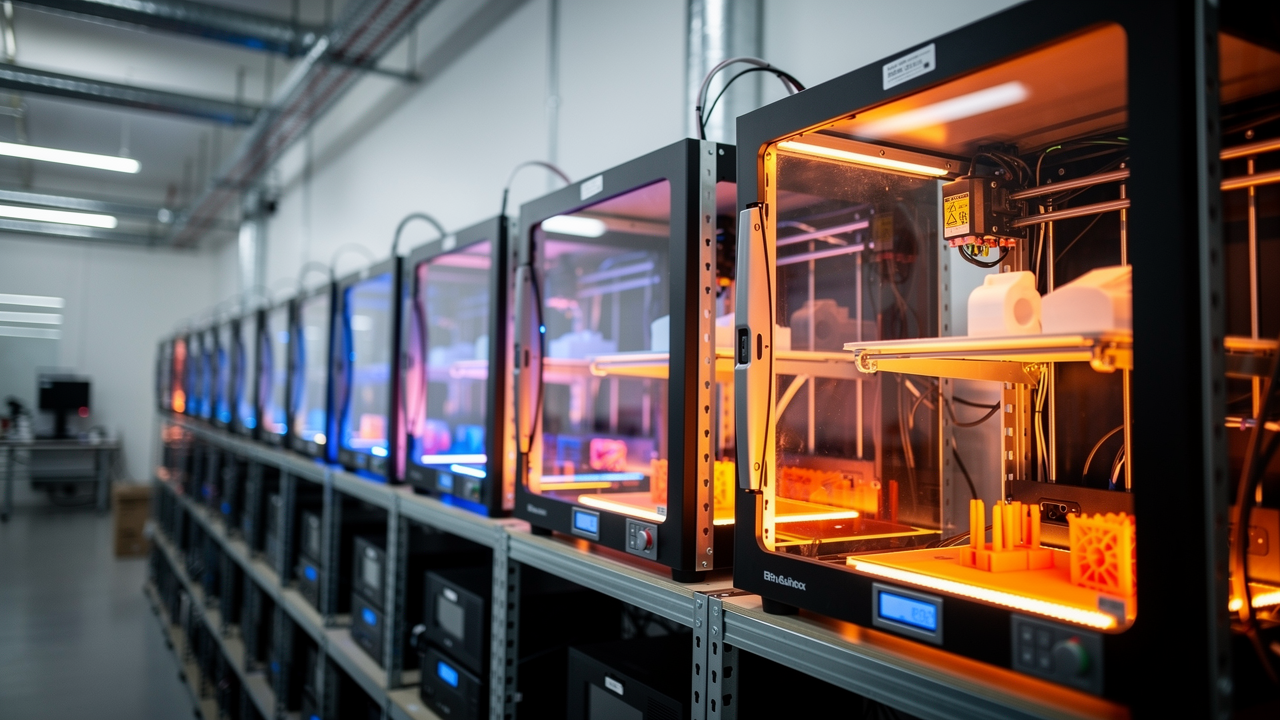

The Speed Race for Prototype 3D Printing: What Do Case Western’s 24 New Bambu Printers Tell Us?
On the prototype 3D printing side, speed, repeatability and material choice remain the three most critical factors. To meet this demand, the Sears think[box] at Case Western Reserve University has added 24 new Bambu Lab printers to its prototyping area. And that is exactly where the significance lies: the desktop FDM fleet is no longer just a “hobby” tool, but is being positioned as a direct part of the rapid product development workflow.
According to the university’s June 12 announcement, the new setup replaces the older Ultimaker machines and went live after months of testing and user feedback. The headline features include higher print speeds, multi-color production, compatibility with engineering-grade materials and AI-assisted error detection. For teams that want to run several prototype cycles within a single day, these four elements can make a serious efficiency difference on the desktop FDM side.
The emphasis on print speeds reaching 1,000 mm/s, mentioned in the announcement, is also striking. Of course, real part quality is not determined by the nominal speed value alone; nozzle, layer height, cooling and material character all have to be evaluated together. Still, the fact that institutions are adding systems at this level to their prototyping fleet shows that the “fast FDM” approach has moved beyond experimentation and settled into daily workflows.
Why does this news matter?
In prototyping processes, the real bottleneck is often not simply getting a print done; it is spotting the design flaw quickly, reproducing the new revision without delay, and being able to switch to a more durable material when needed. That is why a new fleet of 24 printers tells more than a single-device story. Institutions are now taking FDM infrastructure out of the education-lab mindset and placing it into real product development, jig production and test-part preparation workflows.
- Shorter iteration time accelerates design decisions.
- Multi-color printing makes it easier to test assembly logic and visual differentiation at an early stage.
- Engineering-grade filament compatibility supports not just appearance models but functional prototype production as well.
- Automatic error detection can reduce time and material loss during long prints.
This approach also reminds teams developing products in Turkey of a familiar need: the faster you move from the idea stage to a test part, the sooner you get field feedback. That is exactly why the request a quote now flow matters when you need an urgent prototype, enclosure or fixture. If the part needs to be more durable, more heat-resistant or more functional, turning to printing with engineering materials options can deliver a better result.
What is the takeaway for Ucuz3D?
The news here says it directly: prototype 3D printing is no longer just a “let’s print a model” service, but an operational tool that sets the pace of product development. Especially on the FDM side, when the right material and the right print strategy are chosen, electronics enclosures, assembly jigs, test fixtures, small-batch validation parts and spare-part trials can all progress much faster. That is why, when planning a prototype, you should look not only at geometry but also at print orientation, layer structure and the usage scenario; this evergreen guide is useful for that: The Advantages of 3D Printing in Prototyping.
In short, Case Western’s move shows just how mature the desktop FDM ecosystem has become for high-tempo prototyping. If you too want to see a new product quickly, validate the first sample in a short time, or try a functional part with FDM, a short technical brief may be all you need to start the process correctly.


 Türkçe
 العربية
 Русский
 فارسی
فارسی Deutsch