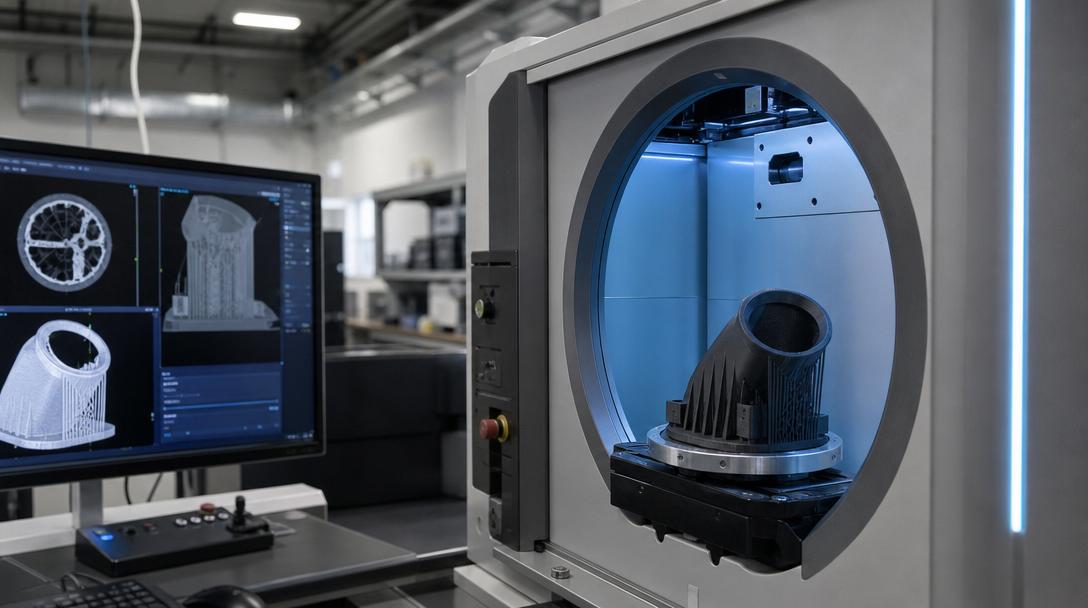

A New Step for Prototype 3D Printing Quality Control: What Do Lumafield’s X-Ray CT Platforms Reveal?
Prototype 3D printing quality control is no longer just a final-stage inspection step—especially when internal cavities, fit tolerances and hidden details matter, it is becoming a tool that speeds up design decisions. The new X-ray CT platforms Lumafield announced on June 25, 2026 illustrate exactly this: validating 3D-printed and complex parts is turning into a more continuous and measurable process across the flow from prototype to production.
Why is the system Lumafield announced drawing attention?
According to the news in TCT Magazine, Lumafield introduced two new industrial X-ray CT solutions called Neptune Performance and Triton Performance. Within the framework the company provided, Neptune Performance aims to deliver faster scanning and higher data quality compared with the previous generation, while Triton Performance is designed to accelerate automated, non-destructive 3D inspection on the factory floor. The report also notes that for some parts a full volumetric CT reconstruction can be produced in roughly 10 seconds, and that the systems stand out particularly in applications with complex internal geometry such as additive manufacturing.
This development does not mean that desktop FDM users will be using a CT machine every day. But the message is clear: value in 3D printing now lies not only in printing the part, but in quickly confirming that the part actually works correctly. On the Ucuz3D side this thinking matters especially for enclosures, fixtures, low-volume functional parts and prototype work; if you would like to get a quick start on your project, you can request a quote right away.
What does this news say for FDM prototyping?
CT scanning may not always be necessary in FDM printing; but the real point the news highlights is a culture of early validation. Even if a part looks good on the outside, internal channels, cable routes, clip slots, thin walls or assembly clearances can cause problems in practice. That is why, in many projects, taking a quick FDM prototype first and then refining the design iteratively through assembly, access, handling and usage tests is a safer path.
- Fit and tolerance check: Lidded enclosures, snap-fit joints and screw bosses become clear during early prototyping.
- Internal geometry awareness: Designs with air channels, cable passages or lightening pockets cannot be evaluated correctly by looking only from the outside.
- Lowering revision cost: Spotting errors before final production saves time, especially with low-volume custom parts.
For this reason the news is not merely a report about a CT investment belonging to large industry; it is also a signal for anyone who takes the prototype stage seriously. In applications with a strong focus on durability and function, such as use cases involving electronics and IoT-oriented 3D printing solutions, in-part placement and assembly accuracy become far more critical.
What practical lesson should a Ucuz3D customer take from this development?
The most practical lesson is this: rather than expecting a flawless part in a single attempt, it is wiser to build a verifiable prototype flow. Especially for functional FDM parts, material choice, wall thickness, screw areas, print orientation and tolerance should be considered together. If your design requires assembly or must fit an existing part, an early prototype print most often prevents the most expensive mistake.
At this point, even though CT scanning is not necessary for everyone, understanding the logic of dimensions, fit and geometry is critical. If you would like to explore the topic from a more technical angle, our 3D Scanning and Reverse Engineering guide is a good complement. The Lumafield news clearly shows that in the world of 3D printing, validation has become a competitive advantage just as much as speed.
If you have an enclosure, fixture or functional prototype that needs to be validated, you can share your project through Ucuz3D to shorten the process with the right material and fast iteration.


 Türkçe
 العربية
 Русский
 فارسی
فارسی Deutsch