
New Post-Processing Tool for 3D Printing: What Does the HOZO NeoBlade Promise for Support Removal and Cleanup?
Post-processing in 3D printing is in the spotlight with the HOZO NeoBlade, a new ultrasonic cutter designed to make support removal, deburring and precise edge trimming more controlled. According to VoxelMatters’ report dated 25 June 2026, its ability to reduce the force a user applies—especially on finely detailed FDM parts—lowering the risk of breakage and surface damage, makes this launch noteworthy on the desktop manufacturing side.
Why is the NeoBlade drawing attention?
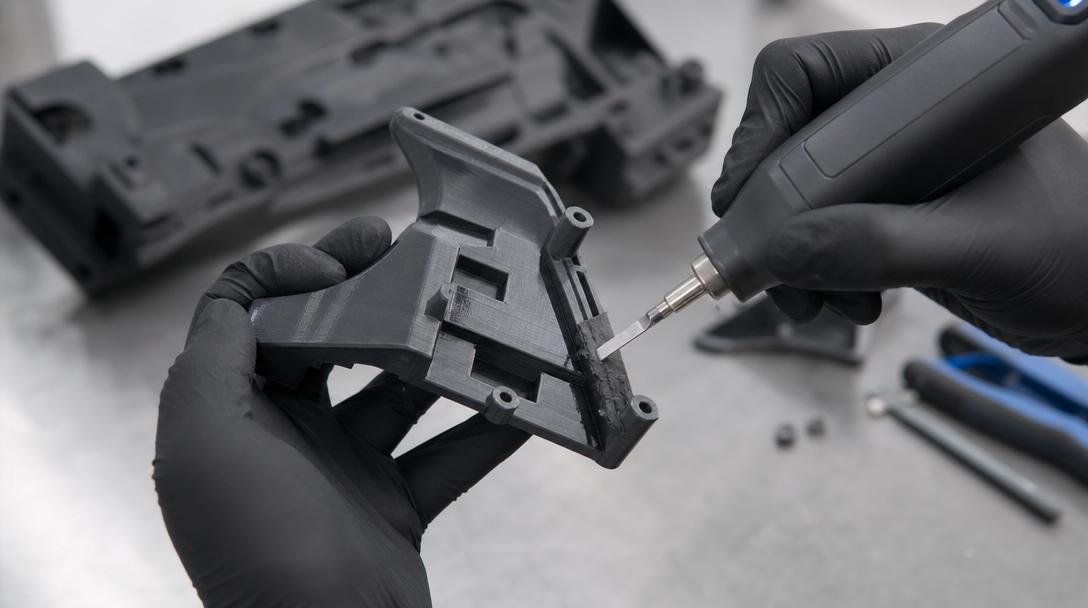
As reported, the NeoBlade’s blade vibrates 40,000 times per second to create a micro-saw-like cutting effect. This allows materials such as plastic, resin and acrylic to be cut without applying high hand force. For Ucuz3D, the critical point is that this offers a meaningful workflow promise specifically for removing support marks on FDM prints, cleaning up thin-walled areas and trimming part edges in a more controlled way.
With classic hobby knives, users often push the blade through as they go, so small protrusions, clips or thin connection areas can crack easily. The NeoBlade’s approach, on the other hand, draws the cutting force from a vibration mechanism rather than the user’s hand, aiming to improve directional control in delicate areas. This can be particularly important for prototype enclosures, small connectors and parts destined for visual presentation.
How does it fit into the FDM workflow?
This story isn’t directly a printer or filament launch; however, because it focuses on steps that affect post-print quality in FDM production, its practical value is high. A part’s final appearance depends not only on print time, but also on how cleanly supports are removed, how carefully the surface is worked, and whether the geometry is damaged. Material choice is also decisive here; for example, to compare tougher or more heat-resistant options, our 17 material options page offers a good starting point for understanding which filament family may suit which part.
The VoxelMatters report also notes that HOZO positions this as the first step in a broader post-processing ecosystem. The company is presenting, as parts of the same workflow, a lightweight sanding tool that focuses on reducing layer lines and runs up to 13,000 back-and-forth strokes, along with a digital measuring tool that highlights dimensional control. This perspective matters, because in 3D printing real quality often emerges not just at the “printed it, done” moment, but in the discipline of dimensions, surface and final touch-ups.
Why is this a meaningful development for Ucuz3D?
Because Ucuz3D only does FDM production, the value of such news lies less in a new industrial machine and more in application lessons that pay off in the field. For thin-supported prototypes, small-batch fixture parts, electronics enclosures or models destined for visual presentation, clean finishing makes a serious difference. If you want to build print-friendly geometry from the start, it’s healthier to think through design and finishing decisions together with our Post-Processing: Sanding, Primer and Paint guide.
In short, the HOZO NeoBlade targets a gap that is often overlooked on the desktop 3D printing side but directly affects final quality: support removal and precision cleanup. The importance of such tools is growing, especially for teams that want to manage finishing more safely on complex or fragile FDM parts. If you too are working on a rapid prototype, fixture or presentation-ready FDM part, you can share your file via our get an instant quote page and clarify the right production workflow.



 Türkçe
 العربية
 Русский
 فارسی
فارسی Deutsch