
On-Demand Shoe Production with Flexible TPU 3D Printing: What Does the Koobz Model Tell Us?
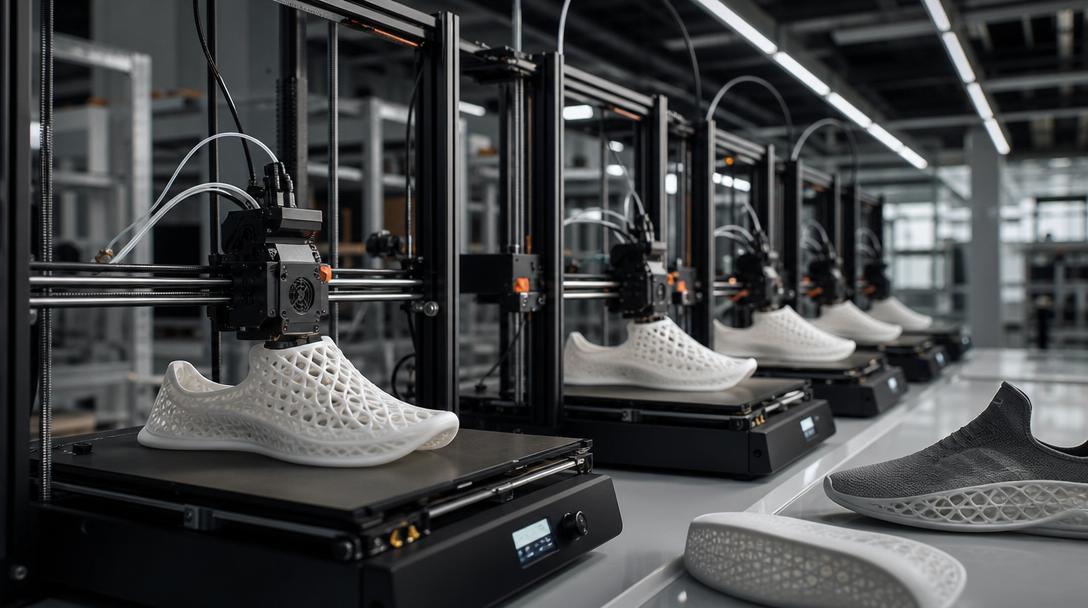
Flexible TPU 3D printing is no longer a topic reserved for hobby parts. Koobz’s Bambu Lab-based production model shows that, in on-demand shoe manufacturing, 3D printing can be a fast, scalable method capable of turning out products within days.
Why is the Koobz model drawing attention?
According to a Bambu Lab post dated June 11, 2026, US-based Koobz built a 3D-printing-focused workflow instead of the classic shoe production that requires molds and high minimum order quantities. By bringing digital design, manufacturing and logistics together on a single line, the company aims to dramatically shorten the time from idea to sale. The important part of the story is that this approach does not stay at the prototype stage; it is treated with a direct production mindset.
The core material Koobz uses is recyclable thermoplastic polyurethane, namely TPU. That makes the story even more meaningful for Ucuz3D, because TPU is one of the most practical materials in the FDM world for flexible structures, impact absorption and wearable product prototypes. At Ucuz3D, applications such as protective parts, gaskets, grip surfaces or wearable product prototypes can be evaluated for similar needs through our flexible TPU printing service.
What do the numbers in this story tell us?
According to the shared information, Koobz scaled from an early setup of around 50 printers to roughly 100 printers, and plans to exceed 500 by the end of 2026. Targeting an output of more than 200,000 pairs per year in the near term shows that 3D printing is now on the table not only for design validation, but also for controlled production scaling.
- Mold requirements drop: The need to cut a steel mold for a new model can be eliminated.
- Iteration time shortens: The traditional development cycle can drop from months to a matter of days.
- Stock risk decreases: Instead of producing large batches and holding them in a warehouse, you can produce according to demand.
- Local production strengthens: As dependence on distant supply chains decreases, delivery planning becomes more agile.
This logic matters not just for shoes. The same approach can be adapted to many FDM scenarios, such as low-volume consumer products, flexible enclosures, custom fixtures and rapid prototypes. If your project has a similar need for flexible parts, you can upload your design file and request a quote right away.
What should the takeaway be for Ucuz3D?
It would be wrong to read this story as “everyone will be selling 3D-printed shoes tomorrow.” The real lesson is that, on the flexible TPU 3D printing side, when the right printer fleet, a suitable slicing strategy and clear product geometry come together, production can move from prototype to commercial application. Especially for products that require flexibility, lightness and customization, 3D printing is now seen as a more serious production alternative.
The point to keep in mind here is that not every flexible part behaves the same way. With TPU parts, wall thickness, infill ratio, layer orientation and contact surface directly affect performance. That is why the opportunity this story points to lies not only in the material, but also in design discipline. If you want a more systematic look at where flexible parts are used, Ucuz3D’s TPU and Flexible Filaments: Where Are They Used? guide is a good starting point.
Conclusion
The Koobz example shows that TPU-based FDM production is expanding from rapid prototyping toward on-demand manufacturing. If you too want to test a flexible product idea, a protective part or a low-volume functional prototype, 3D printing can become a remarkably powerful option with the right material and the right geometry.


 Türkçe
 العربية
 Русский
 فارسی
فارسی Deutsch