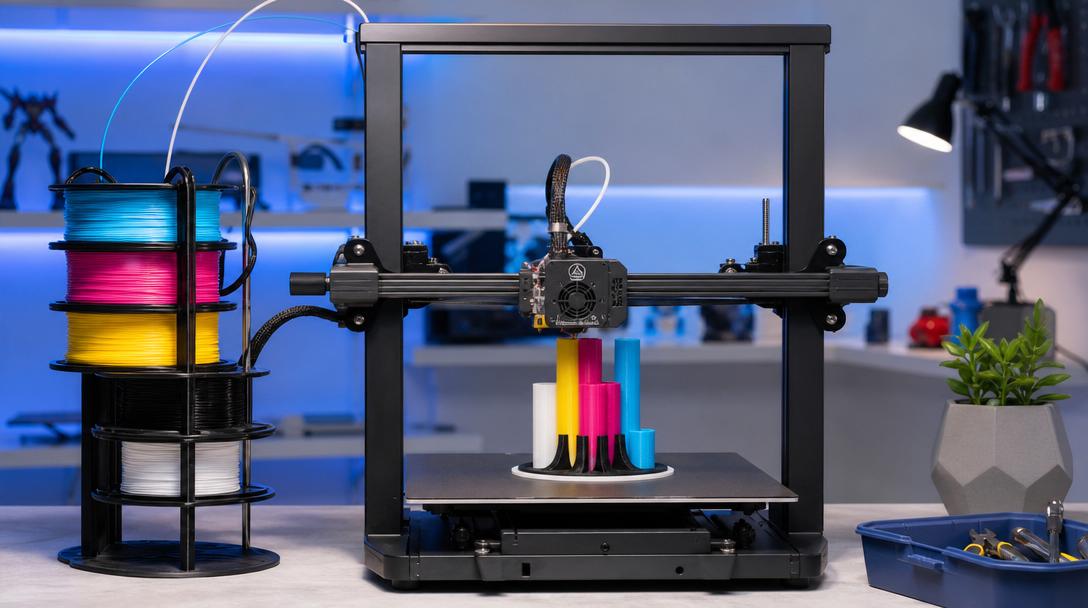

A New Step for Multi-Color FDM Printing: How Prusa ColorMix Makes Dozens of Shades Possible With Five Filaments
Multi-color FDM printing is moving to a more accessible place thanks to Prusa Research’s open-source ColorMix model. Shared on 26 May 2026, this development makes the idea of producing dozens of color shades using only five filaments on a multi-material printer far more practical, which marks a notable step especially for appearance prototypes, educational models, and product presentation samples.
What exactly did Prusa ColorMix announce?
Prusa Research introduced an open-source color-mixing model integrated into the EasyPrint and PrusaSlicer workflow. The system does not copy classic ink logic one-to-one; instead, in FDM printing it alternates colors between layers so that, from a distance, the eye perceives a single intermediate shade. The headline point of the news was that, in addition to the CMY colors, black and white are also taken into account, bringing more controlled results particularly in darker tones.
This approach softens the desktop FDM limit of “you only get as many outputs as the number of colors loaded.” That matters especially for product development teams, because on a single prototype, color separation, directional cues, surfaces close to a brand tone, or user-interface previews can become much easier to read.
Why should it be seen as important on the 3D printing service side?
On the FDM-focused production side, like Ucuz3D, developments of this kind do not always mean a service change you can apply the same day. But they clearly show where the industry is heading: FDM is evolving beyond a “single-color rough prototype” tool into a tool for producing prototypes with stronger visual communication. If you have an idea for a product showcase, a trade-fair demo, a training aid, or a model that explains assembly stages through colors, this trend sends an important signal.
At this point, material choice is just as important as color when deciding on a print. Depending on whether the part is purely for visual purposes or for functional use, you may need to choose a different path among our 17 material options. Once the prototype’s purpose is clear, the question of whether multi-color appearance or durability takes priority can be answered more accurately.
Key technical takeaways from the news
- Open-source structure: Sharing the model under the MIT license opens up room for development for the community and manufacturers.
- CMYKW approach: Adding black filament offers a stronger dark-tone target compared with systems that use only CMYW.
- Software integration: Color generation moves from being a separate experiment to becoming part of the slicing workflow itself.
- Prototype value: It can boost FDM’s presentation power especially in work such as appearance models, training parts, and promotional samples.
There is also an important limit here: achieving a multi-color appearance does not always mean injection-quality surfaces or final mass-production aesthetics. In FDM, layer lines, surface texture, and print time still influence the design decision. So if you are planning a multi-color model, structuring the geometry to suit printing remains critical. Ucuz3D’s How Is Multi-Color 3D Printing Done? (AMS/MMU) guide offers a good starting point on this topic.
What could the practical meaning be for Ucuz3D?
The most valuable part of this news is that multi-color FDM printing is becoming more accessible and more software-supported. In practical terms, this means stronger options coming into play for product presentation mock-ups, color-coded parts for explaining usage, training sets, desktop workflow aids, and visual prototypes. Carrying more visual information in a single print, especially during the design validation stage, can speed up iteration decisions.
If you are also working on a similar prototype, fixture, or visual model, you can clarify the right FDM production path by sharing your project on our request a quote now page. The right material and the right printing approach make it easier to determine from the outset whether you need a single-color or an effective multi-color solution.



 Türkçe
 العربية
 Русский
 فارسی
فارسی Deutsch