
Why Is Custom Insole Production With Flexible 3D Printing Trending? Qwadra’s New License Move
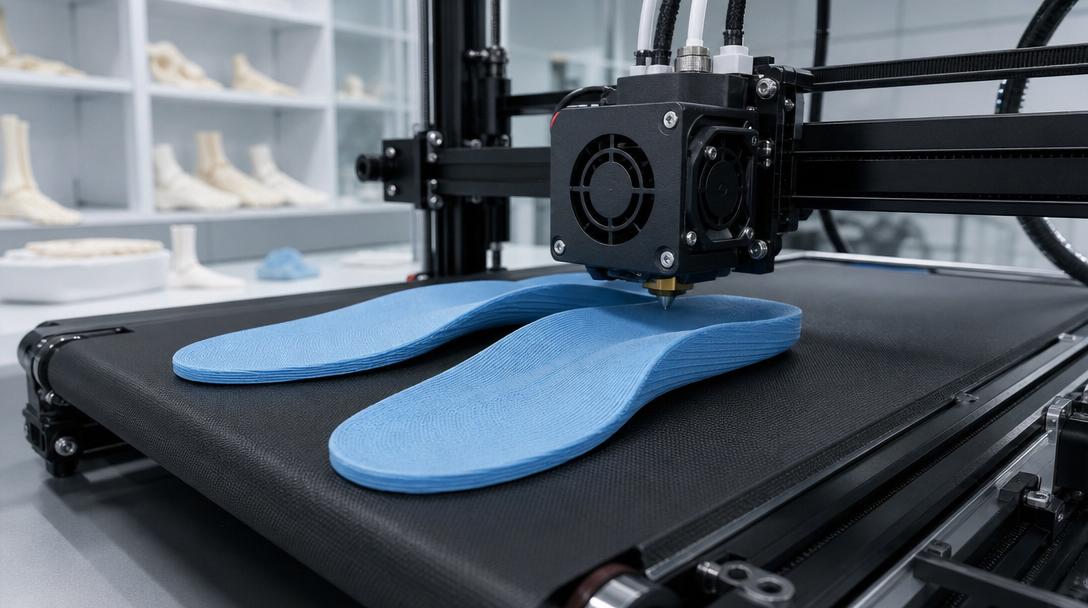
Flexible 3D printing is back in the spotlight for custom insole production because Qwadra has secured an exclusive license for belt-type 3D printing technology from BEGO Medical. This development clearly shows where continuous production, lower equipment investment and FFF/FDM-based workflows can deliver an advantage, especially for insoles produced to match individual foot measurements.
Why is belt-type 3D printing drawing attention?
According to the news published on VoxelMatters on June 3, 2026, Qwadra obtained exclusive rights that commercially strengthen the belt 3D printing approach it uses under the PodoPrinter brand for foot insole production. The key difference here is the use of an angled, continuously moving conveyor surface instead of a classic flat print bed. This way, once a part comes off the print, the system can move on to a new part without stopping.
This approach matters especially in areas where many custom variations need to be produced within the same day. Custom production can also be done on standard desktop FDM printers; however, the belt architecture makes production planning easier in niches that require a continuous flow. On the medical and wearable product development side, examples like this explain why medical and dental 3D printing applications are increasingly being discussed.
What is the real message of this news for insole production?
Foot insoles are products that require a high degree of personalization but are not entirely random geometrically. For this reason, they form a natural use case for additive manufacturing. The point emphasized in the news is exactly this: the manufacturer aims to offer orthopedists, podologists and orthotic laboratories a more seamless flow with its belt-based FFF approach.
- Custom adaptation: Each insole can vary according to measurements.
- Continuous production: Parts can be produced one after another without the machine stopping.
- A more accessible entry barrier: A lower investment threshold than powder-bed systems in certain scenarios.
- Material and process consistency: Repeatability stands out in clinical use scenarios.
What matters here is not that the news says “every insole can now be printed on a desktop printer”; on the contrary, it shows that when the right geometry and the right material are chosen, filament-based production becomes more meaningful in certain niches.
Why is this development important from Ucuz3D’s perspective?
Although Ucuz3D does not directly promise a medical end-use product, this news clearly explains why flexible and functional part prototyping is growing in the FDM world. For the ergonomic parts of a product that touch the foot, hand or body, the first need is often not mass production; it is rapid testing, form checking and usage testing first. In such scenarios, the TPU flexible printing service and similar filament-based solutions can be a powerful tool during the design validation stage.
If you are also designing flexible parts, it is helpful to review where TPU and flexible filaments are used before you start choosing a material. Because with flexible parts, it is not only hardness but also layer orientation, wall thickness and load in use that seriously affect the result.
The practical takeaway from this news
Qwadra’s licensing move shows that filament-based 3D printing is no longer confined to hobby or one-off prototyping; it is also gaining ground in custom, repeatable applications that demand workflow discipline. Particularly for ergonomic plastic parts, insole-like adaptable products and low-to-medium volume customized production needs, the FDM/FFF side is starting to be considered more strategically.
If you are working on a similar flexible part, enclosure or ergonomics prototype, you can clarify the process by sharing your drawing or sample part on the request a quote now page. The right material and the right printing approach save serious time, especially during the testing stage.


 Türkçe
 العربية
 Русский
 فارسی
فارسی Deutsch