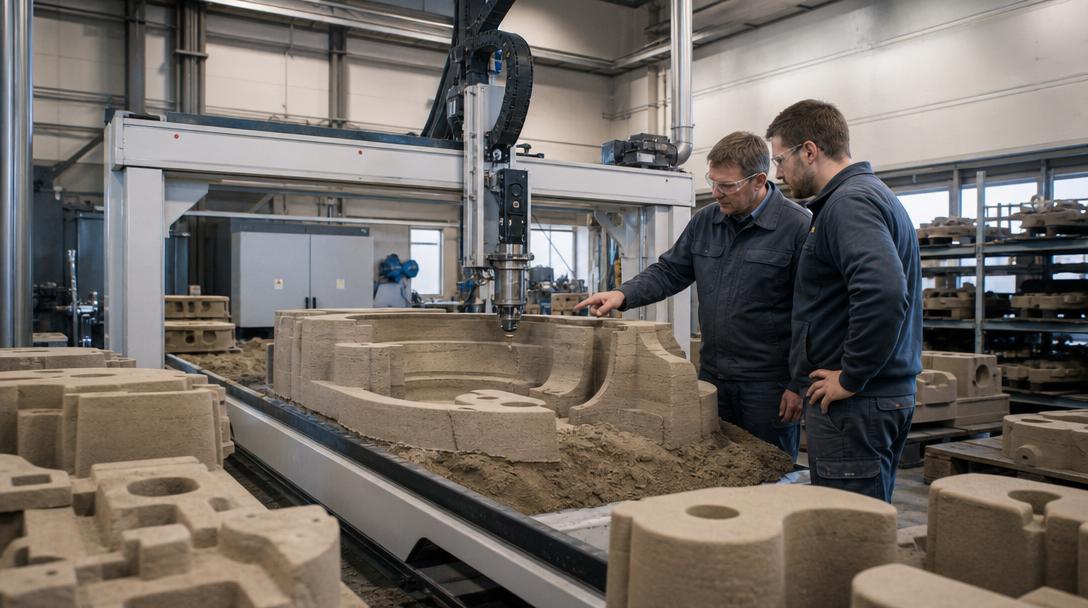

A New Step for Prototype 3D Printing: ExOne S-Print Pro Targets Small Foundries
The S-Print Pro, which ExOne announced on June 22, aims to offer a more accessible sand printing system for small and medium-sized foundries. The news isn’t based directly on the same technology as our FDM service; however, it clearly illustrates why the need for low-volume production, fast validation, and a regional supply chain is growing on the prototype 3D printing side.
Why does it matter for small manufacturers?
According to information shared by TCT Magazine, ExOne is positioning the new system specifically for small foundries, pattern shops, and print service providers. The fact that the machine occupies less than 12 square meters, along with the emphasis on accuracy and repeatability inherited from the S-Max platform, brings the idea of “getting close to production without a major facility investment” to the forefront of industrial 3D printing. What’s more, the target use cases include low-volume casting jobs, contract manufacturing, spare-part production, and custom components. This shows that 3D printing is now seen not just as an R&D showcase, but as a direct tool for operational agility. For this reason, the news concerns not only the casting sector, but also SME manufacturers who make decisions through rapid sampling.
Key technical highlights in the news
- The CoreBoost print head generation and an emphasis on 400 dpi resolution
- A 1200 x 750 x 500 mm build volume
- The goal of producing a full job box in a single shift
- A modular print head and maintenance-friendly design that simplify servicing
This picture is especially important for teams handling mold validation, short-run part preparation, and pre-production design confirmation. That’s because in many businesses, the real bottleneck is how quickly you can reach a test part before the final production technology comes into play. This is exactly where FDM-based rapid prototyping remains a very powerful step. For example, when you need a fixture, an enclosure, an assembly aid, or a pre-check model, jumping to your first physical sample quickly by saying request a quote now can make it easier to decide without waiting on more expensive later steps.
What’s the takeaway for Ucuz3D?
The main lesson to draw from this news is this: the party that gains speed in production isn’t the one that does every job with the same machine, but the one that solves the right job at the right stage. While sand binder jet systems take on a distinct role in casting processes, FDM still remains one of the most accessible options for functional prototypes, jigs, fixtures, enclosures, and low-volume plastic parts. In applications with strength or temperature requirements, a printing with engineering materials approach makes it possible to run tests closer to real-world use scenarios before taking the design into the field.
Moreover, the “spare-part production” focus mentioned in the news suggests that the logic of digital inventory will become even more widespread. Instead of waiting on a mold for every part, solutions that are modeled on demand and produced quickly create a serious advantage, especially in maintenance, custom machinery, and low-volume equipment. If you’d like to see a more concrete equivalent of this logic on the FDM side, our 3D printing in spare-part production guide offers good complementary reading.
In short, ExOne’s S-Print Pro move shows that the race for accessibility in additive manufacturing is accelerating not only in desktop printers but also in industrial production infrastructure. Especially for low-volume, customized, and time-pressured projects, running a quick FDM validation first can make subsequent production decisions far safer. If you too are looking for an FDM-based solution for a validation model, a functional prototype, or a low-volume technical part, clarifying your project at an early stage delivers the biggest time savings.


 Türkçe
 العربية
 Русский
 فارسی
فارسی Deutsch