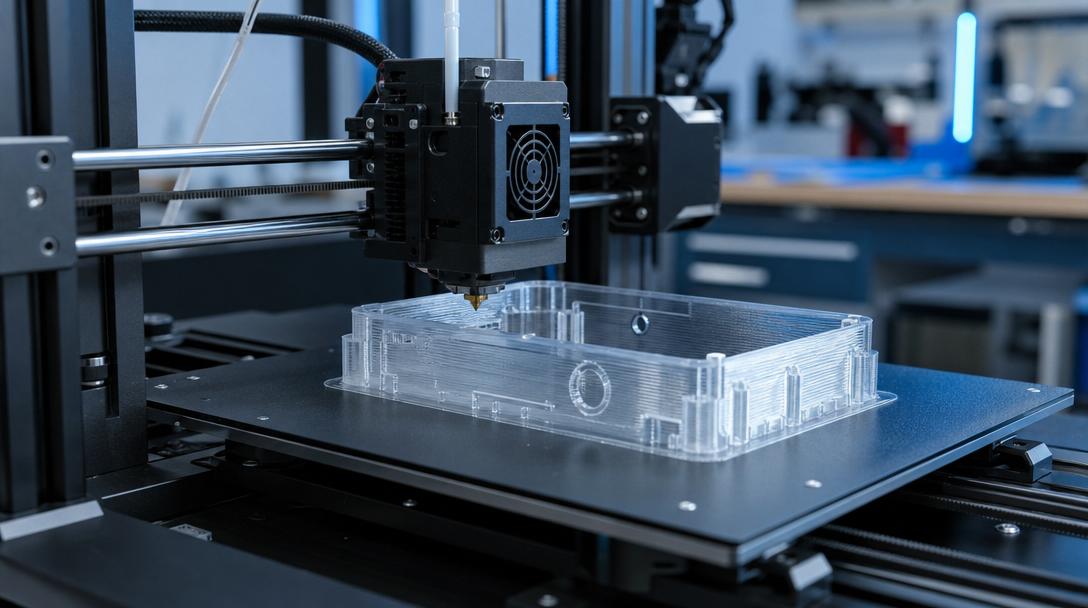

Why Is PETG Printing in the Spotlight Again? What Does eSUN’s Latest Analysis Reveal?
PETG printing has been back in the spotlight over the past few weeks, and the main reason is that it offers more balanced strength and temperature resistance than PLA while not being as demanding as ABS. eSUN’s post dated June 5, 2026 also brings up why PETG is chosen so often, framed around this practical balance.
Why is PETG back on the agenda?
eSUN’s content titled “Why PETG is Dominating 3D Printing” highlights why desktop FDM users and small production teams in particular are turning to PETG. The core idea here is not a claim of new technology; it is that PETG offers a safe middle ground for everyday prototyping, functional parts, and short-run production. Although it is not as easy to process as PLA, its better impact resistance and better heat tolerance make it a stronger candidate for phone holders, fixtures, enclosures, workshop jigs, and some spare-part scenarios.
That is why it is not right to see PETG as just “one more filament.” Especially when a part needs both a clean surface and has to handle light mechanical loads, PETG is often one of the materials that passes the first round of elimination. When comparing different filament options at Ucuz3D, evaluating the material alternatives together is therefore important.
What are the practical advantages for FDM users?
What makes PETG stand out is not a single property, but several critical benefits coming together in the same material:
- Impact resistance: It offers a tougher structure than PLA, providing an advantage in parts where brittleness is a problem.
- Moisture and chemical contact tolerance: It behaves more reassuringly in slightly humid environments or ones exposed to daily use.
- Layer adhesion: When printed with the right settings, it delivers satisfying results in functional parts.
- Balance of visual quality and function: It can be a flexible option in the transition from prototype to end-use part.
Of course, PETG is not automatically the right choice for every job. For finely detailed visual models, PLA may still be easier; for high UV and outdoor exposure, options like ASA may be more suitable. But for many businesses, the real need is not the “toughest” or “easiest” material, but one that works in a balanced way. That is exactly why PETG is being talked about again lately.
Another important point is the ease of use after printing. For cable holders, electronics boxes, prototype enclosures, and workshop helper parts, PETG can leave a safer margin in daily use compared with PLA. This makes it a meaningful choice not just for hobby work, but for small-scale workflows as well.
What does this news mean for the Ucuz3D customer?
This development shows that material selection in FDM printing is now made based on the use scenario, not just price. If a part will be displayed on a desk, one set of choices stands out; if it will be used in a workshop, another; and if it will be exposed to light heat and impact, yet another. PETG’s return to the agenda also shows that customers are starting to ask more often: “Is PLA enough, or do I need a slightly more durable option?”
At this point, for lasting knowledge you can check out our guide explaining how PETG is positioned between PLA and ABS. If you want to plan fast production for your project, you can request a quote right away and have your model evaluated with the most suitable FDM material for its intended use.
In short, eSUN’s latest post does not declare a new “miracle filament”; it makes the real trend in the market visible. If you are aiming for a functional, clean, and balanced FDM part, PETG printing remains one of the most sensible options today as well.




 Türkçe
 العربية
 Русский
 فارسی
فارسی Deutsch