
Natural-Fiber-Reinforced PLA: Why Is It Trending in Biocomposite 3D Printing?
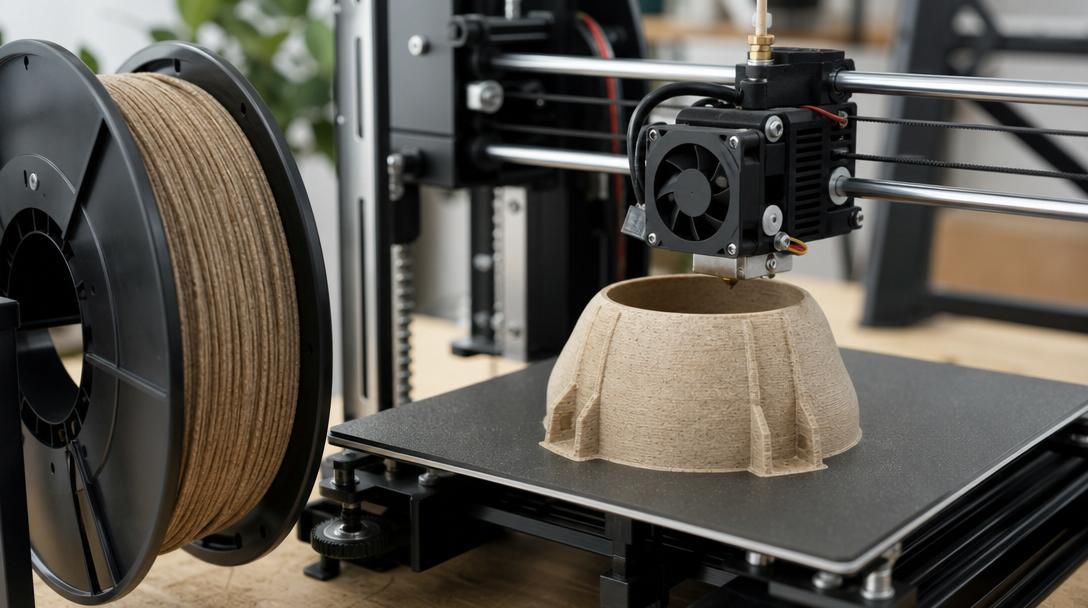
Natural-fiber-reinforced PLA solutions are once again highlighting the idea of producing lighter, more sustainable, and more application-ready composite parts with FDM-based 3D printing. According to a VoxelMatters report dated June 2, 2026, flax-fiber and hemp-focused biocomposite work in Europe shows that this approach is no longer just an academic idea but has entered the pipeline for real parts and prototype development.
The key point highlighted in the report is that, in the examples shared by the Alliance for European Flax-Linen & Hemp, natural fibers are being evaluated together with thermoplastics such as PLA. Continuous flax-fiber-reinforced printing in particular, a co-extrusion approach alongside PLA, and composite filaments usable on standard extrusion platforms all explain why biocomposite 3D printing matters for the FDM world. This is not a metal- or resin-focused story; it means a direct expansion of material options on the filament-based production side.
Why does it stand out in the news?
- Natural fibers are now being discussed not merely as an experimental material but as a functional composite approach.
- Flax-fiber reinforcement combined with PLA offers a new balance for parts that need to be more sustainable yet still demand dimensional precision.
- The same approach has already begun to be tested on real product parts such as footwear components.
Another point that makes the news significant is that biocomposite materials are no longer presented solely as laboratory output. Material developers have started to share more concrete results on topics such as print parameters, surface character, and the lightweight advantage of these filaments. This suggests that the gap between “a material that looks sustainable” and “a material that can genuinely be considered for production” is beginning to close for design teams.
From Ucuz3D’s perspective, the value of this news lies in the fact that material selection in FDM production is becoming increasingly strategic. Even if every new composite filament does not immediately enter daily production, it is critical to correctly read which material makes sense for prototypes, enclosures, fixtures, and low-volume custom parts. That is why, when comparing material options, it is wiser to evaluate classic PLA, PETG, and engineering-focused alternatives together within our 17 material options.
On the practical side, natural-fiber-reinforced PLA does not automatically mean the right choice for every project. The fiber additive also introduces new evaluation criteria such as nozzle wear, layer appearance, moisture sensitivity, and surface homogeneity. Because presentation prototypes and functional fixtures do not share the same expectations, the material decision should be addressed together with the part’s usage environment, not just with trending news. For those who want to better understand the behavior of the PLA base, the guide PLA Filament: Properties, Advantages, and Areas of Use is a good starting point.
For now, many companies are watching biocomposite filaments not as a direct mass-production solution but for material research and a differentiated prototype language. Even so, the direction the news points to is clear: the FDM ecosystem is moving not only toward faster printing but toward smarter material combinations. For brands seeking environmental impact, lightness, and tactile distinction, such solutions will come up more frequently in the period ahead.
If you too want to clarify the most suitable FDM approach for a new product, a custom fixture, or a presentation prototype, request a quote now; determining the right filament path together according to the part’s purpose is the safest way to make newly released materials not just interesting but genuinely useful.


 Türkçe
 العربية
 Русский
 فارسی
فارسی Deutsch