
What Does Creality’s KliTek Change for Multi-Material FDM Printing?
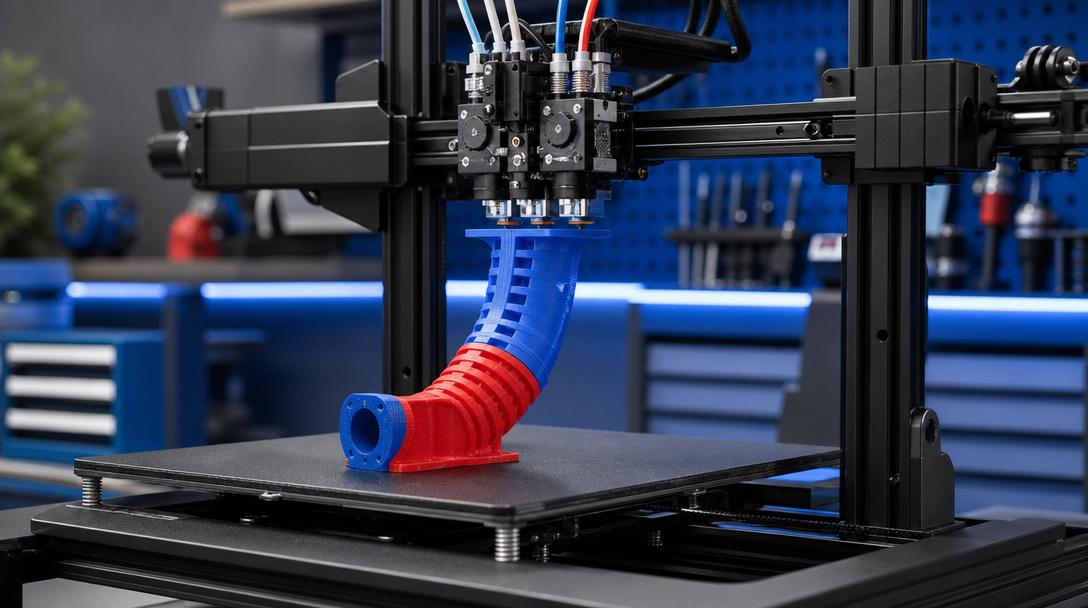
Multi-material FDM printing still struggles with the same core problems: slow color transitions, excessive waste, complex maintenance and unstable results with flexible filaments. The KliTek system that Creality announced in late May targets exactly these bottlenecks, offering a notable advance for desktop FDM users who work with functional materials such as TPU.
Why is KliTek making headlines?
According to a VoxelMatters article dated May 30, 2026, Creality highlighted a nozzle-changing architecture called KliTek as part of its 12th-anniversary announcement. The system aims to reduce the long filament purges seen in classic multi-color or multi-material setups, lower color bleeding and ease the maintenance burden. The report also notes that RFID filament recognition, independent material paths and the S-Drive feeding structure form the foundation for multi-color, multi-material and even varying-hardness TPU printing.
This news matters because innovation in the desktop FDM world is no longer just about a faster printer. The real difference now lies in which part can be produced with the least waste, the most stability and the most predictability. Especially in applications such as flexible parts, protective enclosures, grip surfaces or shock-absorbing fixtures, a reliable material transition directly reflects on the quality of the final part.
Why is this development meaningful for Ucuz3D?
Because Ucuz3D focuses on FDM production, news like this carries high practical value. After all, among the topics customers ask about most are multiple looks in a single part, the need for different hardness levels, or combining decorative and functional surfaces. If your project requires flexibility, choosing the right process such as our TPU flexible printing service is just as important as the design itself.
The approach KliTek promises seeks to answer the following needs in the desktop ecosystem:
- Cleaner material transitions: A goal of reducing waste, particularly in multi-color or multi-zone parts.
- More controlled production with TPU: Feeding stability and easier maintenance with flexible filaments.
- Nozzle choice based on the application: 0.2 mm for detail, 0.6-0.8 mm for speed- and strength-focused production.
- Lower trial-and-error cost: The potential to reduce failed prints through smart slicing and risk detection.
This logic matters not only for hobbyists but also for businesses developing low-volume prototypes, fixtures and functional parts. If you want to clarify the production approach for a similar project, you can request a quote right away and evaluate early on which material and geometry will deliver the best FDM result for your design.
Which parts does it spark ideas for?
Materials highlighted in Creality’s announcement, such as TPU 95A HF and PETG HF, point to the need for fast yet functional prototyping. This shows why parts like phone holders, small protective cases, vibration-damping feet, enclosures around electronics or semi-flexible connectors have moved to the center of the multi-material FDM conversation. On the multi-color side, marking, assembly guidance and user interaction are becoming just as important as aesthetics.
If you are new to this area, our guide explaining the logic of different color and material transitions, How to Do Multi-Color 3D Printing? (AMS/MMU), is a good starting point. Because the real value of this news lies less in a single device announcement than in the expanding range of functional parts that can be produced on desktop FDM.
Conclusion
The Creality KliTek news shows that multi-material FDM printing means not only visual appeal but also less waste, more controlled TPU use and a more practical workflow. If your application requires a flexible, multi-zone or functional part, the right material and the right production approach determine the quality of the result. If you want to clarify the FDM solution that fits your project, send us your file and get a quick assessment in a short time.



 Türkçe
 العربية
 Русский
 فارسی
فارسی Deutsch