
Why Inkbit’s 3D-Printed Luneburg Lenses Are Drawing Attention in mmWave Design
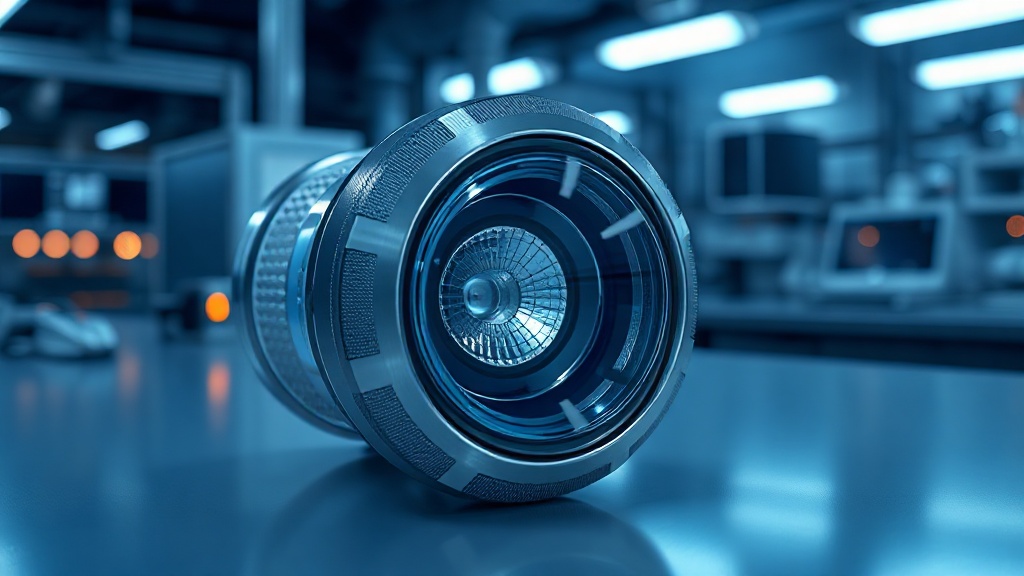
The 3D-printed Luneburg lens approach is reopening the conversation about design limits in high-frequency communications and sensing systems. Massachusetts-based Inkbit announced the gradient-index (GRIN) lenses it developed with the University of Delaware on June 15, 2026, demonstrating that these parts offer a more integrated manufacturing path for radio-frequency and millimeter-wave applications. In the mmWave domain in particular, the ability to produce complex dielectric structures as a single piece carries the potential to reduce prototyping time and assembly overhead.
Why does the Luneburg lens matter?
Luneburg lenses hold a special place in the antenna and beamforming world because they can efficiently direct electromagnetic waves in specific directions. However, the permittivity gradient required in this type of lens is typically approximated in conventional manufacturing by stacking different layers or assembling concentric dielectric pieces. This both complicates production and can introduce limitations in fine tuning, repeatability, and loss performance.
This is exactly where Inkbit’s key point begins: the company argues that producing this gradient within a single 3D-printed structure can simplify a problem that was previously solved through multi-part assemblies. Considering the application areas, this approach sends a compelling signal for telecom, automotive radar, industrial sensors, and electronics and IoT-focused 3D printing projects.
What technical approach did Inkbit use?
According to the announcement, the solution combines Inkbit’s Vision-Controlled Jetting (VCJ) platform with a Cyclic Olefin Thermoset (COT) resin developed for RF use. The company states that real-time visual inspection allows material deposition to be monitored and corrected during printing, which also helps produce lattice structures at sub-wavelength scales. Published data show the COT resin exhibits a loss tangent of 0.0018 at 100 GHz — presented by the company as an exceptionally low dielectric loss level among resins suited for additive manufacturing.
The critical message here is this: additive manufacturing does not merely provide freedom of form; it is also a candidate for building the internal geometry that determines electromagnetic performance in a more controlled way. For engineering teams in particular, this can mean shortening the distance between concept validation and a functional prototype. If you want to see why tolerances are so decisive in similar projects, our guide on tolerance management in interlocking parts provides a useful background.
What do the performance data say?
The 100 mm diameter Luneburg lens developed in collaboration between Inkbit and the University of Delaware was reportedly tested across the Ka, U, and W bands, reaching an operating frequency of 100 GHz. The part is also said to feature an aperture exceeding 30 wavelengths and a realized gain above 34 dBi. These figures suggest that a foundation is being laid not just for laboratory demonstrations, but for more serious engineering scenarios involving mmWave components.
- Single-part gradient structure production can reduce assembly steps.
- In high-frequency applications, geometry control can directly affect performance.
- The availability of evaluation lenses for purchase shows the technology is not staying at the research stage.
Why should this news be tracked from Ucuz3D’s perspective?
Many teams in Turkey may not yet be producing mmWave lenses, but the bigger lesson the news delivers is clear: 3D printing is now being discussed not only for mechanical prototypes but also for functional electronics and communications components. This supports companies working on product development to turn to faster manufacturing methods for early-phase validation. If you want to clarify the cost or lead time of a complex-geometry prototype for your engineering team, you can review our 3D printing production prices or quickly evaluate the right printing scenario for your project.
If you would like to discuss how to move faster on the prototyping side of complex technical parts, you are welcome to share your project files so we can assess the most suitable manufacturing approach together.



 Türkçe
 العربية
 Русский
 فارسی
فارسی Deutsch