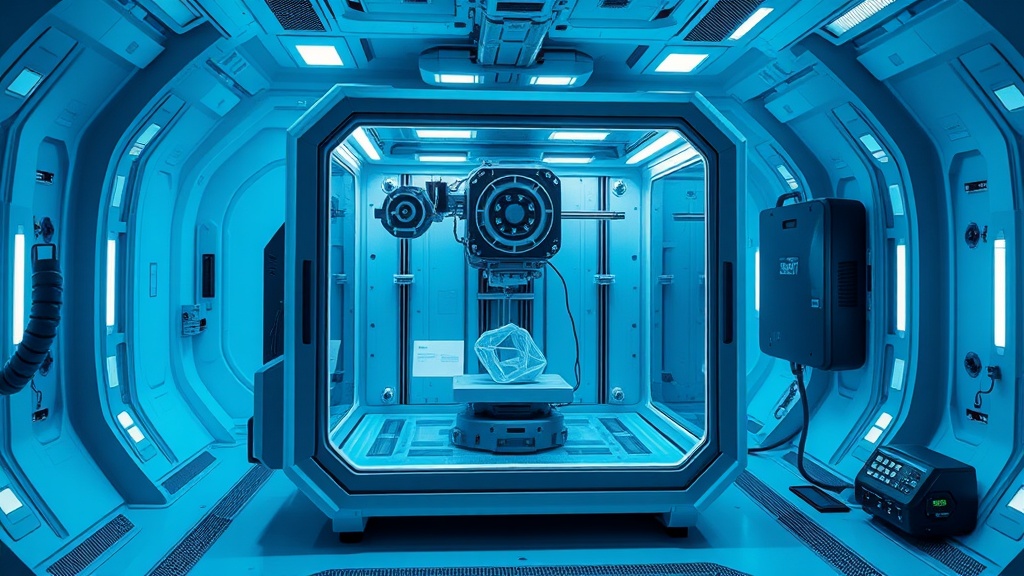

CosmicMaker Strengthens the Case for In-Space Manufacturing with a 3D Printer Tested in Zero Gravity
3D printing in space has, over the past few years, moved beyond being a mere research topic and is starting to edge closer to real production scenarios. According to a TCT Magazine report dated 16 June 2026, Photocentric has positioned its CosmicMaker space division as a separate entity and has successfully trialled the 3D printer concept of the same name during this year’s parabolic flight tests. This development brings back into focus the idea of producing the parts needed in future orbital or lunar missions on site, rather than hauling them up from Earth.
What exactly did CosmicMaker test?
According to the report, the system printed under conditions ranging from 2g to 0g using three separate printers aboard Novespace’s Airbus A310 Zero G flights. Photocentric’s approach uses an LCD-based process inside a sealed chamber. The company states that during the tests it produced parts from silicon carbide, alumina and two different thermoset plastics, and that it observed a more balanced particle distribution in the zero-gravity phase, especially with the ceramic mixtures. In short, what matters here is not a single demo print, but the fact that material behaviour was studied in a measurable way under microgravity.
Why is it seen as important for the industry?
Logistics costs in space missions are extremely high; even transporting a small spare part requires serious planning. For this reason, 3D printing in space is drawing attention as a way to produce critical yet relatively small components during a mission. CosmicMaker’s design, which focuses on low mass and low energy requirements, is therefore significant. If systems of this kind mature, research teams or companies building space infrastructure could manufacture some of the fasteners, housings or custom-geometry parts they need right in the mission environment.
This news also shows just how strongly the idea of “on-site production” in additive manufacturing is heading in a particular direction. At Ucuz3D, we likewise see that choosing the right method according to part geometry, quantity and operating environment is critical in projects; especially on the aerospace and technical prototyping side, this is why aviation and aerospace-focused 3D printing applications are gaining more importance with each passing day.
What message does it send to companies and R&D teams today?
The CosmicMaker news does not mean that everyone will be manufacturing in space overnight; however, it sends a clear message to designers and engineers: production is no longer planned solely with the classic factory environment in mind. The success of the process depends on addressing material behaviour, closed-system control, automation and post-printing steps together. The company’s plans for future centrifugal resin recovery and a more contactless, robot-assisted flow also stem from this.
- Material selection becomes decisive in space or harsh environmental conditions.
- Process stability is critical not just for getting a print, but for being able to reproduce the same result.
- Designs that reduce the need for supports can offer a major advantage by simplifying post-production work.
For similar reasons, for teams wanting to master additive manufacturing terminology and process logic, an additive manufacturing glossary guide can be a good starting point. And if you too would like to compare costs and methods for your prototype, functional part or technical production needs, you can plan the right approach more clearly through our production prices.
Conclusion
CosmicMaker’s parabolic flight tests show that the field of 3D printing in space is moving from marketing rhetoric towards more concrete engineering validation. In the coming period, it would not be surprising to see systems of this kind appear first in research and niche missions, and then in more routine space production scenarios.
Even if your own project isn’t as demanding as space, if you need lightweight, functional and quickly producible parts, you can speed up the process with Ucuz3D by making a clear assessment of the right production method.



 Türkçe
 العربية
 Русский
 فارسی
فارسی Deutsch