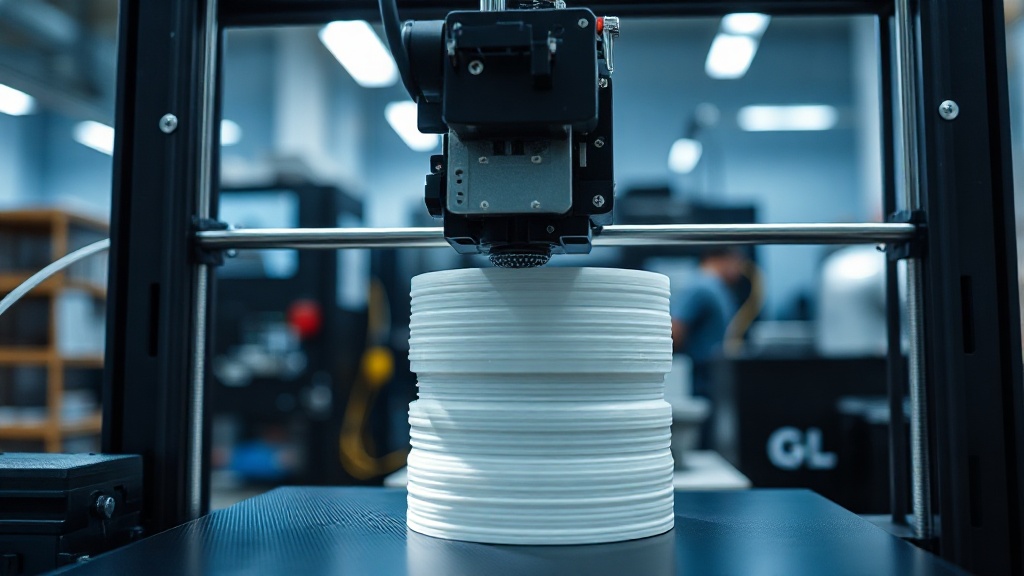

Support-Free 3D Printing Research: How Wave-Based Toolpaths Enable 90-Degree Overhangs on Standard FDM Printers
Support-free 3D printing has become one of the most eye-catching FDM research topics of recent years. A new study shared on 3Dnatives on June 15, 2026 shows that horizontal overhangs which normally require support can be produced on standard 3-axis FDM printers using a different toolpath approach. In short, this is not just about a new printer; by changing the slicing logic, the 45-degree rule we know today could be reinterpreted in certain scenarios.
What exactly does the research propose?
At the core of the study are continuous toolpaths inspired by wave propagation rather than classic straight extrusion lines. The researchers report that this approach was tested with standard PLA on an open-frame FDM printer, and compared to traditional arc-based paths it produced less sagging, better surface overlap and fewer gaps. In other words, the solution relies less on redesigning the hardware and more on managing how material is carried through the air with a smarter geometry.
This perspective can be especially important for parts where support material adds cost, time and surface-cleanup burden. Understanding when supports are truly mandatory is still critical, so it is worth reading up on the fundamentals of when support structures are needed in 3D printing; that said, this new study shows that some of those limits can flex on the software side.
Why is the 45-degree rule being reconsidered?
FDM users have long treated adding support beyond a certain angle as the safe approach for overhangs. The striking part of the new research is its suggestion that this limit may not be a purely physical necessity, but partly a result of the path the printer follows. The team notes that once an initial support-free base line is created, subsequent layers can be built on top of it more stably, and that dimensional deviations stayed close to supported prints on the tested geometry. At the same time, they clearly note that some thermal deformation was observed at the edges.
This point matters because the report does not jump to an exaggerated conclusion like “all supports are now unnecessary.” On the contrary, it states that additional validation is needed across different materials, different fan settings and different part sizes. If you too want to manage overhang angles better at the design stage, it makes more sense to think about the 45-degree rule and print-ready design approach together with this new development.
What could this mean in practice for Ucuz3D?
If this kind of toolpath approach becomes widespread, both material consumption and post-print cleanup time could drop, especially for jigs, fixtures and short-run functional parts. The example given in the study states that removing supports can reduce material consumption by up to 39 percent. That is not only filament savings; it can also make a difference in labor, lead time and surface quality. Teams producing industrial prototypes, jigs and in-cell helper parts in particular may be directly affected by these software innovations, as in automation and robotics-focused 3D printing applications.
- Less support: Means less filament consumption and shorter cleanup time.
- Cleaner surfaces: When support contact marks are reduced, the post-processing load on the part can drop.
- Smarter slicing: More yield can be obtained from the same hardware purely through toolpath strategy.
What should the takeaway be for today?
This news is a reminder that the limits of standard FDM printers are determined not only by mechanics but also by software intelligence. The research has not yet been applied directly to every scenario; however, the fact that it can already be tested on PrusaSlicer and OrcaSlicer derivatives suggests the topic will draw interest beyond the lab. If you want a price and feasibility assessment for a production-ready part with reduced support needs, you can send us your project through our urgent 3D printing quote page.




 Türkçe
 العربية
 Русский
 فارسی
فارسی Deutsch