
Photocentric JENI Marks a New Threshold in 3D Printing for Tool-Free Mass Production
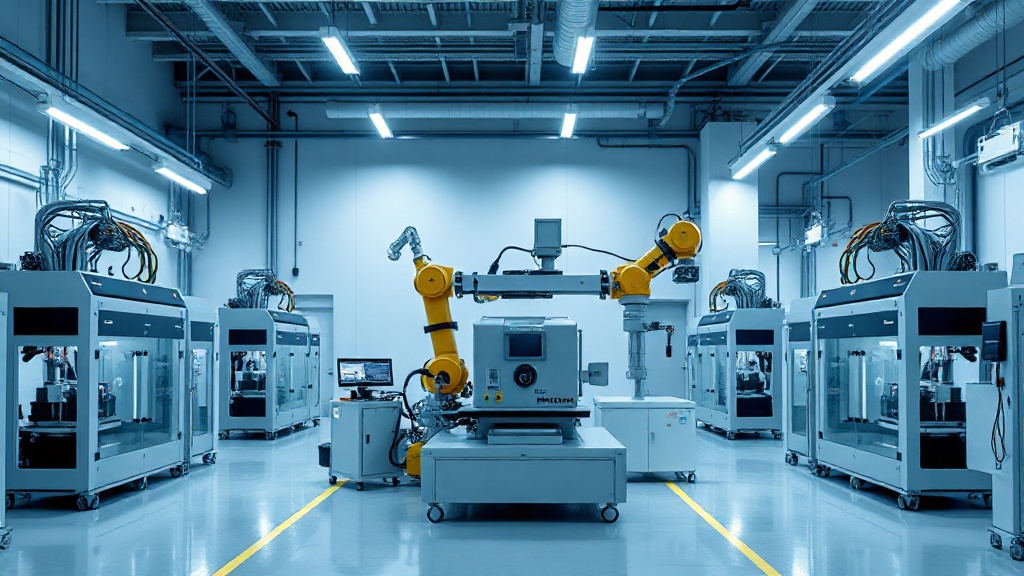
The Photocentric JENI 3D printing platform has once again put on the agenda the idea that additive manufacturing can be positioned not only for prototyping, but also for tool-free mass production. According to a TCT report dated 11 June 2026, JENI combines multiple LCD-based production and post-processing nodes through a robotic workflow, aiming to become an alternative to injection molding for certain plastic parts. This approach can significantly influence production decisions, especially for medium-volume part families that are revised frequently and are geometrically flexible.
Why is JENI attracting attention?
The architecture Photocentric describes differs from classic single-machine logic. The system arranges steps such as printing, washing, rinsing and curing as modular stations and links them together with a high-speed robotic gantry. In doing so, it aims to reduce the operator’s contact with chemicals while increasing process traceability and repeatable quality. According to the data shared in the report, the platform is designed for a flow fast enough to eject a build platform every 20 seconds for the right part types.
The key message here is not just speed; it is tool-free production flexibility. While tooling cost and commissioning time form a major threshold in injection molding, systems like JENI make it possible to bring design changes into production with less delay. This offers a noteworthy model for short-life-cycle electronic accessories, fasteners, clips and customized plastic components.
Which applications could it stand out in?
One of the examples highlighted in the report is small but high-volume plastic parts such as PCB standoffs. As volumes grow, such components demand cost discipline; as product variety increases, they demand agile production at the same time. It is precisely here that electronics and IoT-focused 3D printing applications and pre-mass-production transition scenarios become more visible. Validating a part first with a low-risk pilot run and then scaling it to a larger volume based on demand can be a more sensible route for many teams.
From Ucuz3D’s perspective, this news also clarifies the role of FDM-focused local manufacturing services: not every job goes straight to volumes in the millions. Most projects first require design validation, assembly testing and field feedback. For this reason, reading 3D printing costs and the right production path correctly in the early stages of the production journey is just as important as moving to a state-of-the-art mass production line.
What does this news mean for manufacturers in Turkey?
JENI’s greatest strength is showing that when additive manufacturing is combined with automation, it does not have to be merely a slow but flexible method. This approach matters especially for manufacturers that update their models frequently, companies with a broad spare-parts portfolio and startups that want to delay tooling investment. Of course, it will not be the right answer for every part; for very high-volume products with simple geometry, traditional methods can still be advantageous.
- Short commissioning time: Production can start without waiting for tooling.
- Design flexibility: A part update is managed faster than a mold revision.
- Traceable process: The robotic flow and digital control support the quality standard.
- Competitive cost for the right part: It becomes meaningful especially in medium-volume, high-variation jobs.
When making a similar assessment for your own product, you need to consider geometry, quantity, tolerance and revision frequency together with the per-part cost. At this point, the how to calculate 3D printing cost guide offers a good starting point for simplifying your decision framework.
Conclusion
Photocentric’s JENI platform is an important development that has reignited the debate over 3D printing in mass production. The news tells us one thing clearly: when automation, process control and the right part selection come together, the application area of additive manufacturing expands rapidly. If you too would like to see the most suitable path for your product, from prototype to small-series production, you can get in touch with us about your project and clarify the right production scenario together via our fast quote page.


 Türkçe
 العربية
 Русский
 فارسی
فارسی Deutsch