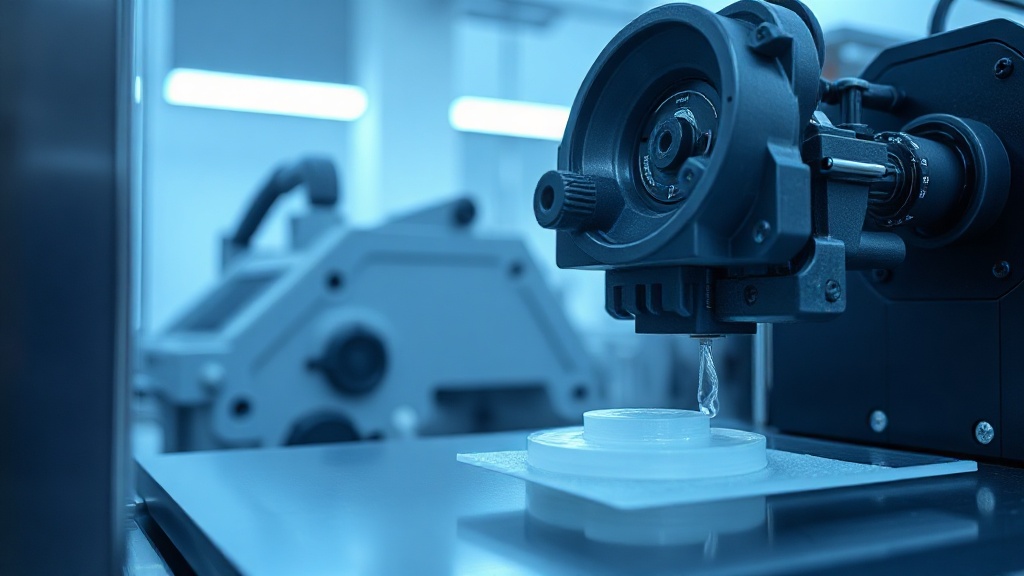

Stockwell Cuts 3D Printing Prototyping Time with Real Silicone to Days
Real silicone 3D printing is closing a long-missing gap in industrial prototyping. According to a 3D Printing Industry report dated June 16, 2026, US-based Stockwell Elastomerics has integrated real silicone-based 3D printing into its operations using the Lynxter S300X system. According to the company, this step reduces customer validation time from weeks to days and makes it possible to test the material behavior of flexible parts at an earlier stage.
Why does this development matter? Because in silicone parts, the gap between a prototype and a final production part can delay critical decisions across many projects. Even if resin-based or silicone-like alternatives are sufficient for visual inspection, they may not always reflect real-world performance in terms of compression, sealing, and elasticity. Stockwell approach aims to provide the customer with a sample closer to production before any tooling investment is made.
Why is validation time shrinking?
The key point highlighted in the report is that the company can prepare multiple prototype iterations within the same week. This means the design team can evaluate a part not only dimensionally but also functionally at an early stage. Especially in components such as gaskets, sealing elements, soft-touch surfaces, or shock absorbers, the real behavior of the material is critically important. If design approval is obtained before tooling opens, the risk of costly revisions later is also reduced.
Teams at Ucuz3D with urgent prototyping needs can similarly compress their project timelines by requesting an express 3D printing quote for early validation. Especially for flexible, functional, or assembly-test parts, short feedback loops save significant time.
Which industries benefit most?
This type of news is most valuable for teams involved in medical, transportation, electronics, and industrial equipment manufacturing. Because in these fields, a part is evaluated not only by its shape but by how it performs under real operating conditions. As can be seen on Ucuz3D medical and dental 3D printing solutions page, as the scope of application expands, material suitability and validation requirements become increasingly prominent.
Another notable point in the Stockwell example is that 3D printing is no longer seen as mere rapid mockup production. The goal here is to bring the decision-making process forward in time by getting as close as possible to the real production material. This approach points to a larger trend we have been seeing frequently in additive manufacturing recently: the shift of printing from visual prototyping toward functional validation.
What should teams in Turkey take away from this?
The key lesson for companies developing products in Turkey is this: the material used during prototyping directly affects the quality of decisions. If a project depends on criteria such as flexibility, impact absorption, sealing, or repeated deformation, a geometrically similar sample alone is not always sufficient. For this reason, it should be clarified at which stage of the design which manufacturing method will be used. For teams who want to comparatively evaluate processes, the FDM, SLA and SLS differences guide in the Ucuz3D Knowledge Center can be a good starting point.
In the coming period, the ability to prototype with real materials is expected to become more widespread. This will further increase the role of 3D printing in low-volume validation, pre-tooling testing, and customized product development processes. If you are also experiencing the need for functional prototypes, assembly trials, or rapid pre-production validation, getting expert support in selecting the right material and the right process will be beneficial.




 Türkçe
 العربية
 Русский
 فارسی
فارسی Deutsch