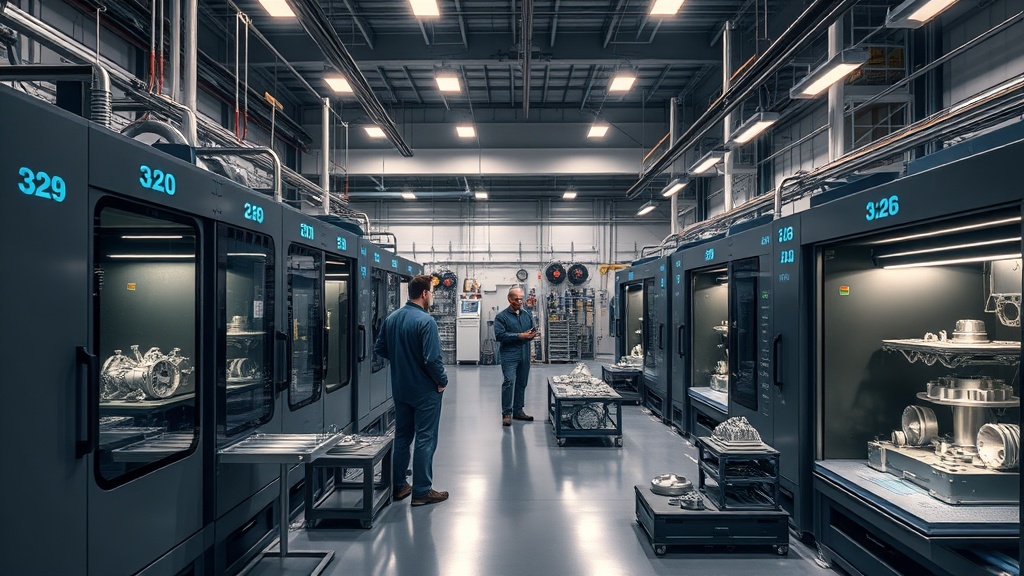

EOS and Incodema3D Signal a New Threshold in Metal 3D Printing Production Capacity
Metal 3D printing production capacity is no longer measured solely by the number of machines, but also by facility planning and process discipline. According to EOS’s announcement dated June 2, 2026, Incodema3D took delivery of five new metal additive manufacturing systems while also signing a deal for nine additional systems. The news stands out because it shows how, particularly in aerospace, energy and highly critical part production, 3D printing is moving beyond prototyping and turning into a more predictable manufacturing infrastructure.
What exactly does this investment show?
According to the source, the company will receive four EOS M 400-4 units and one EOS M4 ONYX in the short term. In addition, a larger order has been placed covering four EOS M4 ONYX, two EOS M 400-4 and three EOS M 300-4 systems. Once all installations are complete, Incodema3D’s EOS-based metal 3D printer fleet will exceed 50 units. An expansion at this scale matters more than a single-machine headline, because the real point is being able to build a repeatable production line from order to delivery.
In its statement, EOS notes that the company is seeing 50 percent year-over-year growth, that it is expanding its current facility with the goal of tripling capacity by 2030, and that it is preparing a second production site. In metal additive manufacturing, investments like these do not simply mean producing more prints. Series production does not become efficient unless powder management, quality assurance, post-processing operations and planning software scale together. That is why the news sends a message of “more mature process” as much as “more machines” to the industry.
Why does metal additive manufacturing look closer to production?
In recent years, metal 3D printing has often been described as an expensive, niche solution. Yet this example shows that the picture changes when part geometry grows complex and when design flexibility gains value in low-to-medium volume production. Parts with internal channels, lightweighted structures and designs that consolidate several components into a single body in particular can offer a strong advantage over classic methods. At Ucuz3D, we frequently see why a similar approach gains importance in aerospace 3D printing applications.
- Capacity planning: Multiple systems of the same class make lead times more predictable.
- Quality standardization: Growing within the same technology family provides an advantage in terms of process validation and operator training.
- Post-processing efficiency: Machined finishing, surface improvement and inspection steps become as critical as the print itself.
For this reason, the news should be read not merely as one company’s investment but as a signal that production maturity is rising on the metal AM side. Additive manufacturing is taking on a more strategic position, especially for producers who want to manage short lead times, redundancy and design updates within the supply chain at the same time.
What can manufacturers in Turkey take away from this development?
Of course, it is not realistic for every business to install more than 50 metal systems. But the lesson of the news is more universal: choosing the right part, identifying the appropriate technology and planning post-processing steps from the very start make 3D printing commercially meaningful. Doing the cost-benefit calculation early is especially important for low-volume functional parts, fixtures, prototypes and products that require fast revisions. At this point, it is worth evaluating 3D printing production prices together with process requirements, and reading correctly where the 3D printing in spare part production approach delivers an advantage.
In short, the EOS and Incodema3D news shows that metal additive manufacturing is not just a showcase technology; with the right business model, it can establish discipline in capacity, quality and delivery. If you want to clarify which 3D printing approach makes more sense for your project, you can get a quick assessment by sharing your need along with its technical requirements.




 Türkçe
 العربية
 Русский
 فارسی
فارسی Deutsch