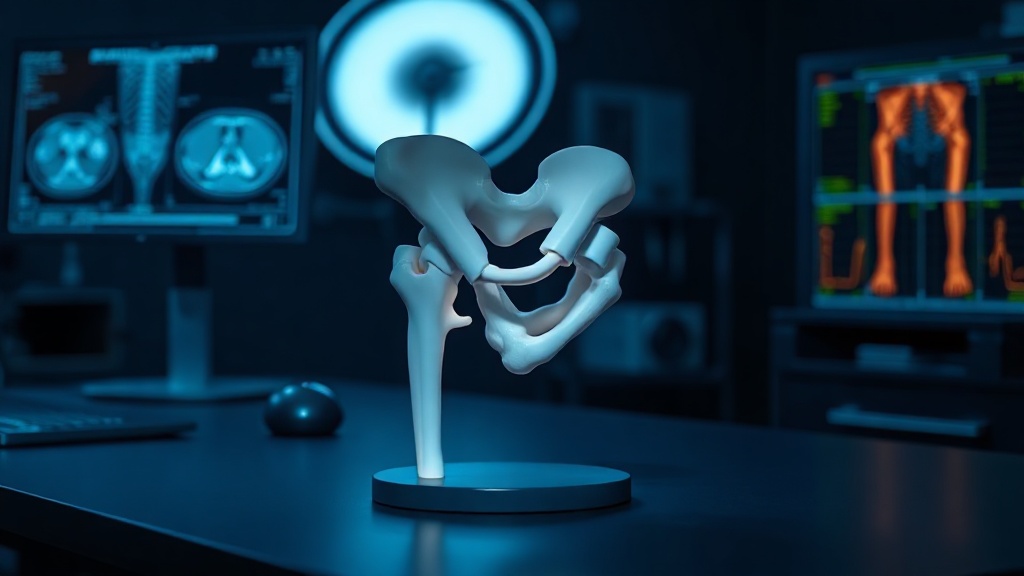

Why Materialise’s Investment in Replasia Puts 3D-Printed Personalized Hip Preservation Treatments in the Spotlight
Personalized hip preservation treatments are becoming one of the most compelling applications of additive manufacturing in the medical field. Belgian company Materialise’s investment in Replasia — a company focused on hip preservation — is a strong signal of this trend. The news shows that 3D printing is no longer seen merely as a prototyping tool, but as a strategic resource for solutions planned around patient anatomy that are less invasive and whose clinical value is becoming increasingly clear.
Why does this investment matter?
Replasia focuses on a patient-adapted solution developed for certain cases of adult hip dysplasia. The key difference here is the adoption of a planning and manufacturing workflow that places the patient’s anatomy at the center, rather than a one-size-fits-all implant logic. Materialise’s investment in this space suggests that personalized medical devices are not only technically feasible but have also moved into a more mature phase clinically and commercially.
In orthopedics in particular, the accuracy of pre-operative planning and the fit of the device to the patient can directly affect treatment outcomes. For this reason, 3D printing — with its advantages of complex geometry, rapid iteration, and patient-specific manufacturing — is positioned more powerfully than traditional methods. At Ucuz3D, similarly, correct geometry and manufacturing discipline are critically important in medical and dental 3D printing solutions shaped by precise measurements and usage scenarios.
What does Replasia’s approach promise?
The 3D Shelf Implant approach highlighted in the news presents an interesting intermediate solution for patients who do not want — or are not yet deemed suitable for — a total hip replacement. The fact that the device is positioned outside the joint capsule and does not fully close off other treatment options in the future is considered a significant advantage on the hip preservation side.
In addition, Replasia’s anatomical analysis and surgical planning software serves as another reminder that additive manufacturing is not limited to the printing stage alone. Value is often created in the layers of data preparation, surgical planning, and pre-production verification. If you would like to see more closely how part geometry affects manufacturing outcomes, you can check out Ucuz3D’s guide on tolerances and interlocking parts.
The real turning point in 3D-printed medical devices
The most important aspect of such developments is that 3D printing in healthcare is moving beyond the label of “custom case production” and transforming into a more systematic treatment component. This transformation is clearly visible especially in the following areas:
- Patient fit: The device can be shaped to individual anatomy rather than standard measurements.
- Less invasive approach: In some cases, an intermediate solution can be offered before larger and more complex surgical options.
- Digital planning: The surgical decision-making process is supported by imaging and analysis software.
- Manufacturing flexibility: 3D printing becomes more meaningful for low-volume but highly customized medical devices.
This picture also explains why additive manufacturing has secured a permanent place in the medical sector. When quality, traceability, and design accuracy are addressed together in the patient-specific device development process, 3D printing becomes a manufacturing method that generates higher added value.
What is the takeaway for manufacturers and design teams in Turkey?
This news is not just an investment announcement; it is a clear signal showing which direction the medical 3D printing market is heading. In the coming period, companies that combine software, imaging data, design validation, and low-volume precision manufacturing processes can be expected to stand out more. This approach provides an important reference especially for teams developing custom orthotics, surgical planning models, or functional prototypes.
Likewise, the balance between manufacturability and cost is a decisive factor in the success of projects. If you want to see early on how production-ready your design is, you can review our 3D printing production prices and plan your project scope more realistically.
If you need to quickly evaluate a medical or technical part and determine the right material and manufacturing approach, the Ucuz3D team can assist you. Especially for personalized and low-volume production needs, proper preparation directly determines the quality of the outcome.



 Türkçe
 العربية
 Русский
 فارسی
فارسی Deutsch