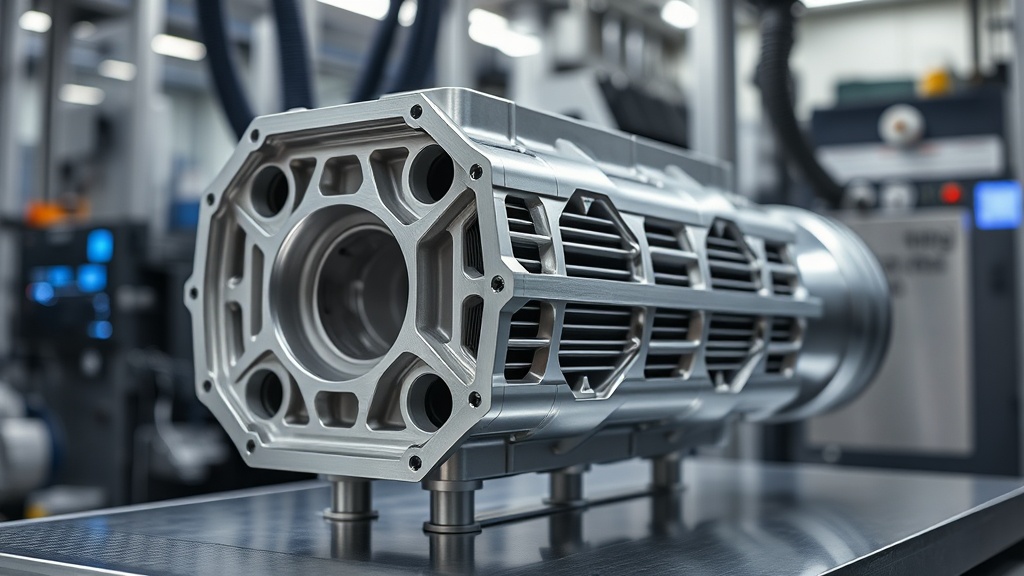

Why Does ORNL’s New High-Temperature 3D Printing Aluminum Alloy Matter?
According to a June 4 report by TCT Magazine, ORNL has taken a notable step in the field of high-temperature 3D printing aluminum alloys. The new alloy, called DuAlumin-3D, aims to reduce the cracking tendency — one of aluminum’s most persistent challenges in additive manufacturing — while maintaining mechanical strength at elevated temperatures. Particularly for sectors such as aerospace and automotive that demand both lightweight construction and heat resistance, this development could open up new design options on the metal additive manufacturing side.
Why does this news matter?
Aluminum is an extremely valuable engineering material thanks to its low weight and good thermal conductivity. However, conventional high-strength aluminum alloys have always been a tricky choice in production because they are prone to cracking during the rapid heating and cooling cycles involved in 3D printing. The standout feature of ORNL’s alloy, as reported, is that it reduces this manufacturability problem while retaining desirable properties up to around 400°C. This brings geometrically advantageous applications — such as heat exchangers, pistons, and parts with complex internal channels — back onto the table.
According to data shared in the report, the alloy contains cerium, nickel, and zirconium alongside aluminum. ORNL states that nano-scale strengthening phases that form during printing contribute to both process stability and high-temperature performance. If you’re looking for a quick reference on metal printing terminology, our additive manufacturing glossary guide can help clarify the key concepts.
What could the practical impact be for aerospace and automotive?
The real value of an alloy like this lies not just in being a “new material,” but in making lightweight, complex parts more viable. In aerospace, even a few hundred grams of reduction per part can translate into significant fuel savings at fleet scale. On the automotive side, parts with optimized internal structures capable of withstanding higher temperature cycles can be meaningful in terms of efficiency. As can be seen on Ucuz3D’s aerospace and space 3D printing applications page, material selection and part geometry are evaluated together in these industries — not just strength, but weight, production time, and repeatability all matter.
- Lightweight advantage: Lower weight and higher thermal conductivity are targeted compared to titanium.
- Complex geometry: Design freedom for parts with internal channels and topology-optimized structures may increase.
- Process compatibility: A reduction in cracking and defect tendency could make the path to serial production more realistic.
- High-temperature performance: New use cases may emerge for components near engines and in thermal management systems.
What is the takeaway for manufacturers in Turkey?
This news does not mean every new alloy will be ready to deploy tomorrow — but it clearly signals the direction the industry is heading. In metal additive manufacturing, the question is no longer just “can it be printed?” but “is it reliable at operating temperature, lightweight, and cost-effective?” For teams in Turkey working on prototyping and functional part development, this approach makes it increasingly important to think about design decisions together with material and process data from an earlier stage.
For FDM-focused rapid product development or geometry validation, plastic prototyping remains a very powerful step before moving to metal production. If you want to physically see a part’s form, assembly logic, or critical details such as airflow channels first, you can compare suitable production approaches via our 3D printing production prices page.
In summary, ORNL’s new alloy pushes the boundaries of metal 3D printing a little further for lightweight parts that operate under high temperatures. If you’d like to validate a next-generation part first through rapid prototyping, we can evaluate the right production path for your project together.




 Türkçe
 العربية
 Русский
 فارسی
فارسی Deutsch