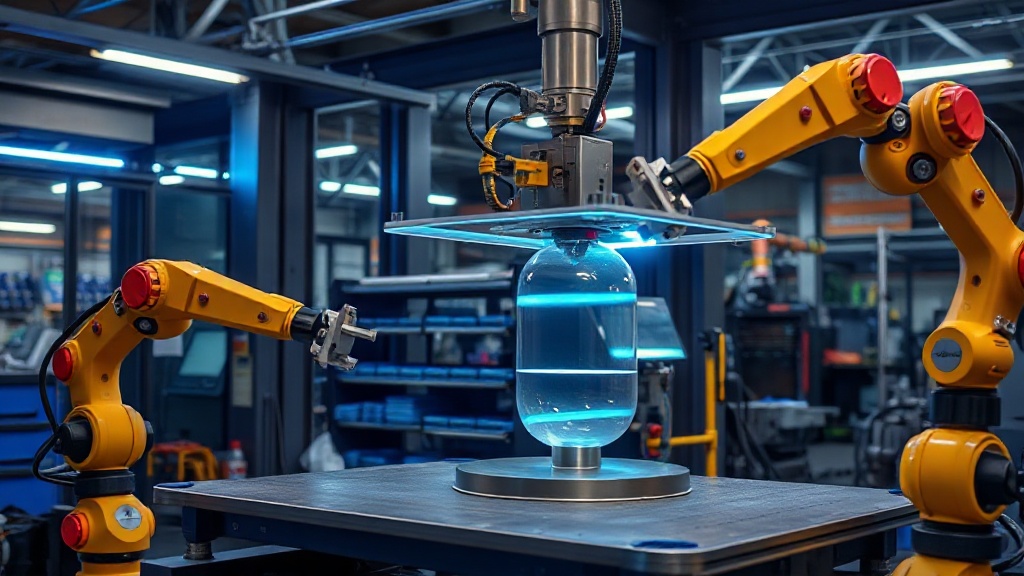

DEEP and Fortius Metals Push the Threshold for Serial Production of Large Metal Parts with Multi-Material WAAM
Multi-material WAAM is an area that has long been discussed in metal additive manufacturing but has proven difficult to validate at production scale. According to a report by 3D Printing Industry dated June 11, 2026, DEEP Manufacturing and Fortius Metals are working on a large-scale wire arc additive manufacturing (WAAM) process capable of combining multiple alloys in a controlled manner within a single print. This development is significant as it demonstrates why it represents a new threshold — particularly for industrial metal parts where different regions are expected to deliver different performance characteristics.
Why is this collaboration attracting attention?
WAAM is a metal manufacturing method that melts welding wire with an electric arc and builds parts layer by layer. The method appears especially efficient for large parts; however, the truly critical point of this news is the intent to use multiple materials within a single structure rather than a single alloy. This allows one section of a part to be optimized for high temperatures while another section is optimized for different mechanical loads.
DEEP Manufacturing handles large-format printing, synchronized multi-robot production, and real-time monitoring, while Fortius Metals contributes simulation, toolpath design, and welding wires developed for more predictable outcomes. This approach has the potential to bring design freedom and process control into the same equation — particularly for aerospace, energy, maritime, and high-integrity manufacturing applications. If you’d like to see how additive manufacturing is positioned in aerospace-focused part development processes, Ucuz3D’s aerospace and space 3D printing approach also offers a good reference framework.
Where does the real challenge in multi-material metal printing lie?
On paper, combining different alloys in a single part looks very attractive; however, on the production floor, the work quickly becomes complex due to interconnected variables such as material transitions, heat input, cooling behavior, distortion, and mechanical performance. Especially for large-scale parts, a failed print means the simultaneous loss of time, energy, and expensive raw materials.
This is precisely the point highlighted in the report: the question has now shifted from “can it be done?” to “can it be produced repeatedly with the same quality?” True transformation in the industry comes not from a single successful demonstration print, but from traceable, simulation-backed, and repeatable processes. If you’d like to read about the concepts used in additive manufacturing more systematically, the Additive Manufacturing Glossary summarizes these distinctions in a straightforward way.
What does this news mean for Ucuz3D?
Although Ucuz3D’s daily production focus is FDM-based rapid prototyping and functional part production, this kind of industrial news clearly illustrates why design validation remains critical. In large-scale metal systems, geometry, assembly, access, or structural logic is often validated through faster and more economical methods before any printing takes place. In other words, every development on the advanced metal production scene makes the value of early-stage prototyping even more visible.
- Material combinations enable regional performance targeting within a single part.
- Simulation and toolpath planning are becoming the key factor in reducing error risk for large prints.
- Real-time monitoring is emerging as one of the fundamental requirements for repeatability in multi-robot production.
- Prototyping discipline continues to be essential for rapidly validating design decisions before moving on to advanced production processes.
The DEEP and Fortius Metals partnership shows that the next competitive frontier in metal 3D printing is not just about installing larger machines, but about establishing more controlled and higher-quality production workflows. If you’d like to validate your part through a quick prototype or functional sample before moving to production, you can compare the process on our production pricing page and clarify the right path for your project.



 Türkçe
 العربية
 Русский
 فارسی
فارسی Deutsch