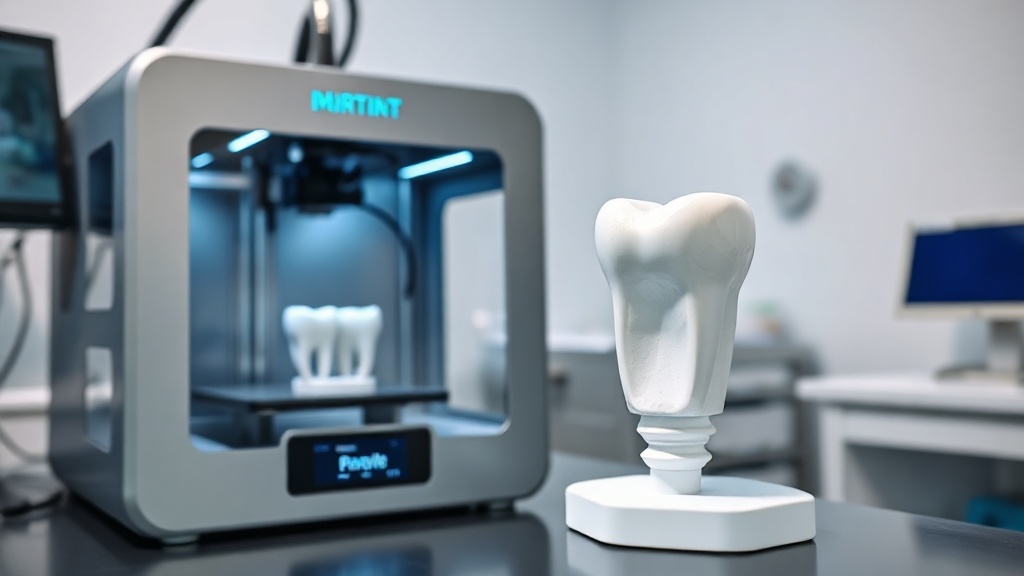

Why Are Ceramic 3D-Printed Zygomatic Onlay Implants Standing Out in Medical Manufacturing?
Ceramic 3D-printed zygomatic onlay implants are back in the spotlight for their potential to accelerate personalised treatment plans in patients with jawbone loss. According to a TCT Magazine report dated 12 June 2026, KLS Martin has moved patient-specific zygomatic onlay implants into production using Lithoz's ceramic 3D printing infrastructure. This development demonstrates that medical additive manufacturing has matured beyond prototyping and is now approaching high-precision parts intended for direct clinical use.
What exactly does a zygomatic onlay implant change?
The zygomatic approach anchors the implant to the cheekbone in patients with advanced jawbone loss. While conventional bone-graft procedures can take months, a patient-specific onlay design can simplify surgical planning significantly. The critical difference here is that implant geometry is adapted to the patient's anatomy rather than relying on standard dimensions. Ceramic 3D printing enters at precisely this point, offering the advantage of producing complex surfaces and controlled biocompatible structures in a more repeatable manner.
What makes this news noteworthy is that it brings personalisation and manufacturing reliability into the same sentence. In medical components, even a deviation of a few millimetres can affect surgical fit, which means the chain of digital design, printing, and post-processing must be validated together. Patient-specific manufacturing earns its value exactly at this point.
Why is ceramic 3D printing standing out?
The key detail in the report is that KLS Martin has entered production using multiple Lithoz CeraFab systems. This signals that the technology has moved beyond the laboratory-trial stage and into a more consistent production workflow. For ceramic-based medical components, success in manufacturing requires not just the printer but equally the material behaviour, sintering steps, tolerance management, and quality verification. When the right technology is not selected, delivery time can be affected as much as part performance. For this reason, evaluating medical and dental 3D printing solutions with a process-oriented perspective is critically important across different applications.
- Personalisation: Geometry can be adapted to every patient's individual anatomy.
- Complex structure production: Surface and form transitions that are difficult with traditional methods become more manageable.
- Digital traceability: The process from design file to production step can be fully documented.
Why does this news matter for production teams in Turkey?
Not every medical application requires ceramics, but the message the news conveys is clear: personalised manufacturing is no longer a niche R&D topic. Digital workflows can save significant time, especially for surgical guides, anatomy models, fixture prototypes, and low-volume custom parts. If your part is not a direct implant, the material-tolerance-lead-time balance must be established from the outset when assessing project feasibility; at this point, evaluating 3D printing production pricing alongside method selection is the healthier approach. If you want a quick refresher on the fundamentals of this topic, the 3D printing in the medical field guide in the Ucuz3D Knowledge Centre is a great starting point.
The main lesson here is that speed and accuracy must be addressed together in medical manufacturing. The fact that a part can be printed quickly is not sufficient on its own; biocompatibility, post-processing, quality documentation, and application boundaries must all be clarified at the beginning of a project. That is why this news is not merely a new product announcement but also a powerful example demonstrating the importance of process maturity.
Industrial takeaway: value is no longer in the printer alone
This development reminds us that competitive advantage in additive manufacturing does not come solely from equipment investment. Real value emerges when design validation, customisation for the patient or use case, process repeatability, and documentation capability all work together. In the coming period, the companies that will stand out most on the medical 3D printing side will be those who make their production line not only fast but also traceable and consistent. This approach is expected to become increasingly common, particularly in the production of low-volume but highly critical parts.
If you want to clarify the production method for a medical or high-precision part, you can share your project along with its technical requirements so the most suitable 3D printing approach can be evaluated together.


 Türkçe
 العربية
 Русский
 فارسی
فارسی Deutsch